Review
. 2015 Sep;135(9):2155-2161.
doi: 10.1038/jid.2015.145. Epub 2015 May 7.

Alternative Treatments For Melanoma: Targeting BCL-2 Family Members to De-Bulk and Kill Cancer Stem Cells

Affiliations
Review

Alternative Treatments For Melanoma: Targeting BCL-2 Family Members to De-Bulk and Kill Cancer Stem Cells

Nabanita Mukherjee et al. J Invest Dermatol. 2015 Sep.

Abstract

For the first time new treatments in melanoma have produced significant responses in advanced diseases, but 30-90% of melanoma patients do not respond or eventually relapse after the initial response to the current treatments. The resistance of these melanomas is likely due to tumor heterogeneity, which may be explained by models such as the stochastic, hierarchical, and phenotype-switching models. This review will discuss the recent advancements in targeting BCL-2 family members for cancer treatments, and how this approach can be applied as an alternative option to combat melanoma, and overcome melanoma relapse or resistance in current treatment regimens.


Conflict of interest statement

CONFLICT OF INTEREST

The authors declared no conflicts of interest.

Figures
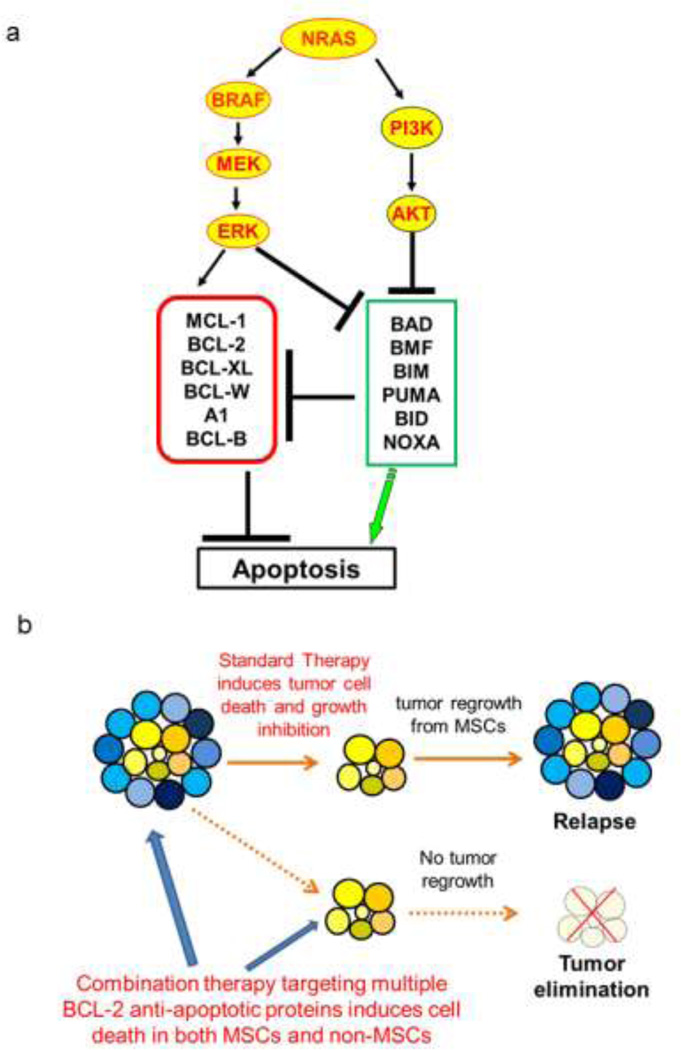
Figure 1
Figure 1. Targeting the BCL-2 family as a treatment option for melanoma
(a) A simplified illustration for the rationale to target BCL-2 family members in melanoma. Green box represents the pro-apoptotic proteins, and red box represents the anti-apoptotic proteins. Multiple BCL-2 proteins are downstream of the RAS/BRAF/MAPK and PI3K/AKT signaling pathways, the commonly activated pathways in melanoma. The activation of these pathways leads to the dysregulated expression of multiple BCL-2 proteins, and likely contributes to resistance to cell death in melanoma. For instance, the activated RAS/BRAF/MAPK signal upregulates MCL-1 and blocks BIM and BAD (see text for details). Thus, targeting the BCL-2 family may provide an alternative way to combat melanoma regardless of its BRAF status, and to overcome melanoma relapse from current treatments. (b) Combination therapy debunks and kills the MSCs. The various blue cells represent heterogeneous non-MSCs populations, and the yellow cells represent the MSC populations. Standard therapy may be successful in debulking melanoma cells initially. However, it fails to kill MSCs, resulting in tumor relapse due to the self-renewal capacity of MSCs. The combination therapy targeting multiple BCL-2 anti-apoptotic members debulks and kills the MSCs, preventing future relapse of melanoma.

References

    1. Begley J, Vo DD, Morris LF, et al. Immunosensitization with a Bcl-2 small molecule inhibitor. Cancer immunology, immunotherapy : CII. 2009;58:699–708. - PMC - PubMed
    1. Belmar J, Fesik SW. Small molecule Mcl-1 inhibitors for the treatment of cancer. Pharmacology & therapeutics. 2014 - PMC - PubMed
    1. Billard C. BH3 mimetics: status of the field and new developments. Molecular cancer therapeutics. 2013;12:1691–1700. - PubMed
    1. Boiko AD, Razorenova OV, van de Rijn M, et al. Human melanoma-initiating cells express neural crest nerve growth factor receptor CD271. Nature. 2010;466:133–137. - PMC - PubMed
    1. Boisvert-Adamo K, Longmate W, Abel EV, et al. Mcl-1 is required for melanoma cell resistance to anoikis. Molecular Cancer Research. 2009;7:549–556. - PMC - PubMed

Publication types

MeSH terms

Substances
