


Functional significance of the sex chromosomes during spermatogenesis
- PMID: 25948089
- PMCID: PMC4510947
- DOI: 10.1530/REP-14-0613
Functional significance of the sex chromosomes during spermatogenesis
Abstract
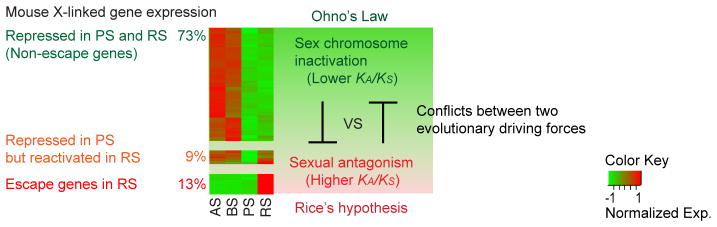
Mammalian sex chromosomes arose from an ordinary pair of autosomes. Over hundreds of millions of years, they have evolved into highly divergent X and Y chromosomes and have become increasingly specialized for male reproduction. Both sex chromosomes have acquired and amplified testis-specific genes, suggestive of roles in spermatogenesis. To understand how the sex chromosome genes participate in the regulation of spermatogenesis, we review genes, including single-copy, multi-copy, and ampliconic genes, whose spermatogenic functions have been demonstrated in mouse genetic studies. Sex chromosomes are subject to chromosome-wide transcriptional silencing in meiotic and postmeiotic stages of spermatogenesis. We also discuss particular sex-linked genes that escape postmeiotic silencing and their evolutionary implications. The unique gene contents and genomic structures of the sex chromosomes reflect their strategies to express genes at various stages of spermatogenesis and reveal the driving forces that shape their evolution.Free Chinese abstract: A Chinese translation of this abstract is freely available at http://www.reproduction-online.org/content/149/6/R265/suppl/DC1.Free Japanese abstract: A Japanese translation of this abstract is freely available at http://www.reproduction-online.org/content/149/6/R265/suppl/DC2.
© 2015 Society for Reproduction and Fertility.
Conflict of interest statement
We declare that there is no conflict of interest that could be perceived as prejudicing the impartiality of the research reported.
Figures

References
-
- Alpatov R, Lesch BJ, Nakamoto-Kinoshita M, Blanco A, Chen S, Stutzer A, Armache KJ, Simon MD, Xu C, Ali M, Murn J, Prisic S, Kutateladze TG, Vakoc CR, Min J, Kingston RE, Fischle W, Warren ST, Page DC, Shi Y. A chromatin-dependent role of the fragile X mental retardation protein FMRP in the DNA damage response. Cell. 2014;157:869–881. - PMC - PubMed
-
- Bellott DW, Hughes JF, Skaletsky H, Brown LG, Pyntikova T, Cho TJ, Koutseva N, Zaghlul S, Graves T, Rock S, Kremitzki C, Fulton RS, Dugan S, Ding Y, Morton D, Khan Z, Lewis L, Buhay C, Wang Q, Watt J, Holder M, Lee S, Nazareth L, Alfoldi J, Rozen S, Muzny DM, Warren WC, Gibbs RA, Wilson RK, Page DC. Mammalian Y chromosomes retain widely expressed dosage-sensitive regulators. Nature. 2014;508:494–499. - PMC - PubMed
