


Effort, success, and nonuse determine arm choice
- PMID: 25948869
- PMCID: PMC4509397
- DOI: 10.1152/jn.00593.2014
Effort, success, and nonuse determine arm choice
Abstract
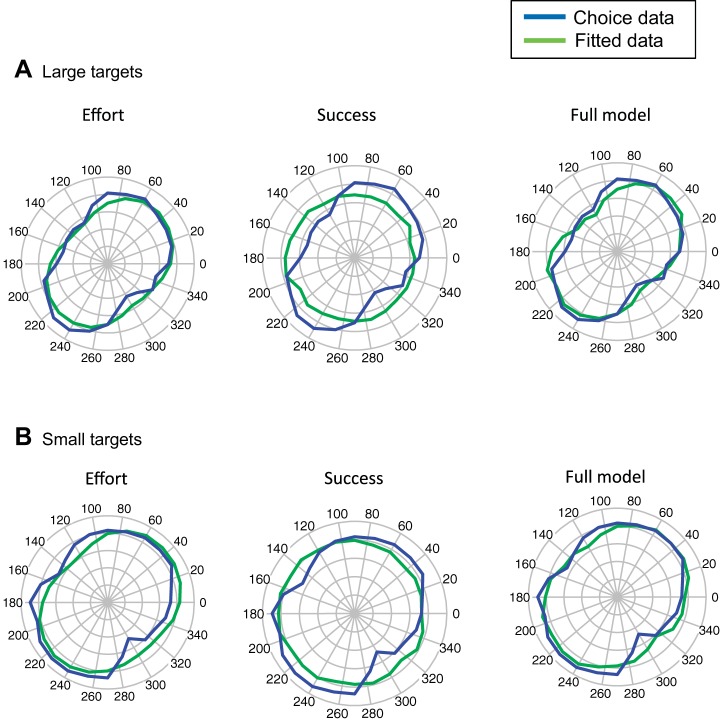
How do humans choose one arm or the other to reach single targets in front of the body? Current theories of reward-driven decisionmaking predict that choice results from a comparison of "action values," which are the expected rewards for possible actions in a given state. In addition, current theories of motor control predict that in planning arm movements, humans minimize an expected motor cost that balances motor effort and endpoint accuracy. Here, we test the hypotheses that arm choice is determined by comparison of action values comprising expected effort and expected task success for each arm, as well as a handedness bias. Right-handed subjects, in either a large or small target condition, were first instructed to use each hand in turn to shoot through an array of targets and then to choose either hand to shoot through the same targets. Effort was estimated via inverse kinematics and dynamics. A mixed-effects logistic-regression analysis showed that, as predicted, both expected effort and expected success predicted choice, as did arm use in the preceding trial. Finally, individual parameter estimation showed that the handedness bias correlated with mean difference between right- and left-arm success, leading to overall lower use of the left arm. We discuss our results in light of arm nonuse in individuals' poststroke.
Keywords: decisionmaking; motor control; motor cost; motor effort; reaching.
Copyright © 2015 the American Physiological Society.
Figures




References
-
- Andrews K, Stewart J. Stroke recovery: he can but does he? Rheumatol Rehabil 18: 43–48, 1979. - PubMed
-
- Behrens TE, Woolrich MW, Walton ME, Rushworth MF. Learning the value of information in an uncertain world. Nat Neurosci 10: 1214–1221, 2007. - PubMed
-
- Bishop DV, Ross VA, Daniels MS, Bright P. The measurement of hand preference: a validation study comparing three groups of right-handers. Br J Psychol 87: 269–285, 1996. - PubMed
-
- Bryden PJ, Pryde KM, Roy EA. A performance measure of the degree of hand preference. Brain Cogn 44: 402–414, 2000. - PubMed
Publication types
MeSH terms
Grants and funding
LinkOut - more resources
Full Text Sources
Other Literature Sources
