doi: 10.4103/0974-2077.155066.
Laser tattoo removal: a clinical update
Affiliations
- PMID: 25949017
- PMCID: PMC4411606
- DOI: 10.4103/0974-2077.155066
Item in Clipboard
Laser tattoo removal: a clinical update
J Cutan Aesthet Surg.
2015 Jan-Mar.
Abstract
Techniques for tattoo removal have evolved significantly over the years. The commonly used Quality-switched (QS) ruby, alexandrite, and Nd:YAG lasers are the traditional workhorses for tattoo removal. Newer strategies using combination laser treatments, multi-pass treatments, and picosecond lasers offer promising results. The tattoo color and skin type of the patient are important considerations when choosing the appropriate laser. Standard protocols can be developed for the effective and safe treatment of tattoos.
Keywords: Picosecond lasers; Quality-switch lasers; Tattoo removal.
Conflict of interest statement
Figures
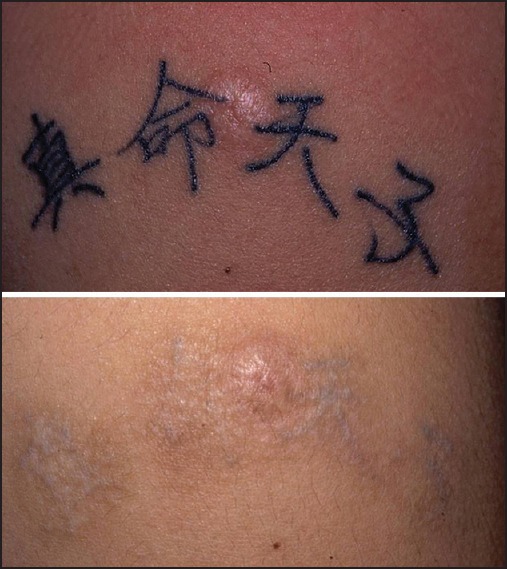
Showing good resolution of dark blue tattoo using the QS Nd:YAG laser after 5 treatment. Noticed textural changes and mild post inflammatory hyperpigmentation and silhouette of old tattoo (Photographs-courtesy of National Skin Centre, Singapore)
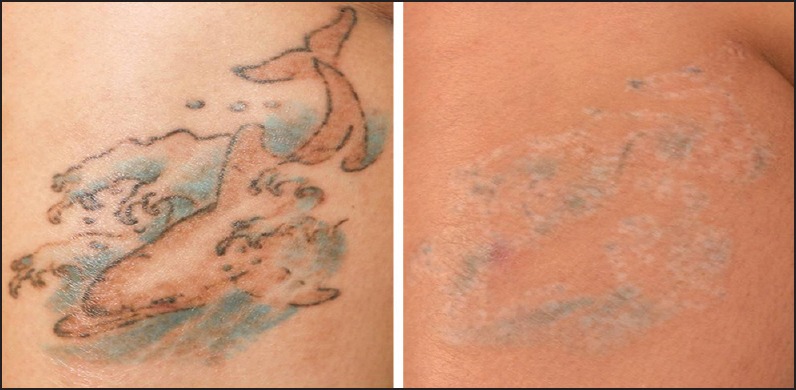
A multicolored tattoo treated with multiple QS alexandrite laser. Note persistence of pigment and hypopigmentation which is a complication of multiple treatment in skin of color (Photographs-courtesy of National Skin Centre, Singapore)
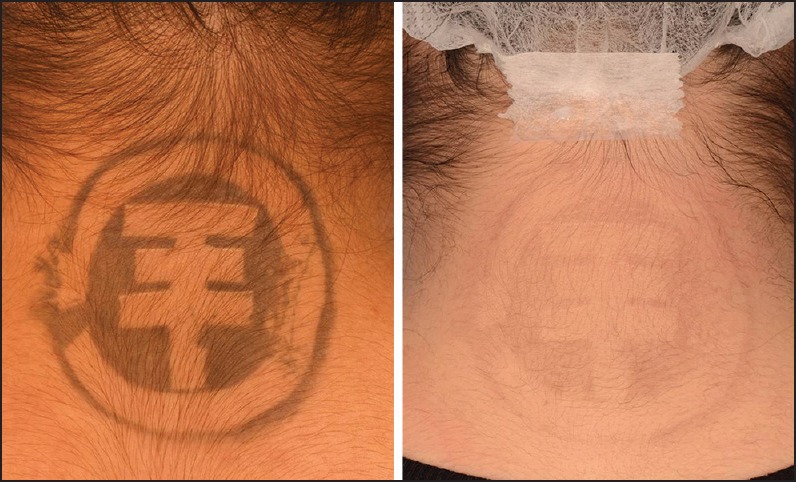
Black amateur tattoo on nape of neck before and after 2 treatments with 1064 nm QS Nd:YAG laser (Photographs courtesy of National Skin Centre, Singapore)
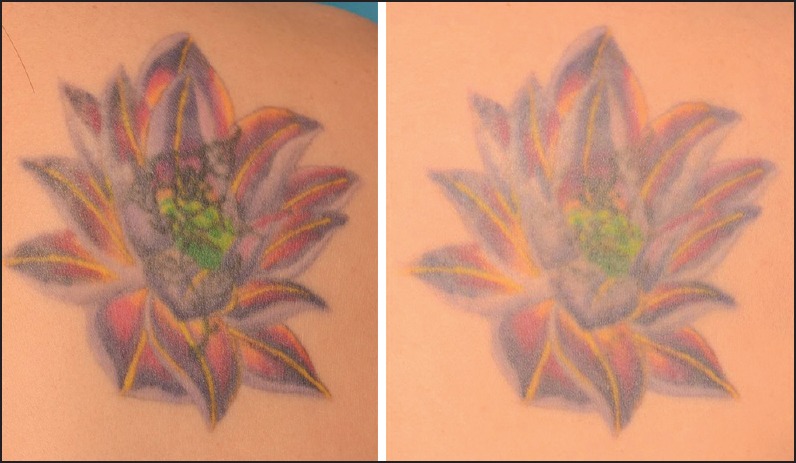
Difficult to treat multi-colored tattoo on the back, before and after 4 treatments with 755 nm QS Alexandrite laser (Photographs courtesy of National Skin Centre, Singapore)
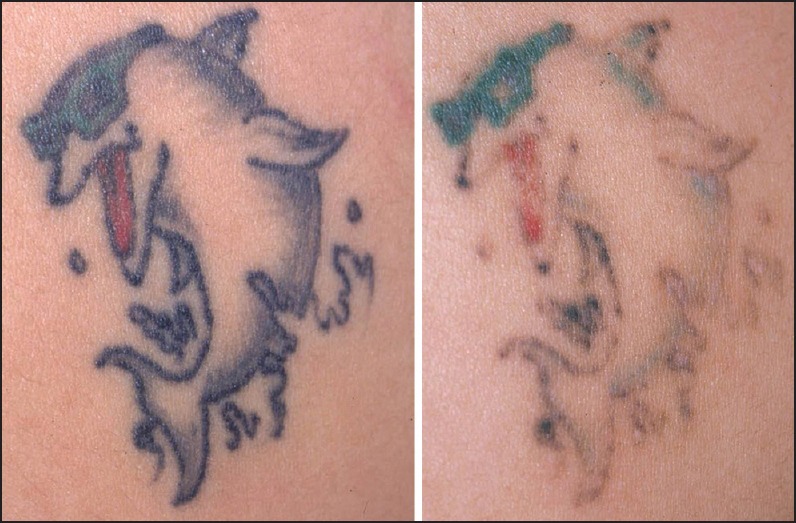
Show multicolored tattoo partially removed with the QS Nd:YAG laser. Note persistence of green pigment which are generally unresponsive to Nd:YAG laser. (Photograph courtesy of National Skin Centre, Singapore)
References
-
- Laumann AE, Derick AJ. Tattoos and body piercings in the United States: A national data set. J Am Acad Dermatol. 2006;55:413–21. - PubMed
-
- One in five US adults now has a tattoo. Harris Interactive Website. [Last accessed on 2014 Aug 15]. Available from: http://www.harrisinteractive.com/NewsRoom/HarrisPolls/tabid/447/ctl/Read... .
-
- Unwanted tattoos. ASDS website. [Last accessed on 2014 Aug 15]. Available from: https://www.asds.net/TattooRemovalInformation.aspx .
-
- Armstrong ML, Roberts AE, Koch JR, Saunders JC, Owen DC, Anderson RR. Motivation for contemporary tattoo removal: A shift in identity. Arch Dermatol. 2008;144:879–84. - PubMed
-
- Alster SA. Q-switched alexandrite laser treatment (755 nm) of professional and amateur tattoos. J Am Acad Dermatol. 1995;33:69–73. - PubMed
LinkOut - more resources
Full Text Sources
Other Literature Sources