


Characterization of the in vivo immune network of IDO, tryptophan metabolism, PD-L1, and CTLA-4 in circulating immune cells in melanoma
- PMID: 25949897
- PMCID: PMC4404886
- DOI: 10.4161/2162402X.2014.982382
Characterization of the in vivo immune network of IDO, tryptophan metabolism, PD-L1, and CTLA-4 in circulating immune cells in melanoma
Abstract
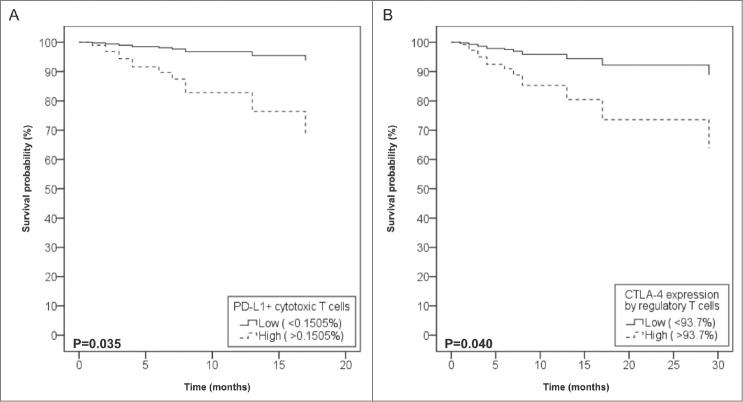
In melanoma, both the induction of immunosuppression by tumor cells and the inflammatory antitumor response can induce an upregulation of counter-regulatory mechanisms such as indoleamine 2,3-dioxygenase (IDO), programmed death-ligand 1 (PD-L1) and CTLA-4+ regulatory T-cells (Tregs) in the tumor microenvironment. Even though these immunosuppressive mediators are targets for immunotherapy, research investigating their expression in the peripheral blood is lacking. We therefore, performed flow cytometry on PBMCs of stage I-IV melanoma patients. IDO expression was detected in plasmacytoid dendritic cells (pDC) and monocytic myeloid-derived suppressor cells (mMDSC), and increased in advanced disease stage (p = 0.027). Tryptophan breakdown confirmed the functional activity of IDO and was linked with increased PD-L1+ cytotoxic T-cells (p = 0.009), relative lymphopenia (p = 0.036), and a higher mDC/pDC ratio (p = 0.002). High levels of circulating PD-L1+ cytotoxic T-cells were associated with increased CTLA-4 expression by Tregs (p = 0.005) and MDSC levels (p = 0.033). This illustrates that counter-regulatory immune mechanisms in melanoma should be considered as one interrelated signaling network. Moreover, both increased PD-L1+ T-cells and CTLA-4 expression in Tregs conferred a negative prognosis, indicating their in vivo relevance. Remarkably, circulating CTLA-4, IDO, and pDC levels were altered according to prior invasion of the sentinel lymph node and IDO expression in the sentinel was associated with more IDO+ PBMCs. We conclude that the expression of IDO, PD-L1, and CTLA-4 in the peripheral blood of melanoma patients is strongly interconnected, associated with advanced disease and negative outcome, independent of disease stage. Combination treatments targeting several of these markers are therefore likely to exert a synergistic response.
Keywords: AJCC; American Joint Committee on Cancer system; CC, correlation coefficientCTLA-4; Cytotoxic T Lymphocyte-Associated Antigen 4; DC, dendritic cells; HR, hazard ratio; IDO, indoleamine 2, 3-dioxygenase; IFNγ, interferon-gamma; IQR, interquartile range; Kyn, kynurenine; MDSC, myeloid-derived suppressor cells; MFI, mean fluorescence intensity; OS, overall survival; PBMC, peripheral blood mononuclear cells; PD-1, programmed cell death protein 1; PD-L1, Programmed-Death Ligand 1; Treg, regulatory T-cell; Tryp, tryptophan; UPLC, ultra-performance liquid chromatography; cytotoxic T lymphocyte-associated antigen 4 (CTLA-4); indoleamine 2-3-dioxygenase (IDO); mDC, myeloid DC; mMDSC, monocytic MDSC; melanoma; negative feedback mechanism; pDC, plasmacytoid DC; pmnMDSC, polymorphonuclear MDSC; prognosis; programmed-death ligand 1 (PD-L1); regulatory T-cells.
Figures
References
-
- Eggermont A, Robert C, Soria JC, Zitvogel L. Harnessing the immune system to provide long-term survival in patients with melanoma and other solid tumors. Oncoimmunology 2014; 3:e27560; PMID:; http://dx.doi.org/10.4161/onci.27560 - DOI - PMC - PubMed
-
- Speeckaert R, Van Geel N, Lambert J, Boone B, Chevolet I, Van Gele M, Speeckaert MM, Brochez L. Immune mediated mechanisms of melanocyte destruction: paving the way for efficient immunotherapeutic strategies against melanoma. Oncoimmunology 2012; 1:526-8; PMID:; http://dx.doi.org/10.4161/onci.19403 - DOI - PMC - PubMed
-
- Ji RR, Chasalow SD, Wang L, Hamid O, Schmidt H, Cogswell J, Alaparthy S, Berman D, Jure-Kunkel M, Siemers NO, et al. An immune-active tumor microenvironment favors clinical response to ipilimumab. Cancer Immunol Immunother 2012; 61:1019-31; PMID:; http://dx.doi.org/10.1007/s00262-011-1172-6 - DOI - PMC - PubMed
-
- Taylor MW, Feng GS. Relationship between interferon-gamma, indoleamine 2,3-dioxygenase, and tryptophan catabolism. FASEB J 1991; 5:2516-22; PMID: - PubMed
Publication types
LinkOut - more resources
Full Text Sources
Research Materials
