A TSHβ Variant with Impaired Immunoreactivity but Intact Biological Activity and Its Clinical Implications
- PMID: 25950606
- PMCID: PMC4533086
- DOI: 10.1089/thy.2015.0096
A TSHβ Variant with Impaired Immunoreactivity but Intact Biological Activity and Its Clinical Implications
Abstract
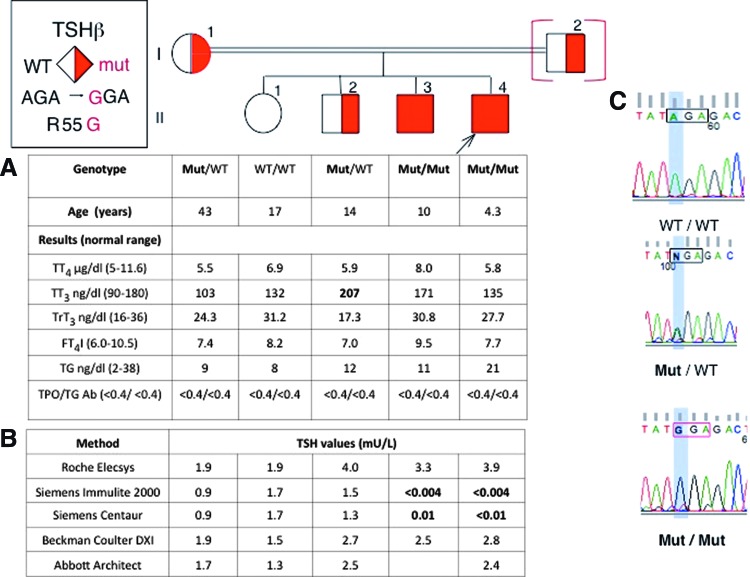
Background: Thyrotropin (TSH) deficiency caused by TSHβ gene mutations is a rare form of congenital central hypothyroidism. Nine different TSHβ gene mutations have been reported, all with clinical manifestations. The aim was to identify the genetic cause of undetectable TSH levels in two siblings with clinical euthyroidism.
Methods: Two brothers born to consanguineous Pakistani parents presented with undetectable serum TSH but normal iodothyronine concentrations and no clinical signs of hypothyroidism. Direct sequencing of the TSHβ gene, functional and immunological studies, protein homology modeling, and population frequency analysis were performed to characterize the cause of undetectable TSH in this family.
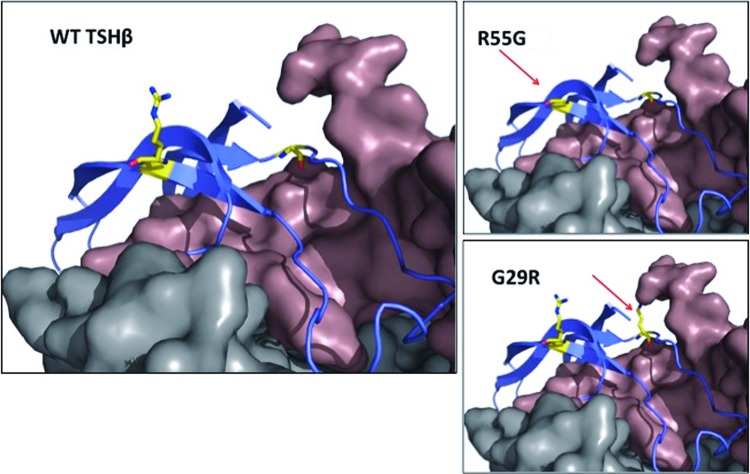
Results: Direct sequencing of the TSHβ gene revealed that the two brothers were homozygous for a single nucleotide substitution (c.223A>G) resulting in the replacement of arginine 55 with glycine (R55G). This variant was found in 12 out of 5008 alleles in the 1000 Genomes project (all South Asian). Serum TSH of the two brothers was undetectable in two of five platforms, both produced by Siemens, whereas TSH levels of the heterozygous brother and mother were half compared to the other three platforms (Roche Elecsys, Abbott Architect, and Beckman Coulter DxI). The falsely low TSH concentration was caused by the monoclonal antibody not recognizing the region containing the variant amino acid. This is supported by the fact that arginine modification--following phenylglyoxal treatment--led to a significant (96%) decrease in the TSH measurement with the Siemens platforms. Predictions based on PolyPhen-2 and in silico modeling revealed no functional impairment of the variant TSH.
Conclusions: A TSHβ variant with impaired immunoreactivity, but not bioactivity, is reported, and its biochemical impact in the homo- and heterozygous state is demonstrated. It is also shown that failure to bind to the monoclonal antibody is a direct consequence of the amino acid substitution.
Figures
References
-
- Pierce JG, Parsons TF. 1981. Glycoprotein hormones: structure and function. Annu Rev Biochem 50:465–495 - PubMed
-
- Grossmann M, Weintraub BD, Szkudlinski MW. 1997. Novel insights into the molecular mechanisms of human thyrotropin action: structural, physiological, and therapeutic implications for the glycoprotein hormone family. Endocr Rev 18:476–501 - PubMed
-
- Lundblad RL. 1994. Techniques in Protein Modification. CRC Press, Boca Raton, FL, pp 163–167
-
- Jacobson MP, Pincus DL, Rapp CS, Day TJ, Honig B, Shaw DE, Friesner RA. 2004. A hierarchical approach to all-atom protein loop prediction. Proteins 55:351–367 - PubMed
-
- Jacobson MP, Friesner RA, Xiang Z, Honig B. 2002. On the role of crystal packing forces in determining protein side chain conformations. J Mol Biol 320:597–608 - PubMed
Publication types
MeSH terms
Substances
Grants and funding
LinkOut - more resources
Full Text Sources
Other Literature Sources
Medical