Review
. 2015 Oct;148(4):859-864.
doi: 10.1378/chest.15-0358.

Optimizing atrial fibrillation management: from ICU and beyond

Affiliations
Review

Optimizing atrial fibrillation management: from ICU and beyond

Allan J Walkey et al. Chest. 2015 Oct.

Abstract

Atrial fibrillation (AF) that newly occurs during critical illness presents challenges for both short- and long-term management. During critical illness, patients with new-onset AF are clinically evaluated for hemodynamic instability owing to the arrhythmia as well as for potentially reversible arrhythmia triggers. Hemodynamically significant AF that persists during critical illness may be treated with heart rate or rhythm control strategies. Recent evidence suggests that patients in whom AF develops during acute illness (eg, sepsis, postoperatively) have high long-term risks for AF recurrence and for AF-associated complications, such as stroke, heart failure, and death. Therefore, we suggest increased efforts to improve communication of AF events between inpatient and outpatient providers and to reassess patients who had experienced new-onset AF during critical illness after they transition to the post-ICU setting. We describe various strategies for the assessment and long-term management of patients with new-onset AF during critical illness.


Figures
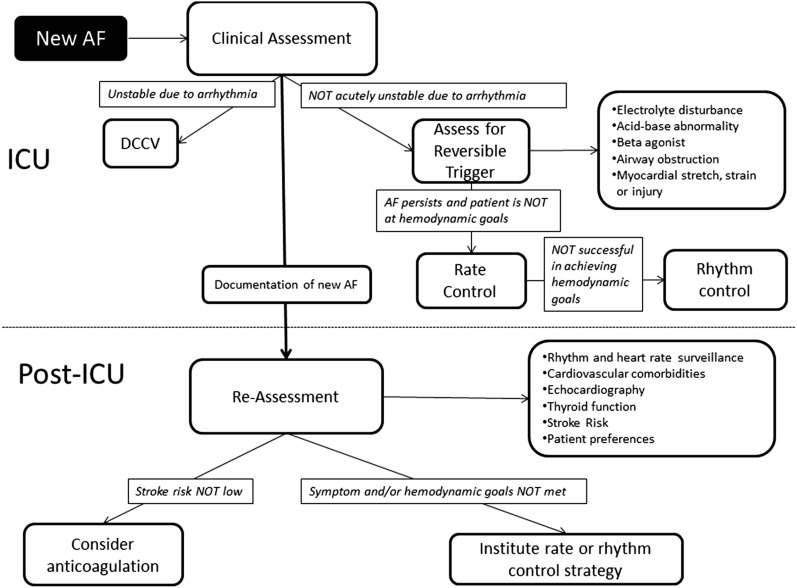
Figure 1 –
Figure 1 –
Approach to the short-term and long-term management of new-onset AF during critical illness. The initial approach involves clinical assessment for hemodynamic and respiratory stability related to AF, with evaluation for reversible triggers and initiation of heart rate or rhythm control treatments to meet hemodynamic goals. After clinical improvement, patients should be systematically reevaluated for stroke risk (eg, CHA2DS2-VASc [congestive heart failure, hypertension, age ≥ 75 y, diabetes, previous stroke/transient ischemic attack, vascular disease, age 65-74 y, sex category] score) and evidence of AF recurrence to guide initiation of thromboembolism prophylaxis, rate control, or rhythm control. AF = atrial fibrillation; DCCV = direct current cardioversion.

References

    1. Annane D, Sébille V, Duboc D, et al. Incidence and prognosis of sustained arrhythmias in critically ill patients. Am J Respir Crit Care Med. 2008;178(1):20-25. - PubMed
    1. Walkey AJ, Wiener RS, Ghobrial JM, Curtis LH, Benjamin EJ. Incident stroke and mortality associated with new-onset atrial fibrillation in patients hospitalized with severe sepsis. JAMA. 2011;306(20):2248-2254. - PMC - PubMed
    1. Walkey AJ, Greiner MA, Heckbert SR, et al. Atrial fibrillation among Medicare beneficiaries hospitalized with sepsis: incidence and risk factors. Am Heart J. 2013;165(6):949-955. - PMC - PubMed
    1. Zeerleder S, Hack CE, Wuillemin WA. Disseminated intravascular coagulation in sepsis. Chest. 2005;128(4):2864-2875. - PubMed
    1. Walkey AJ, Ambrus D, Benjamin EJ. The role of arrhythmias in defining cardiac dysfunction during sepsis. Am J Respir Crit Care Med. 2013;188(6):751. - PMC - PubMed

Publication types
