


Claudins: Gatekeepers of lung epithelial function
- PMID: 25951797
- PMCID: PMC4562902
- DOI: 10.1016/j.semcdb.2015.04.009
Claudins: Gatekeepers of lung epithelial function
Abstract
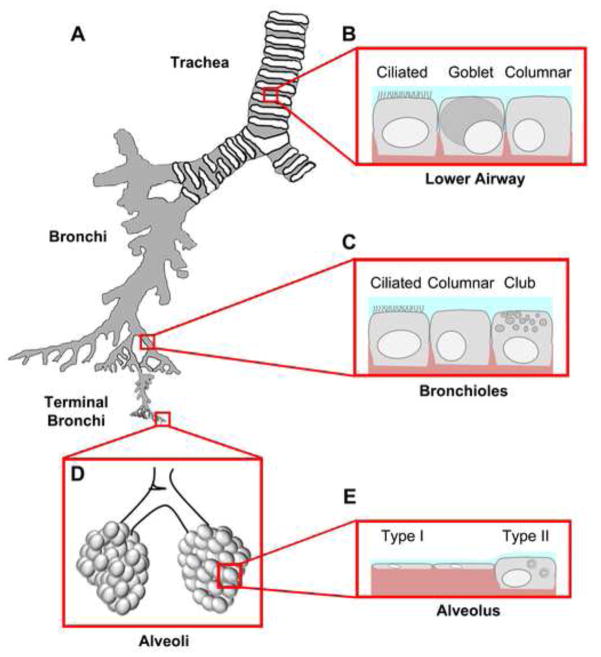
The lung must maintain a proper barrier between airspaces and fluid filled tissues in order to maintain lung fluid balance. Central to maintaining lung fluid balance are epithelial cells which create a barrier to water and solutes. The barrier function of these cells is mainly provided by tight junction proteins known as claudins. Epithelial barrier function varies depending on the different needs within the segments of the respiratory tree. In the lower airways, fluid is required to maintain mucociliary clearance, whereas in the terminal alveolar airspaces a thin layer of surfactant enriched fluid lowers surface tension to prevent airspace collapse and is critical for gas exchange. As the epithelial cells within the segments of the respiratory tree differ, the composition of claudins found in these epithelial cells is also different. Among these differences is claudin-18 which is uniquely expressed by the alveolar epithelial cells. Other claudins, notably claudin-4 and claudin-7, are more ubiquitously expressed throughout the respiratory epithelium. Claudin-5 is expressed by both pulmonary epithelial and endothelial cells. Based on in vitro and in vivo model systems and histologic analysis of lungs from human patients, roles for specific claudins in maintaining barrier function and protecting the lung from the effects of acute injury and disease are being identified. One surprising finding is that claudin-18 and claudin-4 control lung cell phenotype and inflammation beyond simply maintaining a selective paracellular permeability barrier. This suggests claudins have more nuanced roles for the control of airway and alveolar physiology in the healthy and diseased lung.
Keywords: Airway; Alveolarization; Alveolus; Cystic fibrosis; Pulmonary edema; Vascular endothelium.
Copyright © 2015 Elsevier Ltd. All rights reserved.
Figures
References
-
- Soini Y. Claudins in lung diseases. Respir Res. 2011;12:70. http://dx.doi.org/10.1186/1465-9921-12-70. - DOI - PMC - PubMed
-
- Frank JA. Claudins and alveolar epithelial barrier function in the lung. Ann N Y Acad Sci. 2012;1257:175–183. http://dx.doi.org/10.1111/j.1749-6632.2012.06533.x. - DOI - PMC - PubMed
-
- Koval M. Claudin heterogeneity and control of lung tight junctions. Annu Rev Physiol. 2013;75:551–567. http://dx.doi.org/10.1146/annurev-physiol-030212-183809. - DOI - PubMed
-
- Whitsett JA, Alenghat T. Respiratory epithelial cells orchestrate pulmonary innate immunity. Nat Immunol. 2014;16:27–35. http://dx.doi.org/10.1038/ni.3045. - DOI - PMC - PubMed
-
- Tarran R, Button B, Boucher RC. Regulation of normal and cystic fibrosis airway surface liquid volume by phasic shear stress. Annu Rev Physiol. 2006;68:543–561. http://dx.doi.org/10.1146/annurev.physiol.68.072304.112754. - DOI - PubMed
Publication types
MeSH terms
Substances
Grants and funding
LinkOut - more resources
Full Text Sources
Other Literature Sources
