


Synaptic Cytoskeletal Plasticity in the Prefrontal Cortex Following Psychostimulant Exposure
- PMID: 25951902
- PMCID: PMC4849269
- DOI: 10.1111/tra.12295
Synaptic Cytoskeletal Plasticity in the Prefrontal Cortex Following Psychostimulant Exposure
Abstract
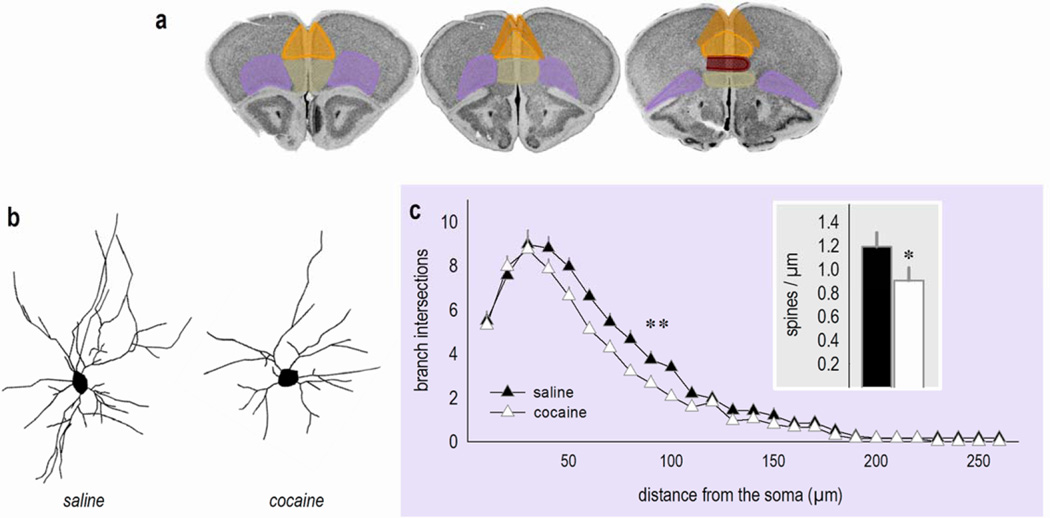
Addiction is characterized by maladaptive decision-making, a loss of control over drug consumption and habit-like drug seeking despite adverse consequences. These cognitive changes may reflect the effects of drugs of abuse on prefrontal cortical neurobiology. Here, we review evidence that amphetamine and cocaine fundamentally remodel the structure of excitatory neurons in the prefrontal cortex. We summarize evidence in particular that these psychostimulants have opposing effects in the medial and orbital prefrontal cortices ('mPFC' and 'oPFC', respectively). For example, amphetamine and cocaine increase dendrite length and spine density in the mPFC, while dendrites are impoverished and dendritic spines are eliminated in the oPFC. We will discuss evidence that certain cytoskeletal regulatory proteins expressed in the oPFC and implicated in postnatal (adolescent) neural development also regulate behavioral sensitivity to cocaine. These findings potentially open a window of opportunity for the identification of novel pharmacotherapeutic targets in the treatment of drug abuse disorders in adults, as well as in drug-vulnerable adolescent populations. Finally, we will discuss the behavioral implications of drug-related dendritic spine elimination in the oPFC, with regard to reversal learning tasks and tasks that assess the development of reward-seeking habits, both used to model aspects of addiction in rodents.
Keywords: D-amphetamine; adolescence; cingulate; dependence; drug abuse; impulsivity; infralimbic; orbitofrontal; prelimbic; review.
© 2015 John Wiley & Sons A/S. Published by John Wiley & Sons Ltd.
Conflict of interest statement
The authors have no conflicts to disclose.
Figures
References
-
- Jentsch JD, Taylor JR. Impulsivity resulting from frontostriatal dysfunction in drug abuse: Implications for the control of behavior by reward-related stimuli. Psychopharmacology. 1999;146:373–390. - PubMed
-
- Robbins TW, Everitt BJ. Drug addiction: Bad habits add up. Nature. 1999;398:567–570. - PubMed
-
- Everitt BJ, Robbins TW. Neural systems of reinforcement for drug addiction: from actions to habits to compulsion. Nat Neurosci. 2005;8:1481–1489. - PubMed
-
- Kalivas PW. Addiction as a pathology in prefrontal cortical regulation of corticostriatal habit circuitry. Neurotox Res. 2008;14:185–189. - PubMed
-
- Kalivas PW. The glutamate homeostasis hypothesis of addiction. Nat Rev Neurosci. 2009;10:561–572. - PubMed
Publication types
MeSH terms
Substances
Grants and funding
LinkOut - more resources
Full Text Sources
Other Literature Sources
