Comparative Study
. 2015;16 Suppl 7(Suppl 7):S9.
doi: 10.1186/1471-2105-16-S7-S9. Epub 2015 Apr 23.

A probabilistic approach for pediatric epilepsy diagnosis using brain functional connectivity networks

Comparative Study

A probabilistic approach for pediatric epilepsy diagnosis using brain functional connectivity networks

Saman Sargolzaei et al. BMC Bioinformatics. 2015.

Abstract

Background: The lives of half a million children in the United States are severely affected due to the alterations in their functional and mental abilities which epilepsy causes. This study aims to introduce a novel decision support system for the diagnosis of pediatric epilepsy based on scalp EEG data in a clinical environment.

Methods: A new time varying approach for constructing functional connectivity networks (FCNs) of 18 subjects (7 subjects from pediatric control (PC) group and 11 subjects from pediatric epilepsy (PE) group) is implemented by moving a window with overlap to split the EEG signals into a total of 445 multi-channel EEG segments (91 for PC and 354 for PE) and finding the hypothetical functional connectivity strengths among EEG channels. FCNs are then mapped into the form of undirected graphs and subjected to extraction of graph theory based features. An unsupervised labeling technique based on Gaussian mixtures model (GMM) is then used to delineate the pediatric epilepsy group from the control group.

Results: The study results show the existence of a statistically significant difference (p < 0.0001) between the mean FCNs of PC and PE groups. The system was able to diagnose pediatric epilepsy subjects with the accuracy of 88.8% with 81.8% sensitivity and 100% specificity purely based on exploration of associations among brain cortical regions and without a priori knowledge of diagnosis.

Conclusions: The current study created the potential of diagnosing epilepsy without need for long EEG recording session and time-consuming visual inspection as conventionally employed.


Figures
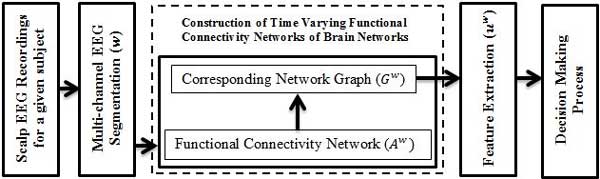
Figure 1
Figure 1
Flowchart of the proposed decision support system. Flowchart of the proposed decision support system for computer aided diagnosis of pediatric epilepsy based on machine learning techniques applied on constructed FCNs of the brain. Algorithm starts with segmentation of multichannel EEG recordings by applying a moving window (w) with overlap. Functional connectivity networks are constructed and mapped into a corresponding graph for each window. Extraction of graph theoretical based features (uw) is then followed by a decision making process which uses a probabilistic approach to determine whether a patient is epileptic or not.
Figure 2
Figure 2
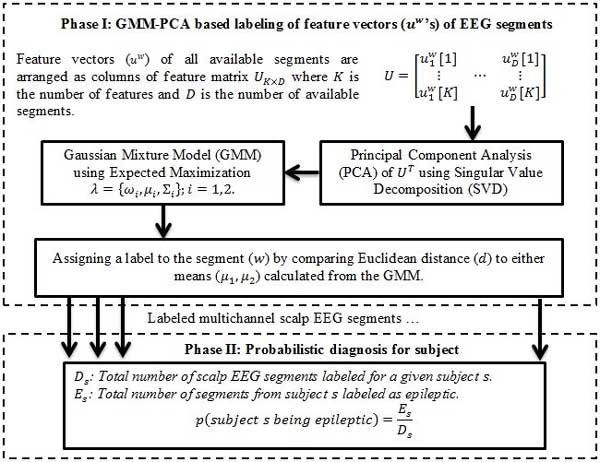
Flowchart of the two phase decision making process. Flowchart of the two-phase decision making process. Phase I assigns labels to multichannel scalp EEG segments based on the Gaussian Mixture Modelling of graph theoretical based features; Phase II assigns labels (epileptic or non-epileptic) to the subjects by assigning a probability in the likelihood of belonging in one of the two groups.
Figure 3
Figure 3
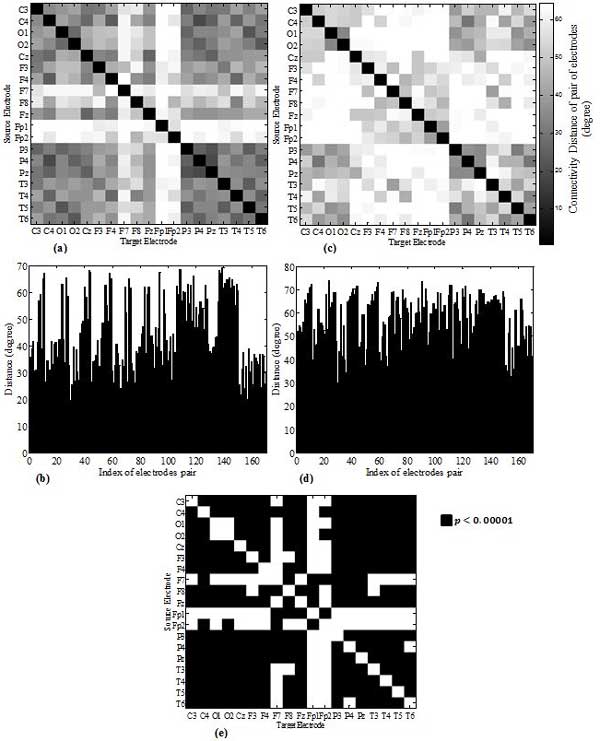
Visualization of constructed functional connectivity networks. Visualization of constructed undirected functional connectivity networks (FCNs) and the corresponding plot of the connectivity distances for the average map across (a), (b) pediatric control group (c), (d) pediatric epilepsy. Index of electrodes pair represent the pair of electrodes, e.g. index 0 corresponds to the connectivity distance (angle) among pair c3-c4 and the index 1 corresponds to the connectivity distance (angle) among pair c3-o1 and etc. (e) shows the results of student t test for the null hypothesis that assumes no statistically significant differences for the index pair of electrodes across the pediatric epilepsy and pediatric control groups. Rejection of the null hypothesis is highlighted with the black boxes when p < 0.00001, bonferroni adjusted for multiple comparison.
Figure 4
Figure 4
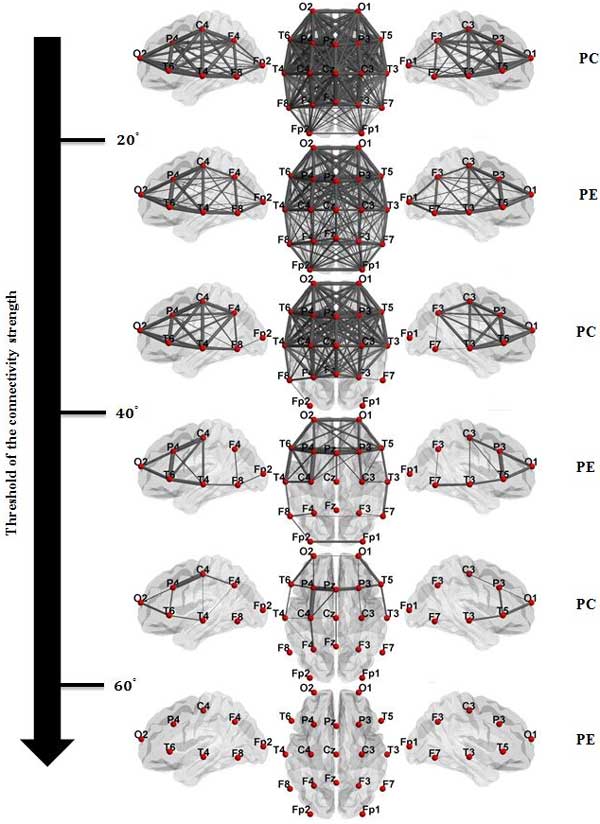
Graph representations. Graph representations of average of constructed FCNs over the (a) pediatric control (PC) group and (b) pediatric epilepsy (PE) group. Thickness of links (graph edges) shows the strength of connectivity among electrode pairs.

References

    1. Control CfD, Prevention. Epilepsy in adults and access to care--United States, 2010. MMWR Morbidity and mortality weekly report. 2012;61(45):909. - PubMed
    1. England MJ, Liverman CT, Schultz AM, Strawbridge LM. Epilepsy across the spectrum: Promoting health and understanding.: A summary of the Institute of Medicine report. Epilepsy & Behavior. 2012;25(2):266–276. doi: 10.1016/j.yebeh.2012.06.016. - DOI - PMC - PubMed
    1. Alonso JF, Mañanas MA, Romero S, Riba J, Barbanoj MJ, Hoyer D. Connectivity analysis of EEG under drug therapy. Conference proceedings: Annual International Conference of the IEEE Engineering in Medicine and Biology Society IEEE Engineering in Medicine and Biology Society Conference. 2006. pp. 6188–6191. - PubMed
    1. Adjouadi M, Sanchez D, Cabrerizo M, Ayala M, Jayakar P, Yaylali I, Barreto A. Interictal spike detection using the Walsh transform. Biomedical Engineering, IEEE Transactions on. 2004;51(5):868–872. doi: 10.1109/TBME.2004.826642. - DOI - PubMed
    1. Adjouadi M, Cabrerizo M, Ayala M, Sanchez D, Yaylali I, Jayakar P, Barreto A. Detection of interictal spikes and artifactual data through orthogonal transformations. Journal of clinical neurophysiology. 2005;22(1):53–64. doi: 10.1097/01.WNP.0000150880.19561.6F. - DOI - PubMed

Publication types