


Long-Term BMI Trajectories and Health in Older Adults: Hierarchical Clustering of Functional Curves
- PMID: 25953813
- PMCID: PMC5436799
- DOI: 10.1177/0898264315584329
Long-Term BMI Trajectories and Health in Older Adults: Hierarchical Clustering of Functional Curves
Abstract
Objective: This project contributes to the emerging research that aims to identify distinct body mass index (BMI) trajectory types in the population. We identify clusters of long-term BMI curves among older adults and determine how the clusters differ with respect to initial health.
Method: Health and Retirement Study cohort (N = 9,893) with BMI information collected in up to 10 waves (1992-2010) is analyzed using a powerful cutting-edge approach: hierarchical clustering of BMI functions estimated via the Principal Analysis by Conditional Expectations (PACE) algorithm.
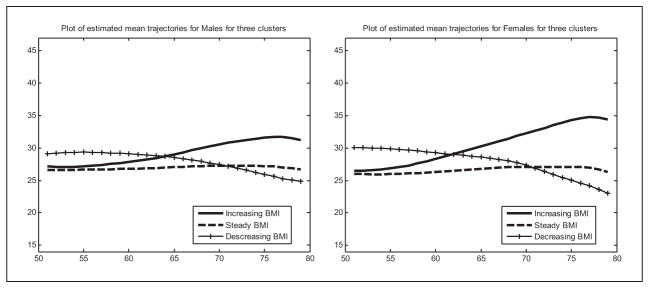
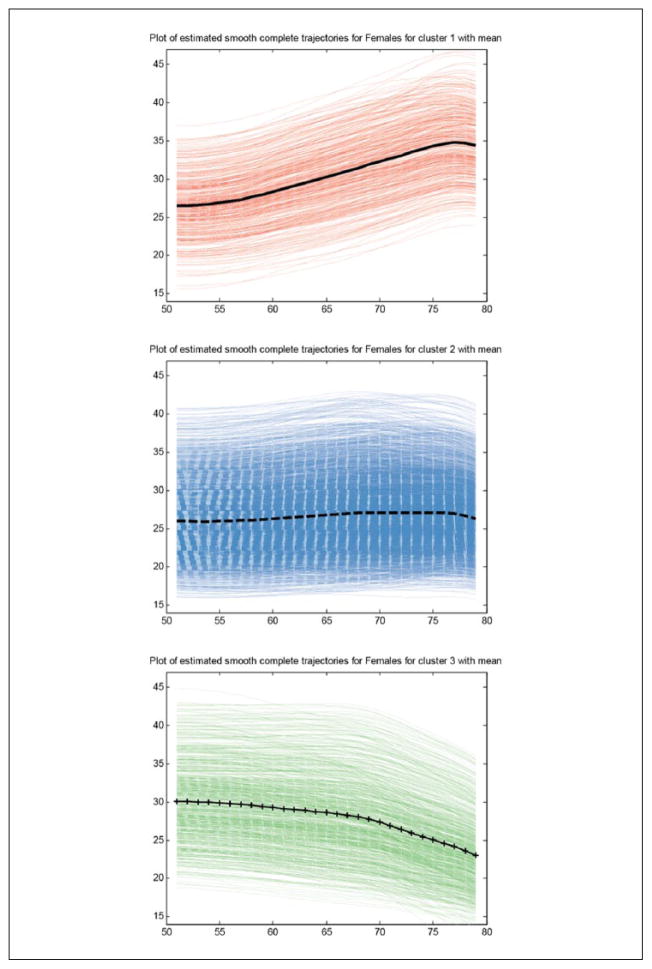
Results: Three BMI trajectory clusters emerged for each gender: stable, gaining, and losing. The initial health of the gaining and stable groups in both genders was comparable; the losing cluster experienced significantly poorer health at baseline.
Discussion: BMI trajectories among older adults cluster into distinct types in both genders, and the clusters vary substantially in initial health. Weight loss but not gain is associated with poor initial health in this age group.
Keywords: BMI trajectories; BMI trajectory clusters; functional data analysis; health; older adults.
© The Author(s) 2015.
Conflict of interest statement
The authors declared no potential conflicts of interest with respect to the research, authorship, and/or publication of this article.
Figures
References
-
- Allison DB, Fontaine KR, Manson JE, Stevens J, VanItallie TB. Annual deaths attributable to obesity in the United States. Journal of the American Medical Association. 1999;282:1530–1538. - PubMed
-
- Bamia C, Halkjaer J, Lagiou P, Trichopoulos D, Tjonneland A, Berentzen T. Weight change in later life and risk of death amongst the elderly: The European Prospective Investigation into Cancer and Nutrition–Elderly Network on Ageing and Health study. Journal of Internal Medicine. 2010;268:133–144. doi: 10.1111/j.1365-2796.2010.02219.x. - DOI - PubMed
Publication types
MeSH terms
Grants and funding
LinkOut - more resources
Full Text Sources
Other Literature Sources
