Review
. 2015 May;200(1):1-19.
doi: 10.1534/genetics.114.172387.

The functional basis of wing patterning in Heliconius butterflies: the molecules behind mimicry

Affiliations
Review

The functional basis of wing patterning in Heliconius butterflies: the molecules behind mimicry

Marcus R Kronforst et al. Genetics. 2015 May.

Abstract

Wing-pattern mimicry in butterflies has provided an important example of adaptation since Charles Darwin and Alfred Russell Wallace proposed evolution by natural selection >150 years ago. The neotropical butterfly genus Heliconius played a central role in the development of mimicry theory and has since been studied extensively in the context of ecology and population biology, behavior, and mimicry genetics. Heliconius species are notable for their diverse color patterns, and previous crossing experiments revealed that much of this variation is controlled by a small number of large-effect, Mendelian switch loci. Recent comparative analyses have shown that the same switch loci control wing-pattern diversity throughout the genus, and a number of these have now been positionally cloned. Using a combination of comparative genetic mapping, association tests, and gene expression analyses, variation in red wing patterning throughout Heliconius has been traced back to the action of the transcription factor optix. Similarly, the signaling ligand WntA has been shown to control variation in melanin patterning across Heliconius and other butterflies. Our understanding of the molecular basis of Heliconius mimicry is now providing important insights into a variety of additional evolutionary phenomena, including the origin of supergenes, the interplay between constraint and evolvability, the genetic basis of convergence, the potential for introgression to facilitate adaptation, the mechanisms of hybrid speciation in animals, and the process of ecological speciation.

Keywords: Heliconius; adaptation; mimicry; speciation.


Figures

Figure 1
Figure 1
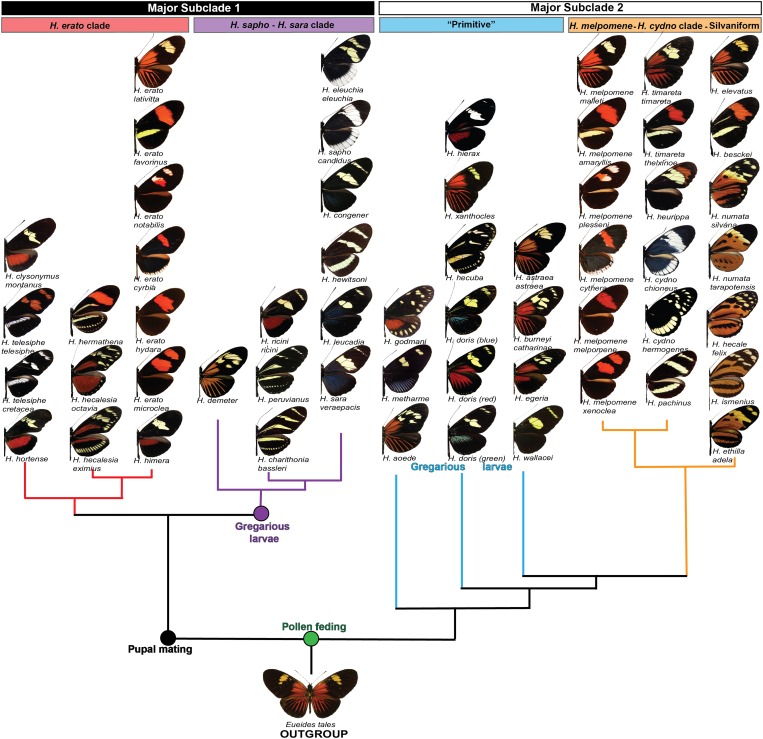
Phenotypic diversity across Heliconius butterflies. Phylogenetic relationships among all major Heliconius clades are shown (Kozak et al. 2015). Names and color patterns of representative species and subspecies are depicted, together with behavioral traits that characterize phylogenetic nodes across the genus.
Figure 2
Figure 2
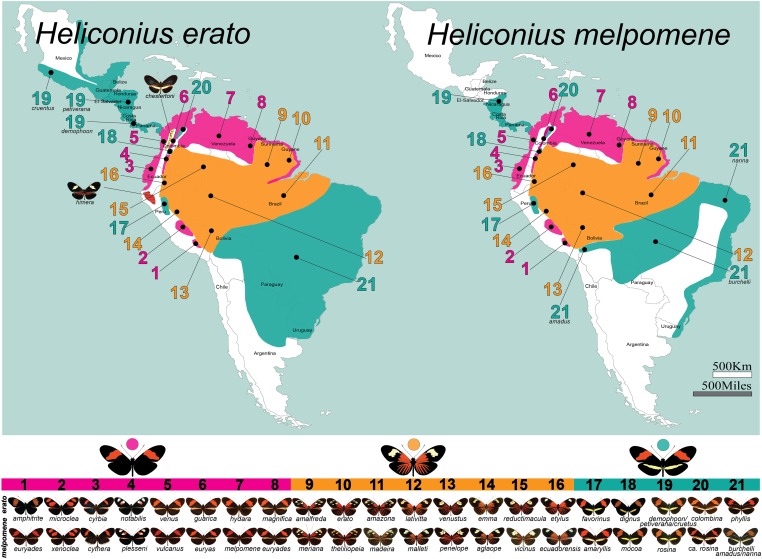
Geographic distributions of the H. erato and H. melpomene convergent radiations. Approximate distributions of the three major phenotypes and locations of many described subspecies, or “races,” of the Müllerian co-mimics H. erato and H. melpomene. Matching wing-color-pattern variation and subspecies names are shown below the maps. Two incipient species that are part of the H. erato radiation, H. himera and H. erato chestertoni, are also presented.
Figure 3
Figure 3
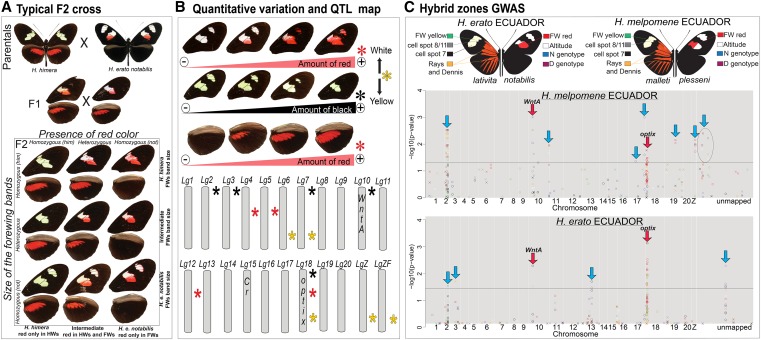
Mapping color-pattern variation in Heliconius: Mendelian segregation, quantitative variation, and genome-wide association. (A) An F2 mapping family from a cross between sister species H. himera and H. erato notabilis shows Mendelian segregation of black (Sd = WntA) and red (D = optix) wing-scale distributions (Papa et al. 2013). (B) Quantitative wing-color variation and linkage group distribution of QTL for black, red, and yellow/white color-pattern variation (stars) in the same mapping family. Stars indicate the presence of at least one locus modulating black (black star), red (red star), or yellow/white (yellow star) pattern variation. (C) Genome-wide association study of wing-color-pattern variation in H. melpomene and H. erato Ecuadorian hybrid zones (Nadeau et al. 2014). The different colors of points represent individual SNPs associated with distinct pattern elements shown in the wing images above. Points above the lines represent significant associations. Red arrows indicate the positions of optix (D locus) and WntA (Sd locus). Blue arrows indicate the positions of putatively undescribed color-pattern loci, many of which are not shared between H. melpomene and H. erato.
Figure 4
Figure 4
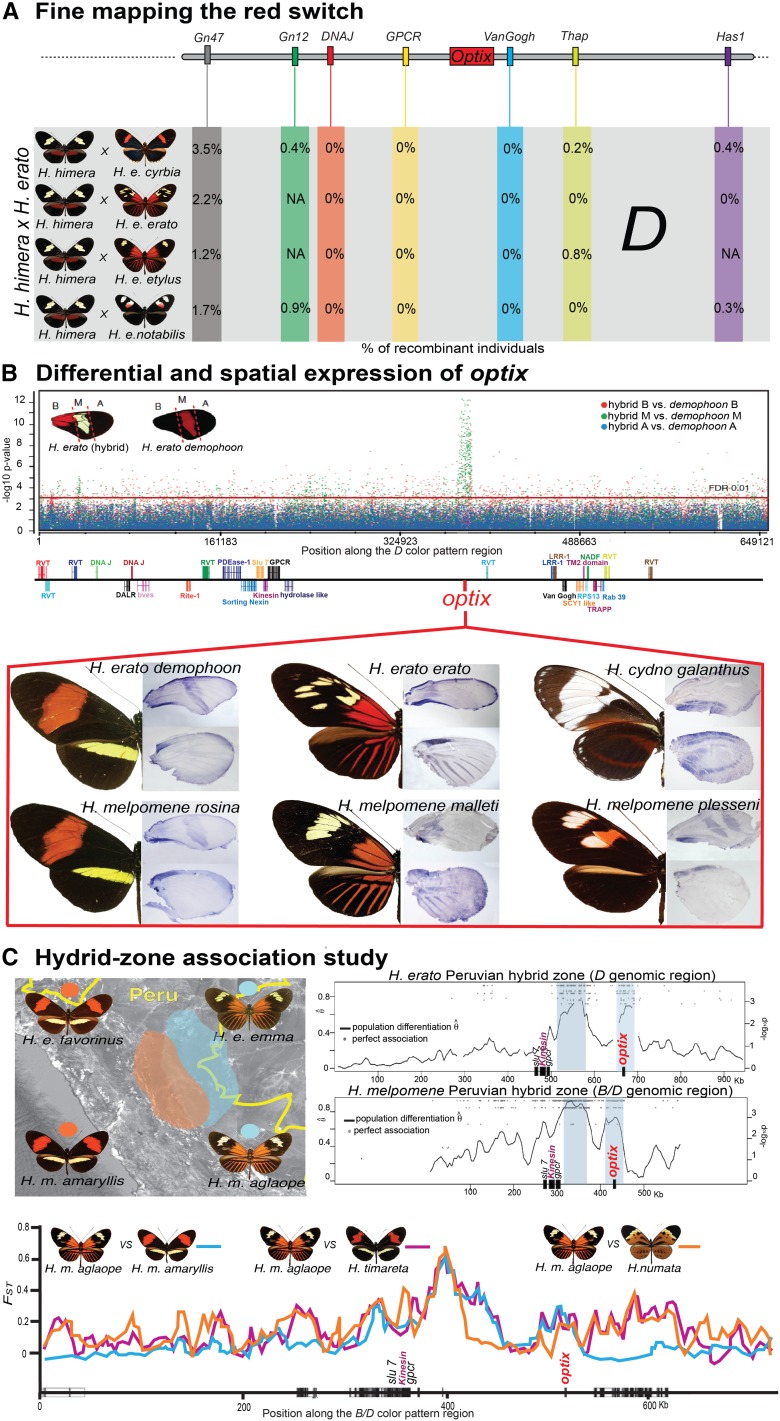
The molecular basis of red wing patterning in Heliconius. (A) Genetic mapping of red wing color-pattern variation (percentage of recombinants at several genes is shown) across multiple H. erato × H. himera families points to a narrow genomic interval containing the transcription factor optix. (B) Comparison of gene expression between three forewing color-pattern sections of two H. erato morphs using a D-locus tiling array suggests optix as the gene regulating red patterning (Reed et al. 2011). Messenger RNA expression (in situ hybridization) of optix on pupal wing discs of different Heliconius species spatially prefigures adult red wing patterning (Reed et al. 2011). (C) Targeted analyses of SNP associations and genetic differentiation (FST) in H. erato and H. melpomene Peruvian hybrid zones (geographic distributions shown in the map) suggest two genomic regions, one centered on optix and another upstream of optix, strongly associated with red wing color-pattern variation (Supple et al. 2013). Patterns of genetic differentiation across the B/D interval between H. melpomene subspecies and closely related species also reveal enhanced divergence in these two genomic regions (bottom) (Nadeau et al. 2012).
Figure 5
Figure 5
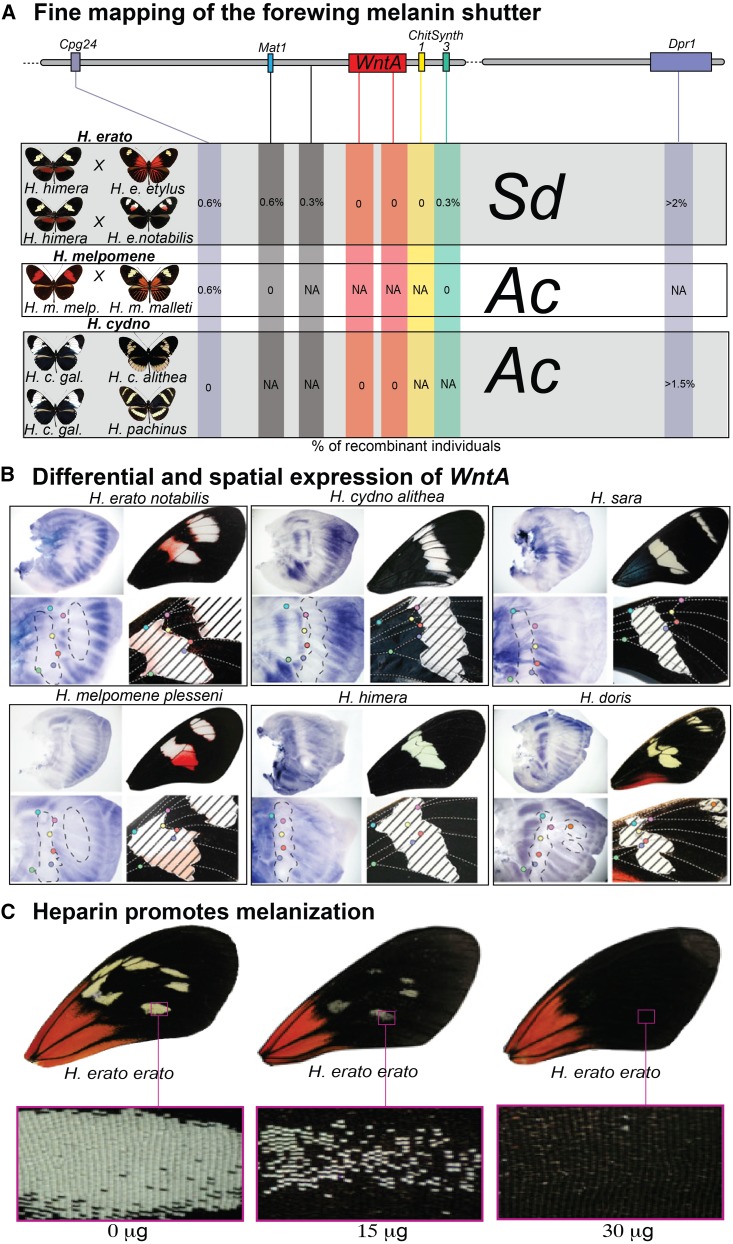
The molecular basis of melanin patterning in Heliconius. (A) Genetic mapping of forewing melanin variation across different families of several Heliconius species (percentage of recombinants at several genes is shown) points to a narrow genomic interval containing the gene WntA (Martin et al. 2012). (B) Spatial expression (in situ hybridization) of WntA on larval wing discs prefigures adult melanin patterning and confirms the role of WntA in forewing black-scale variation (Martin et al. 2012). (C) Pupal injection of heparin sulfate, which is known to extend Wnt signaling, enhances wing melanization (Martin et al. 2012), further supporting the idea that WntA controls melanin patterning in Heliconius.
Figure 6
Figure 6
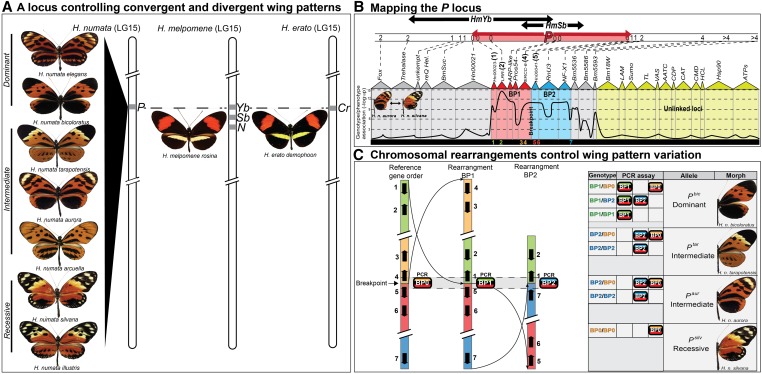
Characterizing the H. numata mimicry supergene. (A) A single Mendelian locus with multiple alleles (the P locus) controls wing-pattern diversity in H. numata. The P locus is positionally homologous to the Yb-Sb-N loci of H. melpomene and the Cr locus of H. erato (Joron et al. 2006b). (B) Fine-mapping and SNP associations narrow the P locus to a 400-kb interval spanning 31 genes and provide evidence of highly reduced recombination (red and blue areas) (Joron et al. 2011). Relative position of the genes (1–7) across the interval that were used to characterize genomic rearrangements is also shown. (C) Allelic variation at the P locus ultimately traces back to an inversion polymorphism with different wing-pattern morphs determined by distinct, nonrecombining haplotypes (Joron et al. 2011). PCR assay of the alternative breakpoints BP0, BP1, and BP2 (left) are perfectly associated with mimicry variation across four distinct morphs in eastern Peru (right).
Figure 7
Figure 7
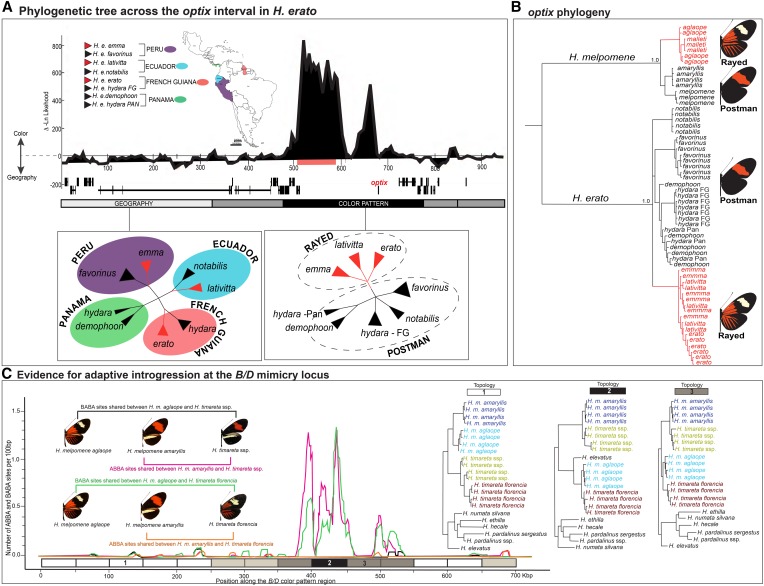
Tracing the evolution of Heliconius mimicry. (A) Genetic variation across most of the genome clusters H. erato races by geography, but the genomic region around optix, which controls red wing patterning, groups races by phenotype (Supple et al. 2013). A similar phenomenon occurs in H. melpomene (Hines et al. 2011). (B) However, wing patterns shared between H. melpomene and H. erato are due to convergent evolution because there is no shared genetic variation between these two distantly related species. (C) Wing-pattern mimicry has been passed among closely related co-mimics H. melpomene, H. timareta, and H. elevatus by interspecific hybridization (Heliconius Genome Consortium 2012). Evidence for adaptive introgression includes an enrichment of shared alleles (ABBA and BABA sites) near optix and phylogenetic clustering among phenotypes across species boundaries (topology 2).

References

    1. Bates H. W., 1862. Contributions to an insect fauna of the Amazon Valley. Lepidoptera: Heliconidae. Trans. Linn. Soc. Lond. 23: 495–566.
    1. Bates H. W., 1864. The Naturalist on the River Amazons. A Record of Adventures, Habits of Animals, Sketches of Brazilian and Indian life, and Aspects of Nature Under the Equator, During Eleven Years of Travel. J. Murray, London.
    1. Baxter S. W., Papa R., Chamberlain N., Humphray S. J., Joron M., et al. , 2008. Convergent evolution in the genetic basis of Mullerian mimicry in Heliconius butterflies. Genetics 180: 1567–1577. - PMC - PubMed
    1. Baxter S. W., Johnston S. E., Jiggins C. D., 2009. Butterfly speciation and the distribution of gene effect sizes fixed during adaptation. Heredity 102: 57–65. - PubMed
    1. Baxter S. W., Nadeau N. J., Maroja L. S., Wilkinson P., Counterman B. A., et al. , 2010. Genomic hotspots for adaptation: the population genetics of Müllerian mimicry in the Heliconius melpomene clade. PLoS Genet. 6: e1000794. - PMC - PubMed

LinkOut - more resources