. 2015 May 8;348(6235):711-4.
doi: 10.1126/science.aaa3526.

Malaria. A forward genetic screen identifies erythrocyte CD55 as essential for Plasmodium falciparum invasion

Affiliations

Malaria. A forward genetic screen identifies erythrocyte CD55 as essential for Plasmodium falciparum invasion

Elizabeth S Egan et al. Science. .

Abstract

Efforts to identify host determinants for malaria have been hindered by the absence of a nucleus in erythrocytes, which precludes genetic manipulation in the cell in which the parasite replicates. We used cultured red blood cells derived from hematopoietic stem cells to carry out a forward genetic screen for Plasmodium falciparum host determinants. We found that CD55 is an essential host factor for P. falciparum invasion. CD55-null erythrocytes were refractory to invasion by all isolates of P. falciparum because parasites failed to attach properly to the erythrocyte surface. Thus, CD55 is an attractive target for the development of malaria therapeutics. Hematopoietic stem cell-based forward genetic screens may be valuable for the identification of additional host determinants of malaria pathogenesis.


Figures

Fig. 1
Fig. 1
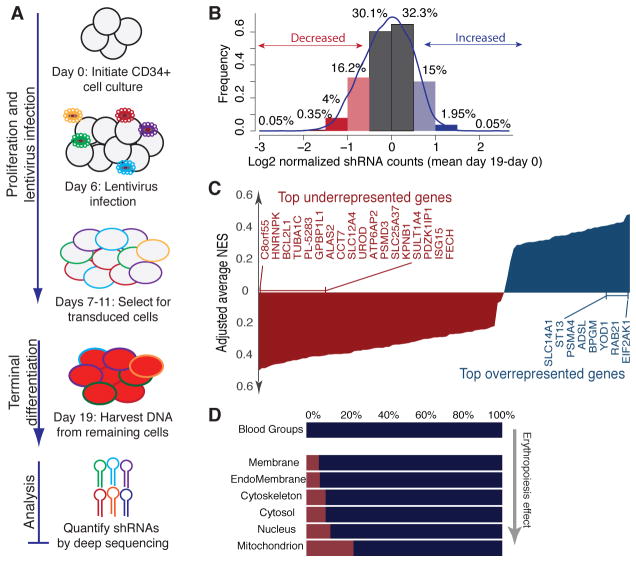
Pooled shRNA screen for genes that regulate terminal erythroid differentiation. (A) Schematic of pooled shRNA screen. CD34+ HSC were induced toward erythroid development, transduced with shRNA library on Day 6 and selected with puromycin. On day 19, shRNA proviruses in orthochromatic erythroblasts were quantified by Illumina sequencing. (B) Change in relative abundance of 5530 shRNAs in erythrocyte proteome library after 19 days of differentiation. (C) RNAi Gene Enrichment Ranking (RIGER) analysis of 116 candidate genes based on magnitude of erythropoiesis phenotype. NES= Normalized Enrichment Score. (D) Predicted localization of library components, with percent of genes that influence erythropoiesis in red.
Fig. 2
Fig. 2
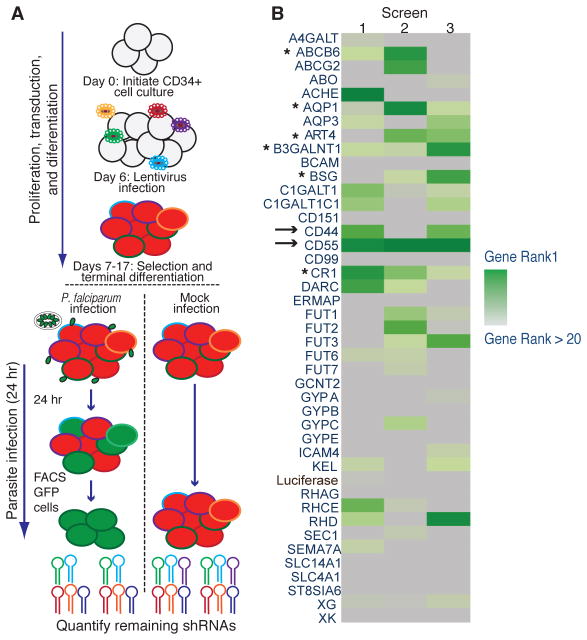
Pooled shRNA screen to identify host determinants of P. falciparum infection. (A) Schematic of blood group shRNA screen. HPCs were transduced with pooled lentivirus library expressing 308 shRNAs targeting 42 blood group genes. Knockdown cRBCs infected with P. falciparum were sorted, and shRNAs were quantified by deep sequencing. (B) RIGER analysis ranking results for three independent experiments. Genes were ranked based on NES scores (green heat map). →, top hits; *, additional candidates.
Fig. 3
Fig. 3
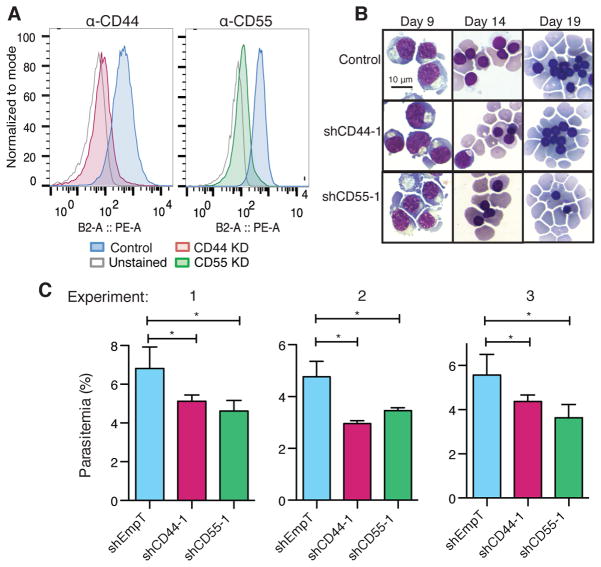
Validation of CD44 and CD55 as host factors required for P. falciparum invasion. (A) CD44 and CD55 levels on day 19/20 cRBCs expressing CD44, CD55, or control shRNAs (EmpT). Detection was by antibody staining and flow cytometry. (B) Morphology of differentiating cRBCs depleted for CD44 and CD55, detected by May-Grünwald and Giemsa staining. (C) P. falciparum strain 3D7 invasion assays in control, CD44 knockdown, and CD55 knockdown cRBCs. Three independent biological replicates from two distinct bone marrow donors are shown. Mean ± SD, n=2 or 3. *, p<0.05, one-tailed t test.
Fig. 4
Fig. 4
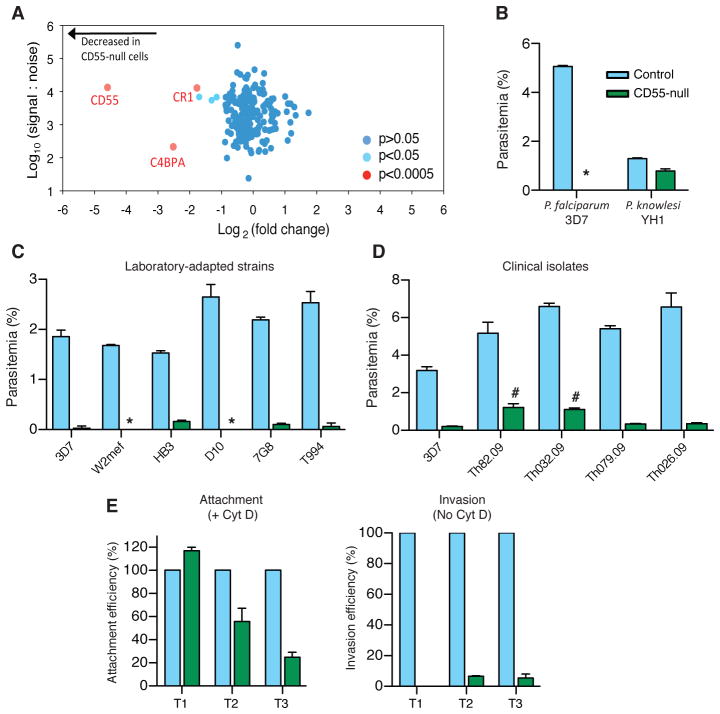
CD55 is a critical host receptor for P. falciparum. (A) Scatter plot of plasma membrane proteins identified by PMP of CD55-null erythrocytes relative to controls from two unrelated individuals, and quantified by > 2 peptides. (B) Invasion of control erythrocytes (blue) or CD55-null erythrocytes (green) by P. falciparum strain 3D7 or P. knowlesi strain YH1. *, below detection. (C) Invasion by laboratory-adapted P. falciparum strains. (D) Invasion by P. falciparum clinical isolates. #, thin smears showed 0.6–1% gametocytes. For B-D: Mean ± SD, N=3. 10,000 cells scored per well by flow cytometry. (E) Efficiency of P. falciparum 3D7 merozoite attachment to the surface of CD55-null (green) versus control (blue) RBCs using cytochalasin D (Cyt D). Invasion was measured in the absence of Cyt D. T1=30 min, T2=60 min, T3=180 min after addition of schizonts (Fig. S10). Attachment to controls at T1 was 3.6–5.3%. Mean ± SD, N=2. 20,000 cells scored per well by flow cytometry.

Comment in

References

    1. Murray CJ, Rosenfeld LC, Lim SS, Andrews KG, Foreman KJ, et al. Global malaria mortality between 1980 and 2010: a systematic analysis. Lancet. 2012;379:413–431. - PubMed
    1. Fairhurst RM, Wellems TE. In: Mandell, Douglas, and Bennett’s Principles and Practice of Infectious Diseases. Mandell GL, Bennett JE, Dolin R, editors. Vol. 2. Livingstone Churchill Elsevier; Philadelphia, PA: 2010. pp. 3437–3462. chap. 275.
    1. Allison AC. Protection afforded by sickle-cell trait against subtertian malareal infection. British medical journal. 1954;1:290–294. - PMC - PubMed
    1. Taylor SM, Fairhurst RM. Malaria parasites and red cell variants: when a house is not a home. Current opinion in hematology. 2014;21:193–200. - PMC - PubMed
    1. Timmann C, Thye T, Vens M, vans JE, May J, et al. Genome-wide association study indicates two novel resistance loci for severe malaria. Nature. 2012;489:443–446. - PubMed

Publication types

MeSH terms