. 2015 Aug 1;24(15):4327-39.
doi: 10.1093/hmg/ddv166. Epub 2015 May 7.

Spatiotemporal dynamics of the postnatal developing primate brain transcriptome

Affiliations

Spatiotemporal dynamics of the postnatal developing primate brain transcriptome

Trygve E Bakken et al. Hum Mol Genet. .

Abstract

Developmental changes in the temporal and spatial regulation of gene expression drive the emergence of normal mature brain function, while disruptions in these processes underlie many neurodevelopmental abnormalities. To solidify our foundational knowledge of such changes in a primate brain with an extended period of postnatal maturation like in human, we investigated the whole-genome transcriptional profiles of rhesus monkey brains from birth to adulthood. We found that gene expression dynamics are largest from birth through infancy, after which gene expression profiles transition to a relatively stable state by young adulthood. Biological pathway enrichment analysis revealed that genes more highly expressed at birth are associated with cell adhesion and neuron differentiation, while genes more highly expressed in juveniles and adults are associated with cell death. Neocortex showed significantly greater differential expression over time than subcortical structures, and this trend likely reflects the protracted postnatal development of the cortex. Using network analysis, we identified 27 co-expression modules containing genes with highly correlated expression patterns that are associated with specific brain regions, ages or both. In particular, one module with high expression in neonatal cortex and striatum that decreases during infancy and juvenile development was significantly enriched for autism spectrum disorder (ASD)-related genes. This network was enriched for genes associated with axon guidance and interneuron differentiation, consistent with a disruption in the formation of functional cortical circuitry in ASD.


Figures

Figure 1.
Figure 1.
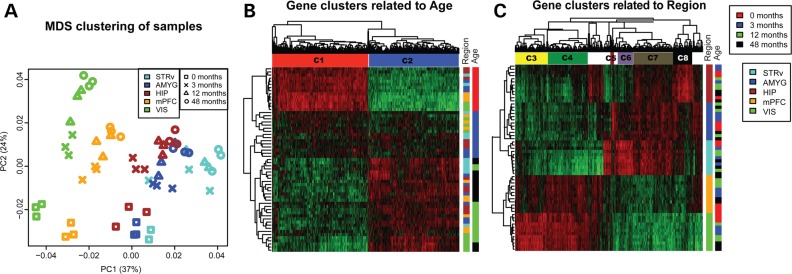
Gene expression is associated with both brain region and development stages. (A) MDS using all genes shows that samples cluster by both region (x-axis) and age (y-axis). Brain regions are illustrated by different shapes, while ages are labeled by different colors. The x- and y-axes represent the first and second PC, respectively, with the percent variance explained by each coordinate in parentheses. (B and C) Heatmap of top 1000 ANOVA genes for age (B) and region (C). Genes are hierarchically clustered along the x-axis, and gene clusters associated with different ages and regions are labeled by horizontal color bars. Samples are clustered along the y-axis and are color coded based both on region (left vertical bars) and age (right vertical bars).
Figure 2.
Figure 2.
Developmental transcriptional profiles common to and unique between brain regions. (A) Venn-diagram shows the overlap of age-associated genes identified in neocortex and the three non-neocortical areas. (B) Overlap between genes DE in visual cortex and medial prefrontal cortex. (C) Heatmaps show age-associated genes unique to each brain region. Samples are in columns and ordered by age. Genes are presented on the rows, sorted such that genes decreasing with age are on top and genes increasing with age are at the bottom. Gene symbols for selected transcription factors are displayed in the right margins. Red indicates high expression and green indicates low expression.
Figure 3.
Figure 3.
WGCNA identified modules predominately associated with region and age. Heatmap plot shows the correlation between MEs and age (A) or region (B). Modules were hierarchically clustered and sorted along the x-axis based on their eigengene–trait relationships. Traits were likewise sorted along the y-axis. Red indicates positive correlation, while blue shows negative correlation.
Figure 4.
Figure 4.
Expression patterns of modules associated with ages and regions. Line plot for four modules related to region (A) and four related to age (B). The left plots show the developmental profiles of each module, plotted separately for each brain region (using different colors). X-axes show the developmental stages, while y-axes show the value of eigengene (PC1) for each module. Adjacent plots show the top 5 GO pathways associated with each module, with some redundant categories filtered. Bars show the significance of each category. Vertical red lines indicate nominal P = 0.05.
Figure 5.
Figure 5.
Module M12 is associated with ASD candidate genes. (A) VisANT plot showing the top 200 connections in M12. The hub genes, which have more connections, are displayed in the inner circle. Purple nodes indicate genes identified as ASD candidate genes from SFARI Base, with the remaining nodes shown in green. (B) Heatmap of the expression patterns for two hub genes in module M12. Cell colors show the average expression of samples from the specified age (y-axis) and region (x-axis).

References

    1. Huttenlocher P.R., Dabholkar A.S. (1997) Regional differences in synaptogenesis in human cerebral cortex. J. Comp. Neurol., 387, 167–178. - PubMed
    1. Bourgeois J.P., Goldman-Rakic P.S., Rakic P. (1994) Synaptogenesis in the prefrontal cortex of rhesus monkeys. Cereb. Cortex, 4, 78–96. - PubMed
    1. Paus T., Keshavan M., Giedd J.N. (2008) Why do many psychiatric disorders emerge during adolescence? Nat. Rev. Neurosci., 9, 947–957. - PMC - PubMed
    1. Kang H.J., Kawasawa Y.I., Cheng F., Zhu Y., Xu X., Li M., Sousa A.M.M., Pletikos M., Meyer K.a., Sedmak G., et al. (2011) Spatio-temporal transcriptome of the human brain. Nature, 478, 483–489. - PMC - PubMed
    1. Colantuoni C., Lipska B.K., Ye T., Hyde T.M., Tao R., Leek J.T., Colantuoni E.A., Elkahloun A.G., Herman M.M., Weinberger D.R., et al. (2011) Temporal dynamics and genetic control of transcription in the human prefrontal cortex. Nature, 478, 519–523. - PMC - PubMed

Publication types

MeSH terms