


Emerging viral disease risk to pollinating insects: ecological, evolutionary and anthropogenic factors
- PMID: 25954053
- PMCID: PMC4415536
- DOI: 10.1111/1365-2664.12385
Emerging viral disease risk to pollinating insects: ecological, evolutionary and anthropogenic factors
Abstract
The potential for infectious pathogens to spillover and emerge from managed populations to wildlife communities is poorly understood, but ecological, evolutionary and anthropogenic factors are all likely to influence the initial exposure and subsequent infection, spread and impact of disease. Fast-evolving RNA viruses, known to cause severe colony losses in managed honeybee populations, deserve particular attention for their propensity to jump between host species and thus threaten ecologically and economically important wild pollinator communities. We review the literature on pollinator viruses to identify biological and anthropogenic drivers of disease emergence, highlight gaps in the literature, and discuss potential management strategies. We provide evidence that many wild pollinator species are exposed to viruses from commercial species, resulting in multiple spillover events. However, it is not clear whether species become infected as a result of spillover or whether transmission is occurring within these wild populations. Ecological traits of pollinating insects, such as overlapping ranges, niches and behaviours, clearly promote cross-species transmission of RNA viruses. Moreover, we conclude that the social behaviour and phylogenetic relatedness of social pollinators further facilitate within- and between-host transmission, leaving these species particularly vulnerable to emerging diseases. We argue that the commercial use of pollinators is a key driver of disease emergence in these beneficial insects and that this must be addressed by management and policy. Synthesis and applications. There are important knowledge gaps, ranging from disease distribution and prevalence, to pathogen life history and virulence, to the impacts of disease emergence, which need to be addressed as research priorities. It is clear that avoiding anthropogenic pathogen spillover is crucial to preventing and managing disease emergence in pollinators, with far-reaching effects on our food security, ecosystem services and biodiversity. We argue that it is crucial to prevent the introduction of diseased pollinators into natural environments, which can be achieved through improved monitoring and management practices.
Keywords: RNA viruses; anthropogenic; biological risk factors; emerging disease; infection; multihost pathogens; niche overlap; pollination; pollinators; transmission.
Figures
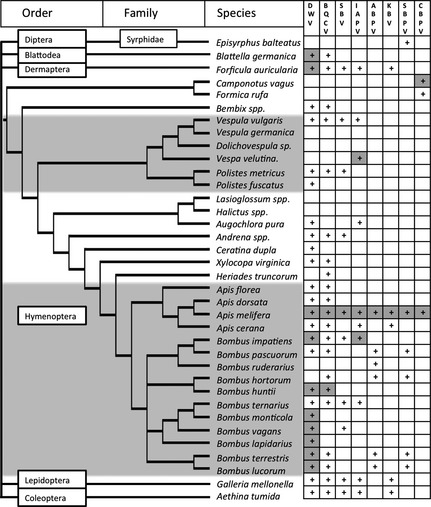
 ’ indicates virus replication has been demons trated. Virus abbreviations: DWV, deformed wing virus; BQCV, black queen cell virus; SBV, sacbrood virus; IAPV, Israeli acute paralysis virus; ABPV, acute bee paralysis virus; KBV, Kashmir bee virus; SBPV, slow bee paralysis virus; CBPV, chronic bee paralysis virus. Note that some data are based on small sample sizes, see Table S4.
References
-
- Baer, B. & Schmid‐Hempel, P. (1999) Experimental variation in polyandry affects parasite loads and fitness in a bumblebee. Nature, 397, 151–153.
-
- Baranowski, E. , Ruiz‐Jarabo, C. & Domingo, E. (2001) Evolution of cell recognition by viruses. Science, 292, 1102–1105. - PubMed
-
- Birmingham, A. , Hoover, S.E. , Winston, M.L. & Ydenberg, R.C. (2004) Drifting bumble bee (Hymenoptera: Apidae) workers in commercial greenhouses may be social parasites. Canadian Journal of Zoology, 82, 1843–1853.
-
- Branquart, E. & Hemptinne, J. (2000) Selectivity in the exploitation of floral resources by hoverflies (Diptera: Syrphinae). Ecography, 23, 732–742.
-
- Brown, M.J.F. (2011) Conservation: the trouble with bumblebees. Nature, 469, 169–170. - PubMed
Publication types
LinkOut - more resources
Full Text Sources
Other Literature Sources