Review
. 2015 Apr 21:7:52.
doi: 10.3389/fnagi.2015.00052. eCollection 2015.

Long-chain omega-3 fatty acids and the brain: a review of the independent and shared effects of EPA, DPA and DHA

Affiliations
Review

Long-chain omega-3 fatty acids and the brain: a review of the independent and shared effects of EPA, DPA and DHA

Simon C Dyall. Front Aging Neurosci. .

Abstract

Omega-3 polyunsaturated fatty acids (PUFAs) exhibit neuroprotective properties and represent a potential treatment for a variety of neurodegenerative and neurological disorders. However, traditionally there has been a lack of discrimination between the different omega-3 PUFAs and effects have been broadly accredited to the series as a whole. Evidence for unique effects of eicosapentaenoic acid (EPA), docosahexaenoic acid (DHA) and more recently docosapentaenoic acid (DPA) is growing. For example, beneficial effects in mood disorders have more consistently been reported in clinical trials using EPA; whereas, with neurodegenerative conditions such as Alzheimer's disease, the focus has been on DHA. DHA is quantitatively the most important omega-3 PUFA in the brain, and consequently the most studied, whereas the availability of high purity DPA preparations has been extremely limited until recently, limiting research into its effects. However, there is now a growing body of evidence indicating both independent and shared effects of EPA, DPA and DHA. The purpose of this review is to highlight how a detailed understanding of these effects is essential to improving understanding of their therapeutic potential. The review begins with an overview of omega-3 PUFA biochemistry and metabolism, with particular focus on the central nervous system (CNS), where DHA has unique and indispensable roles in neuronal membranes with levels preserved by multiple mechanisms. This is followed by a review of the different enzyme-derived anti-inflammatory mediators produced from EPA, DPA and DHA. Lastly, the relative protective effects of EPA, DPA and DHA in normal brain aging and the most common neurodegenerative disorders are discussed. With a greater understanding of the individual roles of EPA, DPA and DHA in brain health and repair it is hoped that appropriate dietary recommendations can be established and therapeutic interventions can be more targeted and refined.

Keywords: Alzheimer’s disease; Parkinson’s disease; aging; docosahexaenoic acid; docosapentaenoic acid; eicosapentaenoic acid; omega-3 fatty acids.


Figures
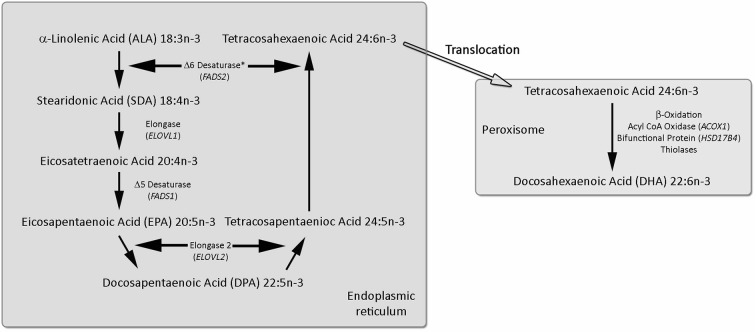
Figure 1
Figure 1
Synthesis of EPA, DPA and DHA from ALA. The longer chain omega-3 polyunsaturated fatty acids (PUFAs) are synthesized from ALA by a progressive series of enzymatic desaturation and chain elongation steps, initially in the endoplasmic reticulum. In the final stage tetracosahexaenoic acid (24:6n-3) is translocated to the peroxisome and is shorted by one cycle of the β-oxidation pathway to form DHA (22:6n-3). For further details refer to the text. Figure adapted from Dyall and Michael-Titus (2008).
Figure 2
Figure 2
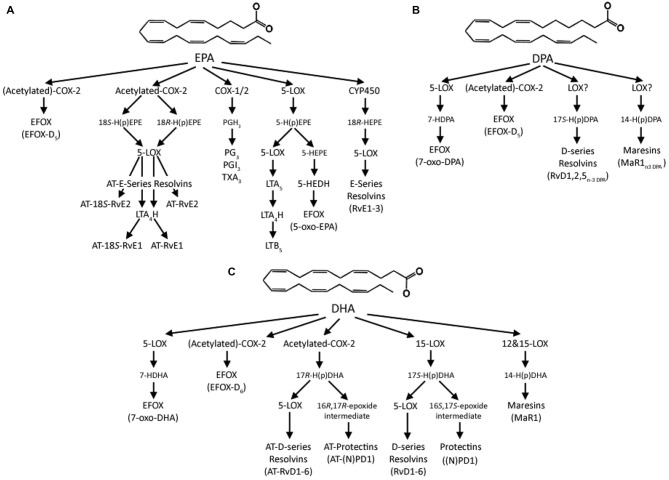
Summary of the lipid mediators derived from (A) EPA, (B) DPA and (C) DHA. In the classical “canonical” pathway EPA is initially converted to the intermediate prostaglandin G2 (PGG2) by either COX-1 or -2 and then enzymatically to the 3 series prostaglandins, prostacylcins or thromboxanes. EPA can also be converted by 5-lipoxygenase (LOX) to 5-hydroperoxyeicosapenataenoic acid (5-H(p)EPE), which can then either be converted by 5-LOX to leukotriene A5 (LTA5) and then by Leukotriene A4 Hydrolase (LTA4) to leukotriene B5 (LTB5) or to 5-hydroxyeicosapentaenoic acid (5-HEPE), which is then converted into 5-oxo-EPA by 5-hydroxyeicosanoid dehydrogenase (5-HEDH). EPA can also be sequentially converted by cytochrome P450 (CYP450) enzymes to 18R-hydroxyeicosapentaenoic acid (18R-HEPE) and then by 5-LOX to E-series resolvins (RvE). COX-2 can also convert EPA to the electrophilic fatty acid oxo-derivative electrophilic fatty acid oxo-derivates (EFOX)-D5, in a process enhanced by aspirin acetylation of COX-2. Aspirin acetylation of COX-2 also produces 18S- and 18R-hydroperoxyeicosapentaenoic acids (18S-, or 18R-HETE) from EPA, which are either converted by 5-LOX to aspirin-triggered 18S-resolvin E1 and resolvin E1 (AT-18S-RvE1 and AT-RvE1), respectively, or through an extra step by LTA4H to AT-18S-RvE2 and AT-RvE2. Analogous series of resolvins, maresins, and EFOXs produced from DPA to those from DHA have recently been identified; however, the nature of the enzymatic conversions remains to be elucidated. DHA is converted to 17S-hydroperoxydocosahexaenoic acid (17S-H(p)DHA) by 15-LOX, which is converted by 5-LOX to D-series resolvins (RvD), or enzymatically hydrolysed to (neuro)protectin D1 ((N)PD1. DHA can also be converted by 12 or 15-LOX via 14-hydroperoxydocosahexaenoic acid (14-H(p)DHA) to the maresins. DHA can also be converted by 5-LOX to 7-hydroxydocosahexaenoic acid (7-HDHA) and then by a dehydrogenase to 7-oxo-DHA, with 5-HEDH a likely candidate, or by COX-2 to EFOX-D6, which is enhanced by aspirin acetylation. Acetylation also produces 17R-hydroperoxyDHA, which can then be converted to aspirin triggered resolvins and protectins.

References

    1. Able J. A., Liu Y., Jandacek R., Rider T., Tso P., McNamara R. K. (2014). Omega-3 fatty acid deficient male rats exhibit abnormal behavioral activation in the forced swim test following chronic fluoxetine treatment: association with altered 5-HT1A and alpha2A adrenergic receptor expression. J. Psychiatr Res. 50, 42–50. 10.1016/j.jpsychires.2013.11.008 - DOI - PMC - PubMed
    1. Akbar M., Calderon F., Wen Z., Kim H. Y. (2005). Docosahexaenoic acid: a positive modulator of Akt signaling in neuronal survival. Proc. Natl. Acad. Sci. U S A 102, 10858–10863. 10.1073/pnas.0502903102 - DOI - PMC - PubMed
    1. Ames B. N. (2004). Delaying the mitochondrial decay of aging. Ann. N Y Acad. Sci. 1019, 406–411. 10.1196/annals.1297.073 - DOI - PubMed
    1. Anderton B. H. (2002). Ageing of the brain. Mech. Ageing Dev. 123, 811–817. 10.1016/S0047-6374(01)00426-2 - DOI - PubMed
    1. Anderson B. M., Ma D. W. (2009). Are all n-3 polyunsaturated fatty acids created equal? Lipids Health Dis. 8:33. 10.1186/1476-511x-8-33 - DOI - PMC - PubMed