


The EHR's roles in collaboration between providers: A qualitative study
- PMID: 25954444
- PMCID: PMC4419964
The EHR's roles in collaboration between providers: A qualitative study
Abstract
Objective: Examine how the Electronic Health Record (EHR) and its related systems support or inhibit provider collaboration.
Background: Health care systems in the US are simultaneously implementing EHRs and transitioning to more collaborative delivery systems; this study examines the interaction between these two changes.
Methods: This qualitative study of five US EHR implementations included 49 interviews and over 60 hours of provider observation. We examined the role of the EHR in building relationships, communicating, coordinating, and collaborative decision-making.
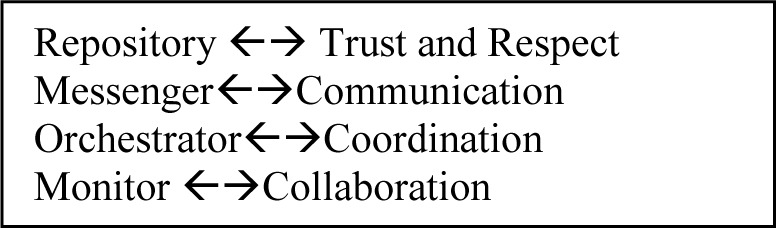
Results: The EHR plays four roles in collaboration: a repository, a messenger, an orchestrator, and a monitor. While EHR performance varied, common themes were decreased trust due to poor quality documentation, incomplete communication, potential for increased effectiveness through better coordination, and the emerging role of the EHR in identifying performance gaps.
Conclusion: Both organizational and technical innovations are needed if the EHR is to truly support collaborative behaviors.
Figures
References
-
- Bodenheimer T, Wagner EH, Grumbach K. Improving primary care for patients with chronic disease. JAMA. 2002;288(14):1775–1779. - PubMed
-
- Merriam-Webster Merriam-Webster Online Dictionary. Available at: http://www.merriam-webster.com/dictionary/collaborate. Accessed August 4, 2013.
-
- Zillich AJ, Doucette WR, Carter BL, Kreiter CD. Development and initial validation of an instrument to measure physician-pharmacist collaboration from the physician perspective. Value in Health. 2005 Jan-Feb;8(1):59–66. - PubMed
-
- Stock R. Developing Team Based Care. 2013. Available at: http://www.pcpci.org/resources/webinars/developing-team-based-care-in-pa.... Accessed March 11, 2014.