


Enzymatic C(sp3)-H Amination: P450-Catalyzed Conversion of Carbonazidates into Oxazolidinones
- PMID: 25954592
- PMCID: PMC4416466
- DOI: 10.1021/cs5018612
Enzymatic C(sp3)-H Amination: P450-Catalyzed Conversion of Carbonazidates into Oxazolidinones
Abstract
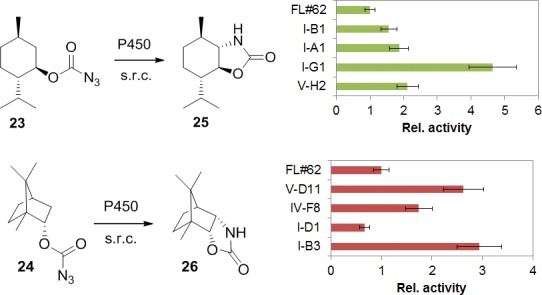
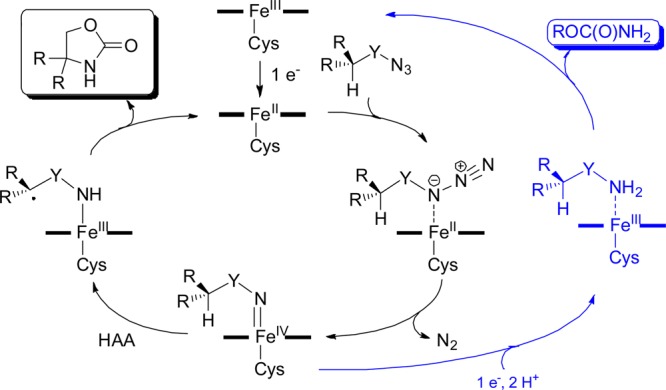
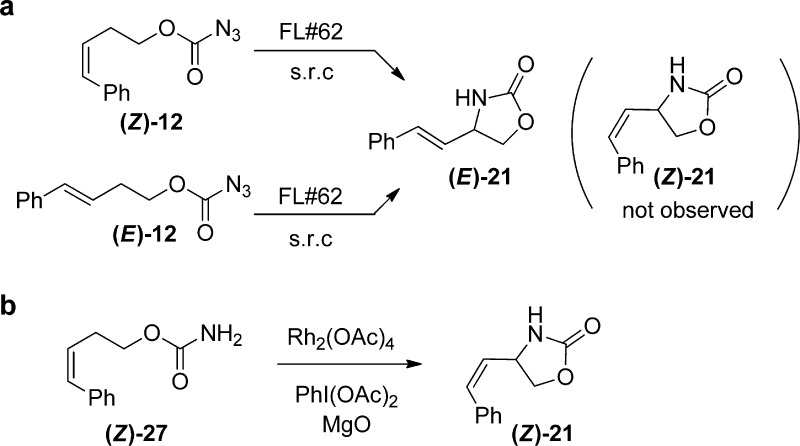
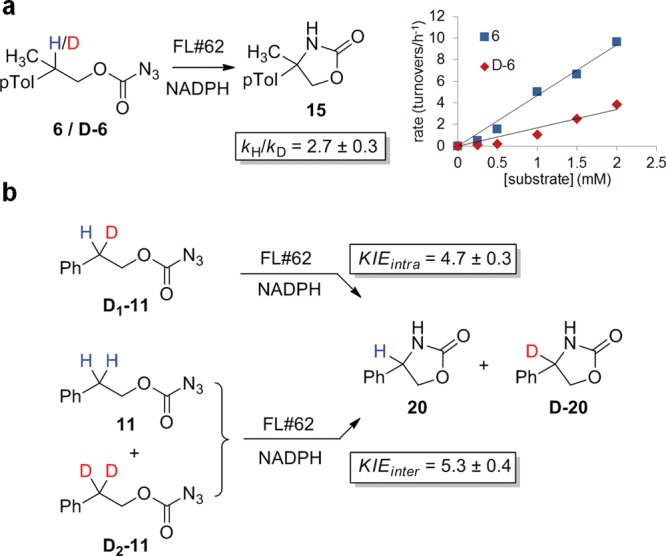
Cytochrome P450 enzymes can effectively promote the activation and cyclization of carbonazidate substrates to yield oxazolidinones via an intramolecular nitrene C-H insertion reaction. Investigation of the substrate scope shows that while benzylic/allylic C-H bonds are most readily aminated by these biocatalysts, stronger, secondary C-H bonds are also accessible to functionalization. Leveraging this "non-native" reactivity and assisted by fingerprint-based predictions, improved active-site variants of the bacterial P450 CYP102A1 could be identified to mediate the aminofunctionalization of two terpene natural products with high regio- and stereoselectivity. Mechanistic studies and KIE experiments show that the C-H activation step in these reactions is rate-limiting and proceeds in a stepwise manner, namely, via hydrogen atom abstraction followed by radical recombination. This study expands the reactivity scope of P450-based catalysts in the context of nitrene transfer transformations and provides first-time insights into the mechanism of P450-catalyzed C-H amination reactions.
Keywords: C−H amination; biocatalysis; carbonazidate; cytochrome P450; oxazolidinones.
Figures
References
-
- Wilson M. E.; Whitesides G. M. J. Am. Chem. Soc. 1978, 100, 306–307 10.1021/ja00469a064. - DOI
Grants and funding
LinkOut - more resources
Full Text Sources
Other Literature Sources