. 2015 May 8:5:10320.
doi: 10.1038/srep10320.

Selectivity Mechanism of the Voltage-gated Proton Channel, HV1

Affiliations

Selectivity Mechanism of the Voltage-gated Proton Channel, HV1

Todor Dudev et al. Sci Rep. .

Abstract

Voltage-gated proton channels, HV1, trigger bioluminescence in dinoflagellates, enable calcification in coccolithophores, and play multifarious roles in human health. Because the proton concentration is minuscule, exquisite selectivity for protons over other ions is critical to HV1 function. The selectivity of the open HV1 channel requires an aspartate near an arginine in the selectivity filter (SF), a narrow region that dictates proton selectivity, but the mechanism of proton selectivity is unknown. Here we use a reduced quantum model to elucidate how the Asp-Arg SF selects protons but excludes other ions. Attached to a ring scaffold, the Asp and Arg side chains formed bidentate hydrogen bonds that occlude the pore. Introducing H3O(+) protonated the SF, breaking the Asp-Arg linkage and opening the conduction pathway, whereas Na(+) or Cl(-) was trapped by the SF residue of opposite charge, leaving the linkage intact, thus preventing permeation. An Asp-Lys SF behaved like the Asp-Arg one and was experimentally verified to be proton-selective, as predicted. Hence, interacting acidic and basic residues form favorable AspH(0)-H2O(0)-Arg(+) interactions with hydronium but unfavorable Asp(-)-X(-)/X(+)-Arg(+) interactions with anions/cations. This proposed mechanism may apply to other proton-selective molecules engaged in bioenergetics, homeostasis, and signaling.


Figures
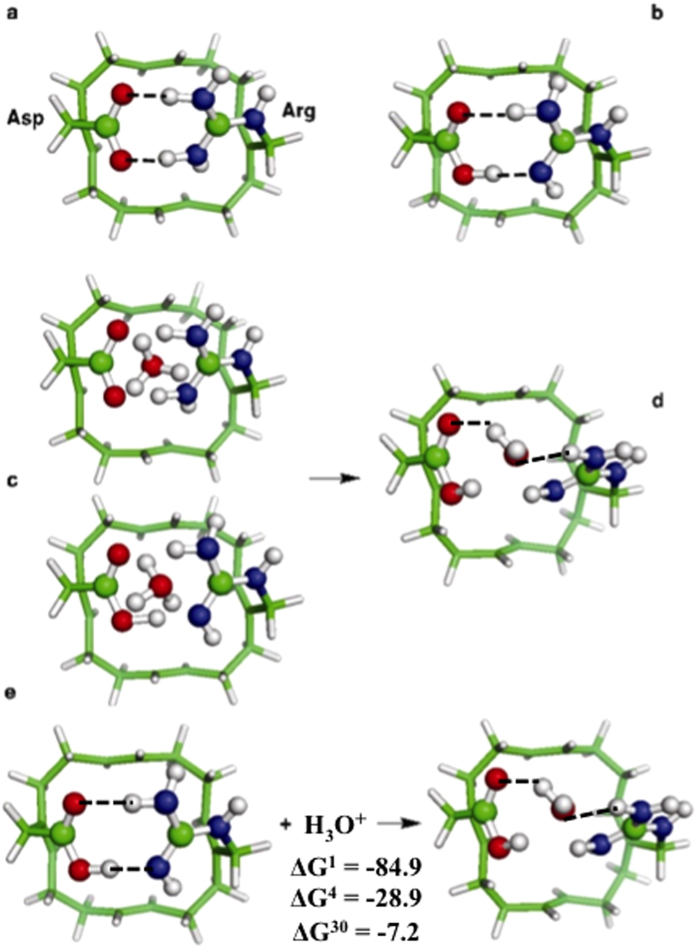
Figure 1
Figure 1. Binding of H3O+ to the Asp–Arg SF.
Fully optimized B3-LYP/6-31+G(3d,p) structures of (a) ion-free Asp–Arg+ SF, (b) Asp0–Arg0 SF, (c) initial configurations of the SF-H3O+ complex and (d) final configuration of the SF–H3O+ complex, AspH0–H2O–Arg+ with H in grey, C in green, N in blue and O in red. A dashed line denotes a hydrogen bond, which is defined by a donor–acceptor distance ≤3.5 Å and a H–acceptor distance ≤2.5 Å. The reaction between SF and H3O+ is depicted in (e) with free energies given in kcal/mol; ΔG1 is the binding free energy in the gas phase, whereas ΔG4 and ΔG30 are the corresponding free energies in the SF characterized by an effective dielectric constant of 4 and 30, respectively.
Figure 2
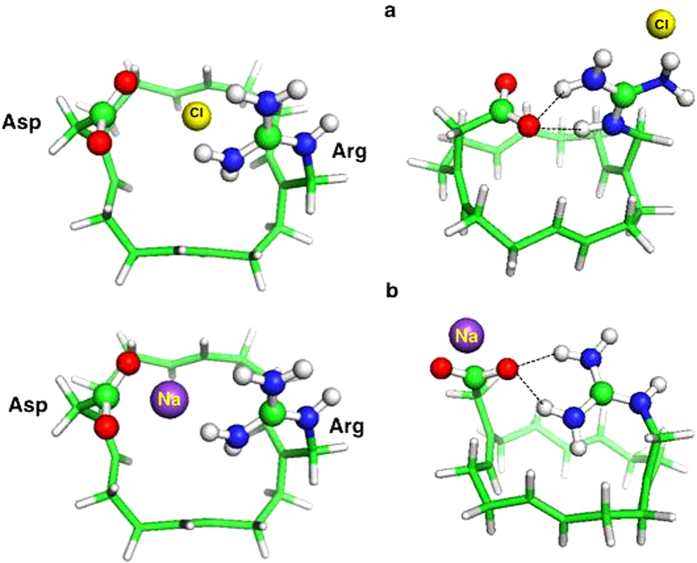
Figure 2. Binding of Cl and Na+ to Asp–Arg SF.
Ball and stick diagrams of the initial (left) and final (right) structures of SF complexes with (a) Cl and (b) Na+.
Figure 3
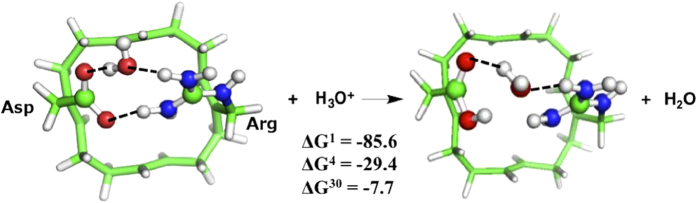
Figure 3. Free energies (in kcal/mol) for replacing H2O bound in Asp–Arg SF with H3O+.
See Fig. 1 legend.
Figure 4
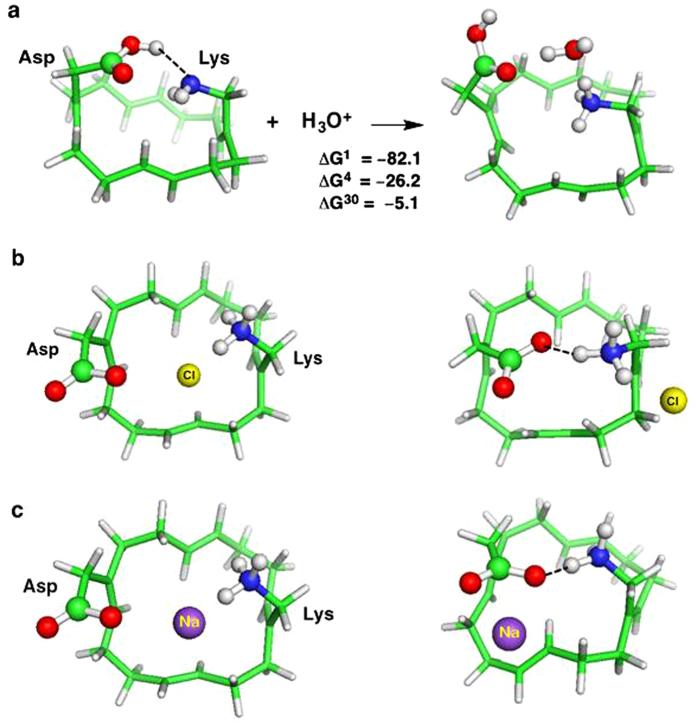
Figure 4. (a) Free energies (in kcal/mol) for binding of H3O+ to Lys mutant SF.
Ball and stick diagrams of the initial (left) and final (right) structures of Arg → Lys mutant SF complexes with Cl (b) and Na+ (c). See Fig. 1 legend.
Figure 5
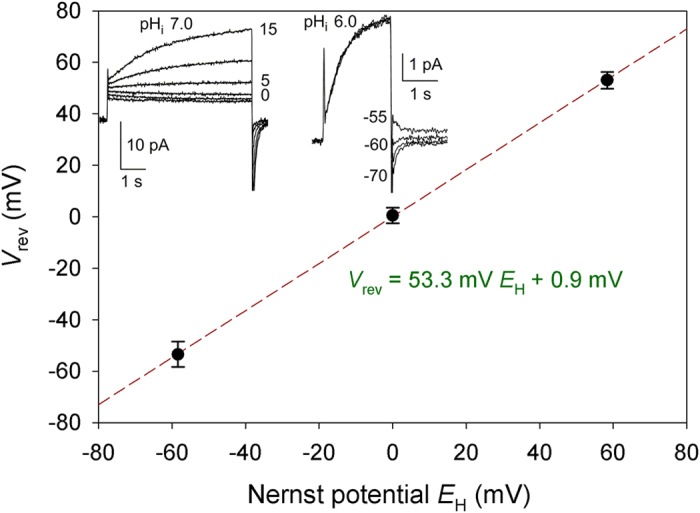
Figure 5. The Lys208 mutant is proton selective.
Measured values of Vrev at ΔpH –1.0, 0, or 1.0 (mean ± SEM, n = 3, 9, or 6, respectively), with pHo ranging 5.5 to 7.0 and pHi ranging 5.5 to 8.0. The linear regression slope was 53.3 mV/unit ΔpH, compared with the Nernst value of 58.4 mV. Inset: Proton currents in an inside out patch during pulses applied in 5 mV increments (left) indicate reversal between 0 and 5 mV (the conductance activated negative to Vrev) at pHi 7.0, with pHo 7.0 (in the pipette). Tail currents in the same patch at pHi 6.0 indicate reversal at –58 mV. Both values are near the Nernst predictions of 0 mV and –58.4 mV.
Figure 6
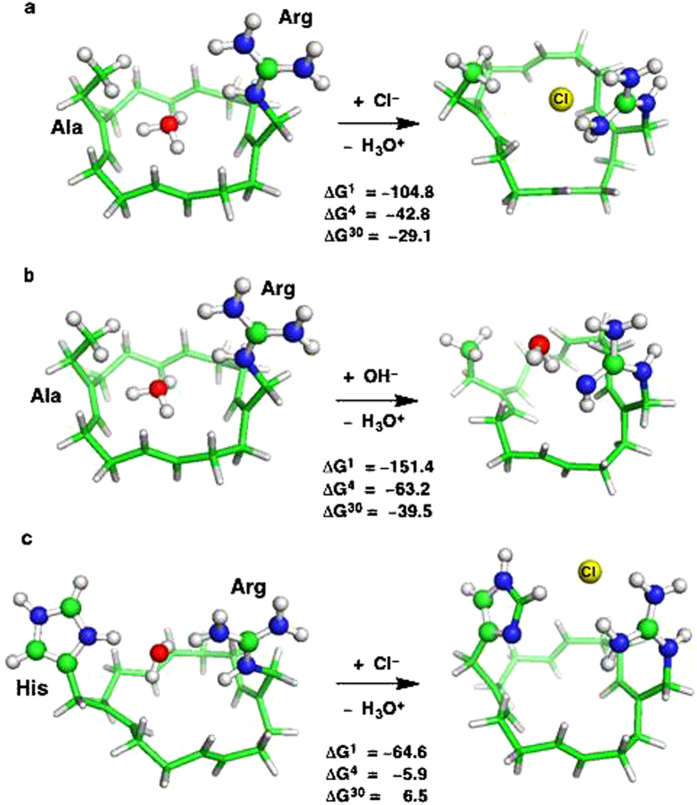
Figure 6. Binding of Cl and/or OH to H3O+-bound mutant SFs.
B3LYP/6-31+G(3d,p) fully optimized structures of H3O+–SF, Cl–SF and OH–SF complexes, and free energies (in kcal/mol) for (a) [SF(Ala-Arg+)-H3O+] + Cl → [SF(Ala-Arg+)-Cl] + H3O+, (b) [SF(Ala-Arg+)-H3O+] + OH → [SF(Ala-Arg+)-OH] + H3O+, and (c) [SF(His-Arg+)-H3O+] + Cl → [SF(His-Arg+)-Cl] + H3O+. ΔG1 is the ion exchange free energy in the gas phase, whereas ΔG4 and ΔG30 are the corresponding free energies in the SF characterized by an effective dielectric constant of 4 and 30, respectively. If the resulting free energy is negative, the pore is Cl or OH-selective, but if it is positive, the pore is proton-selective.
Figure 7
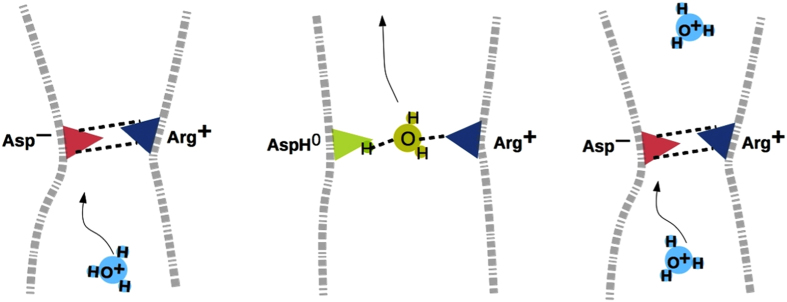
Figure 7. Schematic cartoon of the proposed proton selectivity mechanism by the HV1 SF.
Negatively charged Asp is red, neutral AspH0 and H2O0 are green, whereas positively charged H3O+ and Arg are light and dark blue, respectively. The dashed lines denote hydrogen bonds or salt bridges that occlude the SF pore. When H3O+ approaches the SF (left), it breaks the hydrogen bonds and protonates the SF, resulting in neutral H2O bridging AspH0 and Arg+ (middle). Transfer of a proton from the SF to H2O completes the conduction cycle (right).
Figure 8
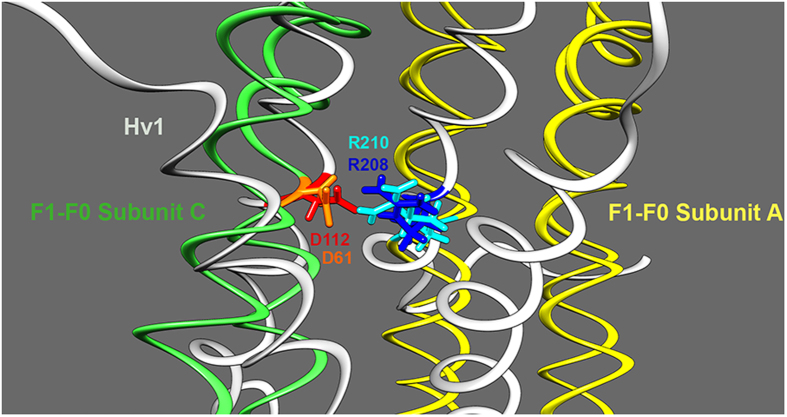
Figure 8. A critical Asp-Arg pair in F1-Fo ATPase shares similar geometry to that in HV1.
Based on a homology model of HV1 in the open state and the crystal structure of F1-Fo ATPase (PDB ID 1C17), Asp112 in HV1 was superimposed onto Asp61 of F1-Fo subunit c using Chimera, which minimizes the root-mean-square deviations of superimposed atoms. This resulted in Arg208 of HV1 occupying a similar position to Arg210 of F1-Fo subunit a, which is known to participate in proton translocation.

References

    1. DeCoursey T. E. Voltage-gated proton channels: molecular biology, physiology, and pathophysiology of the HV family. Physiol. Rev. 93, 599–652, doi: 10.1152/physrev.00011.2012 (2013). - DOI - PMC - PubMed
    1. DeCoursey T. E., Morgan D. & Cherny V. V. The voltage dependence of NADPH oxidase reveals why phagocytes need proton channels. Nature 422, 531–534, doi: 10.1038/nature01523 (2003). - DOI - PubMed
    1. Henderson L. M., Chappell J. B. & Jones O. T. G. The superoxide-generating NADPH oxidase of human neutrophils is electrogenic and associated with an H+ channel. Biochem. J. 246, 325–329 (1987). - PMC - PubMed
    1. Iovannisci D., Illek B. & Fischer H. Function of the HVCN1 proton channel in airway epithelia and a naturally occurring mutation, M91T. J. Gen. Physiol. 136, 35–46, doi: 10.1085/jgp.200910379 (2010). - DOI - PMC - PubMed
    1. Musset B. et al. A pH-stabilizing role of voltage-gated proton channels in IgE-mediated activation of human basophils. Proc. Natl. Acad. Sci. USA 105, 11020–11025, doi: 10.1073/pnas.0800886105 (2008). - DOI - PMC - PubMed

Publication types

LinkOut - more resources