


Biased Exposure-Health Effect Estimates from Selection in Cohort Studies: Are Environmental Studies at Particular Risk?
- PMID: 25956004
- PMCID: PMC4629739
- DOI: 10.1289/ehp.1408888
Biased Exposure-Health Effect Estimates from Selection in Cohort Studies: Are Environmental Studies at Particular Risk?
Abstract
Background: The process of creating a cohort or cohort substudy may induce misleading exposure-health effect associations through collider stratification bias (i.e., selection bias) or bias due to conditioning on an intermediate. Studies of environmental risk factors may be at particular risk.
Objectives: We aimed to demonstrate how such biases of the exposure-health effect association arise and how one may mitigate them.
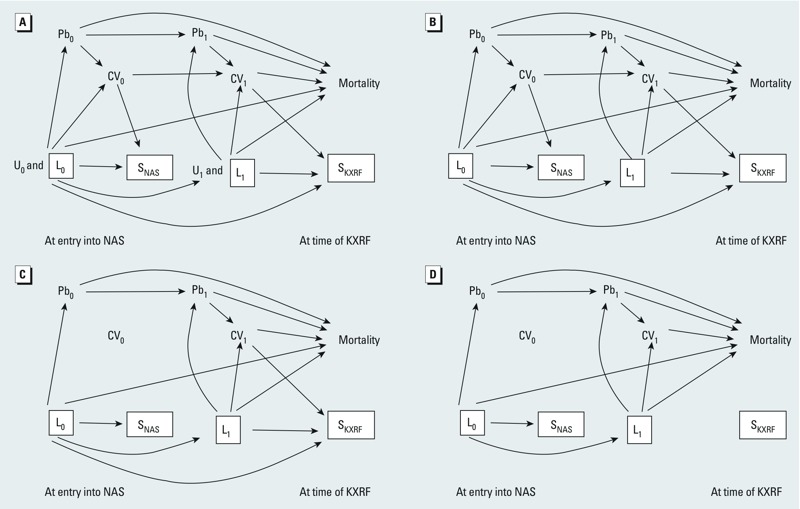
Methods: We used directed acyclic graphs and the example of bone lead and mortality (all-cause, cardiovascular, and ischemic heart disease) among 835 white men in the Normative Aging Study (NAS) to illustrate potential bias related to recruitment into the NAS and the bone lead substudy. We then applied methods (adjustment, restriction, and inverse probability of attrition weighting) to mitigate these biases in analyses using Cox proportional hazards models to estimate adjusted hazard ratios (HRs) and 95% confidence intervals (CIs).
Results: Analyses adjusted for age at bone lead measurement, smoking, and education among all men found HRs (95% CI) for the highest versus lowest tertile of patella lead of 1.34 (0.90, 2.00), 1.46 (0.86, 2.48), and 2.01 (0.86, 4.68) for all-cause, cardiovascular, and ischemic heart disease mortality, respectively. After applying methods to mitigate the biases, the HR (95% CI) among the 637 men analyzed were 1.86 (1.12, 3.09), 2.47 (1.23, 4.96), and 5.20 (1.61, 16.8), respectively.
Conclusions: Careful attention to the underlying structure of the observed data is critical to identifying potential biases and methods to mitigate them. Understanding factors that influence initial study participation and study loss to follow-up is critical. Recruitment of population-based samples and enrolling participants at a younger age, before the potential onset of exposure-related health effects, can help reduce these potential pitfalls.
Citation: Weisskopf MG, Sparrow D, Hu H, Power MC. 2015. Biased exposure-health effect estimates from selection in cohort studies: are environmental studies at particular risk? Environ Health Perspect 123:1113-1122; http://dx.doi.org/10.1289/ehp.1408888.
Conflict of interest statement
The authors declare they have no actual or potential competing financial interests.
Figures


Comment in
-
Bias in Environmental Cohort Studies: The Example of Bone Lead and Mortality.Environ Health Perspect. 2015 Nov;123(11):A288. doi: 10.1289/ehp.123-A288. Environ Health Perspect. 2015. PMID: 26524143 Free PMC article. No abstract available.
References
-
- Alonso A, Mosley TH, Jr, Gottesman RF, Catellier D, Sharrett AR, Coresh J. Risk of dementia hospitalisation associated with cardiovascular risk factors in midlife and older age: the Atherosclerosis Risk in Communities (ARIC) study. J Neurol Neurosurg Psychiatry. 2009;80(11):1194–1201. - PMC - PubMed
-
- Andersen PK, Keiding N. Interpretability and importance of functionals in competing risks and multistate models. Stat Med. 2012;31(11–12):1074–1088. - PubMed
-
- Bell B, Rose CL, Damon A. The Normative Aging Study: an interdisciplinary and longitudinal study of health and aging. Int J Aging Hum Dev. 1972;3(1):5–17.
-
- Chaix B, Evans D, Merlo J, Suzuki E. Commentary: Weighing up the dead and missing: reflections on inverse-probability weighting and principal stratification to address truncation by death. Epidemiology. 2012;23(1):129–131. - PubMed
Publication types
MeSH terms
Substances
Grants and funding
LinkOut - more resources
Full Text Sources
Other Literature Sources