Review
. 2015 Aug:32:24-32.
doi: 10.1016/j.dnarep.2015.04.010. Epub 2015 Apr 30.

Exonuclease 1-dependent and independent mismatch repair

Affiliations
Review

Exonuclease 1-dependent and independent mismatch repair

Eva M Goellner et al. DNA Repair (Amst). 2015 Aug.

Abstract

DNA mismatch repair (MMR) acts to repair mispaired bases resulting from misincorporation errors during DNA replication and also recognizes mispaired bases in recombination (HR) intermediates. Exonuclease 1 (Exo1) is a 5' → 3' exonuclease that participates in a number of DNA repair pathways. Exo1 was identified as an exonuclease that participates in Saccharomyces cerevisiae and human MMR where it functions to excise the daughter strand after mispair recognition, and additionally Exo1 functions in end resection during HR. However, Exo1 is not absolutely required for end resection during HR in vivo. Similarly, while Exo1 is required in MMR reactions that have been reconstituted in vitro, genetics studies have shown that it is not absolutely required for MMR in vivo suggesting the existence of Exo1-independent and Exo1-dependent MMR subpathways. Here, we review what is known about the Exo1-independent and Exo1-dependent subpathways, including studies of mutations in MMR genes that specifically disrupt either subpathway.

Keywords: DNA replication fidelity; Excision; Mispaired base; Mlh1–Pms1; Msh2–Msh6; Mutagenesis; Recombination.


Figures

Fig. 1
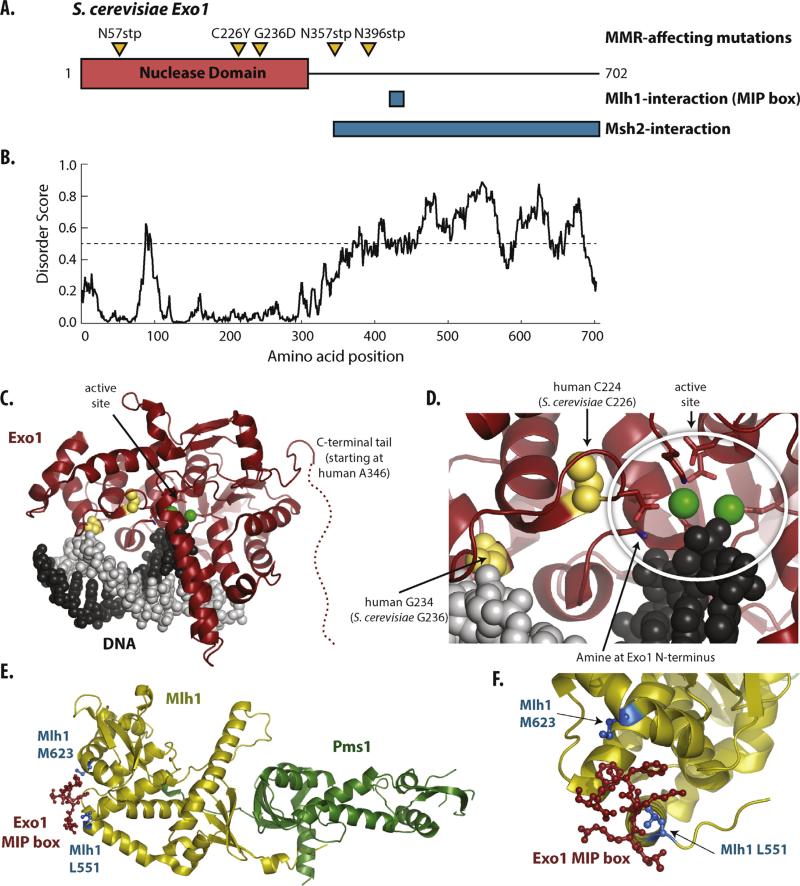
Fig. 1. Exonuclease 1
(A) Schematic representation of S. cerevisiae Exo1 (702 residues long) depicting the endonuclease domain as a red box and the C-terminal tail as a black line. The positions of amino acids affected by mutations in the EXO1 gene that disrupt Exo1-dependent MMR [13] are shown as orange triangles. Interaction regions with Mlh1 (the MIP box) and Msh2 are shown as blue boxes [5,8]. (B) Predicted long-range disorder for S. cerevisiae Exo1 calculated by IUPRED [113] suggests that the C-terminal tail is largely disordered. (C) Structure of the nuclease domain of human Exo1 in complex with DNA (PDB id 3qea, [2]) is shown with the nuclease domain in red and the DNA strands as light and dark grey. Metal bound to the nuclease active site are displayed as green spheres. (D) Expanded view of the structure with active site residues, including the N-terminal amine, displayed as sticks, and the amino acid substitutions caused by the Exo1-dependent MMR defective mutations shown in yellow. The G236D amino acid substitution likely disrupts an interaction between the Exo1 helix-two-turn-helix (H2TH) motif and the uncleaved strand, and the C226Y amino acid substitution likely has steric interference that disrupts the enzyme active site. (E) Structure of interaction of the S. cerevisiae Exo1 MIP box (red) with the C-terminal domains of S. cerevisiae Mlh1–Pms1 (PDB id 4fmo; [9]). (F) Expanded view of the MIP box–Mlh1 interaction with the amino acid positions that are affected by mutations that disrupt Exo1-dependent MMR (L551 and M623; [13]) shown as blue ball-and-sticks.
Fig. 2
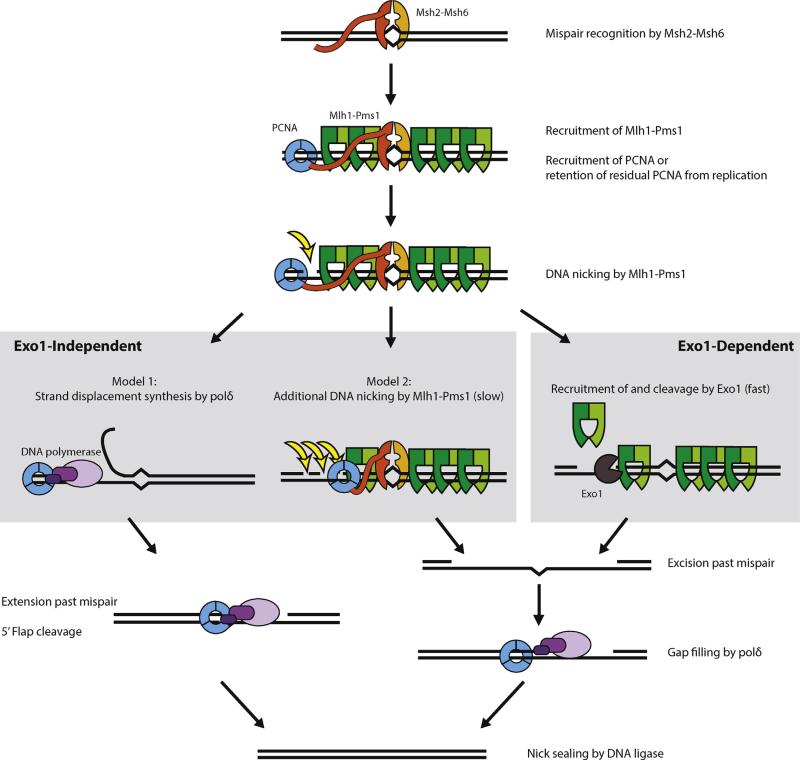
Fig. 2. Eukaryotic MMR
Eukaryotic mismatch repair downstream of mispair recognition by a replication-coupled or replication-uncoupled Msh2–Msh6 (or Msh2–Msh3) heterodimer (not shown) involves common and subpathway-specific steps. Mispair- and ATP-dependent recruitment of Mlh1–Pms1 by Msh2–Msh6, recruitment and/or retention of PCNA, and at least one endonucleolytic cleavage of the newly synthesized strand by Mlh1–Pms1 are common upstream steps in eukaryotic MMR. Mlh1–Pms1 foci are repair intermediates that contain either substoichiometric amounts of Msh2–Msh6 or no Msh2–Msh6 [92]. After at least one initial cleavage event by PCNA-activated Mlh1–Pms1, eukaryotic MMR follows either an Exo1-independent or Exo1-dependent subpathway. In Exo1-dependent MMR, a nick 5′ to the mispair allows Exo1 to be recruited and excise the newly synthesized strand to a position past the mispair. Exo1-independent MMR has been proposed to follow one of two models. In the first model, an Mlh1-Pms1 dependent nick 5′ to the mispair initiates strand displacement synthesis by DNA polymerase δ to a position past the mispair. The 5′ flap is then cleaved and the resulting nick is sealed by DNA ligase [112]. In the second model, Mlh1-Pms1 stimulated by PCNA performs multiple rounds of endonuclease cleavage leading to DNA degradation past the mispair, generating a product similar to that generated by Exo1 [105]. The two Exo1-independent models are not necessarily exclusive. Multiple rounds of cleavage by Mlh1–Pms1 could precede a mixture of gap filling and strand displacement synthesis by DNA polymerase δ, and the balance of the two mechanisms could vary in vivo from mispair to mispair.

References

    1. Tran PT, Erdeniz N, Symington LS, Liskay RM. EXO1–a multi-tasking eukaryotic nuclease. DNA Repair. 2004;3:1549–1559. - PubMed
    1. Orans J, McSweeney EA, Iyer RR, Hast MA, Hellinga HW, Modrich P, Beese LS. Structures of human exonuclease 1 DNA complexes suggest a unified mechanism for nuclease family. Cell. 2011;145:212–223. - PMC - PubMed
    1. Szankasi P, Smith GR. A role for exonuclease I from S. pombe in mutation avoidance and mismatch correction. Science (New York, N.Y.) 1995;267:1166–1169. - PubMed
    1. Szankasi P, Smith GR. A DNA exonuclease induced during meiosis of Schizosaccharomyces pombe. J. Biol. Chem. 1992;267:3014–3023. - PubMed
    1. Tishkoff DX, Boerger AL, Bertrand P, Filosi N, Gaida GM, Kane MF, Kolodner RD. Identification and characterization of Saccharomyces cerevisiae EXO1, a gene encoding an exonuclease that interacts with MSH2. Proc. Natl. Acad. Sci. U. S. A. 1997;94:7487–7492. - PMC - PubMed

Publication types