


Yet another job for Dna2: Checkpoint activation
- PMID: 25956863
- PMCID: PMC4522331
- DOI: 10.1016/j.dnarep.2015.04.009
Yet another job for Dna2: Checkpoint activation
Abstract
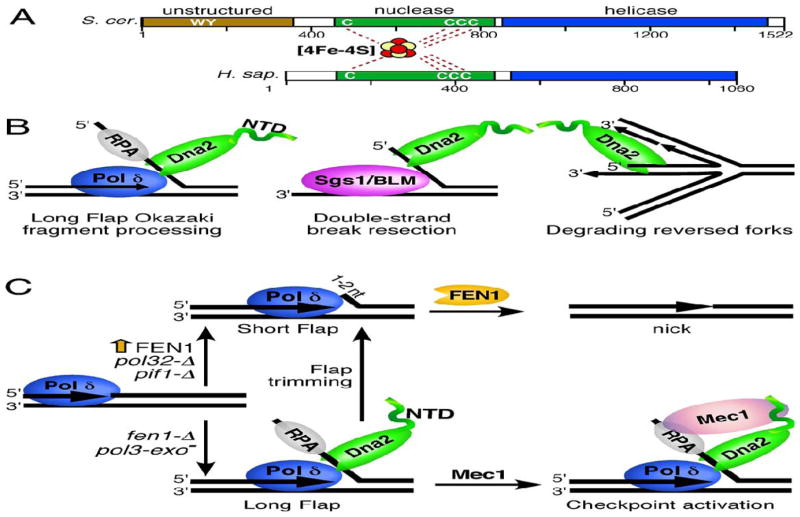
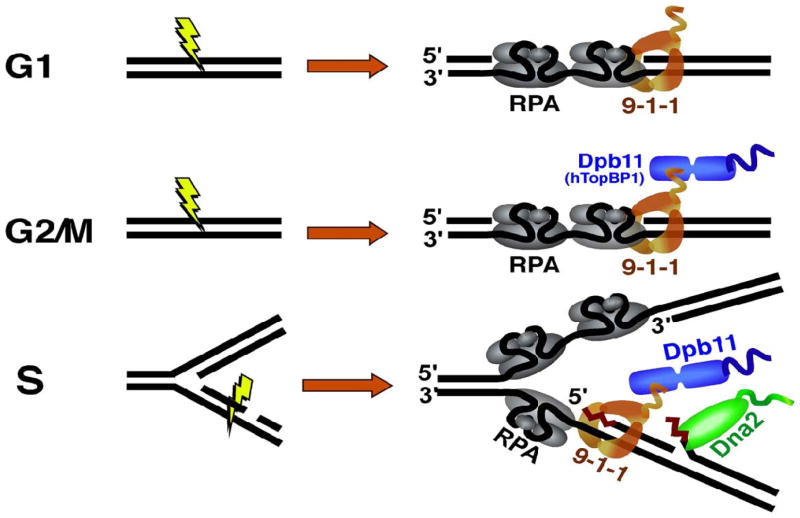
Mec1 (ATR in humans) is the principal kinase responsible for checkpoint activation in response to replication stress and DNA damage in Saccharomyces cerevisiae. Checkpoint initiation requires stimulation of Mec1 kinase activity by specific activators. The complexity of checkpoint initiation in yeast increases with the complexity of chromosomal states during the different phases of the cell cycle. In G1 phase, the checkpoint clamp 9-1-1 is both necessary and sufficient for full activation of Mec1 kinase whereas in G2/M, robust checkpoint function requires both 9-1-1 and the replisome assembly protein Dpb11 (human TopBP1). A third activator, Dna2, is employed specifically during S phase to stimulate Mec1 kinase and to initiate the replication checkpoint. Dna2 is an essential nuclease-helicase that is required for proper Okazaki fragment maturation, for double-strand break repair, and for protecting stalled replication forks. Remarkably, all three Mec1 activators use an unstructured region of the protein, containing two critically important aromatic residues, in order to activate Mec1. A role for these checkpoint activators in channeling aberrant replication structures into checkpoint complexes is discussed.
Keywords: ATR; Dna2; Mec1; Nuclease; Replication checkpoint.
Copyright © 2015 Elsevier B.V. All rights reserved.
Figures
References
-
- Budd ME, Choe WC, Campbell JL. DNA2 encodes a DNA helicase essential for replication of eukaryotic chromosomes. J Biol Chem. 1995;270:26766–26769. - PubMed
-
- Bae SH, Choi E, Lee KH, Park JS, Lee SH, Seo YS. Dna2 of Saccharomyces cerevisiae possesses a single-stranded DNA-specific endonuclease activity that is able to act on double-stranded DNA in the presence of ATP. J Biol Chem. 1998;273:26880–26890. - PubMed
Publication types
MeSH terms
Substances
Grants and funding
LinkOut - more resources
Full Text Sources
Other Literature Sources
Molecular Biology Databases
Miscellaneous
