. 2015 Aug;66(15):4537-49.
doi: 10.1093/jxb/erv224. Epub 2015 May 8.

AINTEGUMENTA-LIKE genes have partly overlapping functions with AINTEGUMENTA but make distinct contributions to Arabidopsis thaliana flower development

Affiliations

AINTEGUMENTA-LIKE genes have partly overlapping functions with AINTEGUMENTA but make distinct contributions to Arabidopsis thaliana flower development

Beth A Krizek. J Exp Bot. 2015 Aug.

Abstract

AINTEGUMENTA (ANT) is an important regulator of Arabidopsis flower development that has overlapping functions with the related AINTEGUMENTA-LIKE6 (AIL6) gene in floral organ initiation, identity specification, growth, and patterning. Two other AINTEGUMENTA-LIKE (AIL) genes, AIL5 and AIL7, are expressed in developing flowers in spatial domains that partly overlap with those of ANT. Here, it is shown that AIL5 and AIL7 also act in a partially redundant manner with ANT. The results demonstrate that AIL genes exhibit unequal genetic redundancy with roles for AIL5, AIL6, and AIL7 only revealed in the absence of ANT function. ant ail5 and ant ail7 double mutant flowers show alterations in floral organ positioning and growth, sepal fusion, and reductions in petal number. In ant ail5, petals are often replaced by filaments or dramatically reduced in size. ant ail7 double mutants produce increased numbers of carpels, which have defects in valve fusion and a loss of apical tissues. The distinct phenotypes of ant ail5, ant ail7 and the previously characterized ant ail6 indicate that AIL5, AIL6, and AIL7 make unique contributions to flower development. These distinct roles are also supported by genetic analyses of ant ail triple mutants. While ant ail5 ail6 triple mutants closely resemble ant ail6 double mutants, ant ail5 ail7 triple mutants exhibit more severe deviations from the wild type than either ant ail5 or ant ail7 double mutants. Furthermore, it is shown that AIL5, AIL6, and AIL7 act in a dose dependent manners in ant and other mutant backgrounds.

Keywords: AINTEGUMENTA-LIKE; Arabidopsis thaliana; carpel patterning; flower development; organ growth; organ initiation; petal; sepal fusion; unequal genetic redundancy..


Figures

Fig. 1.
Fig. 1.
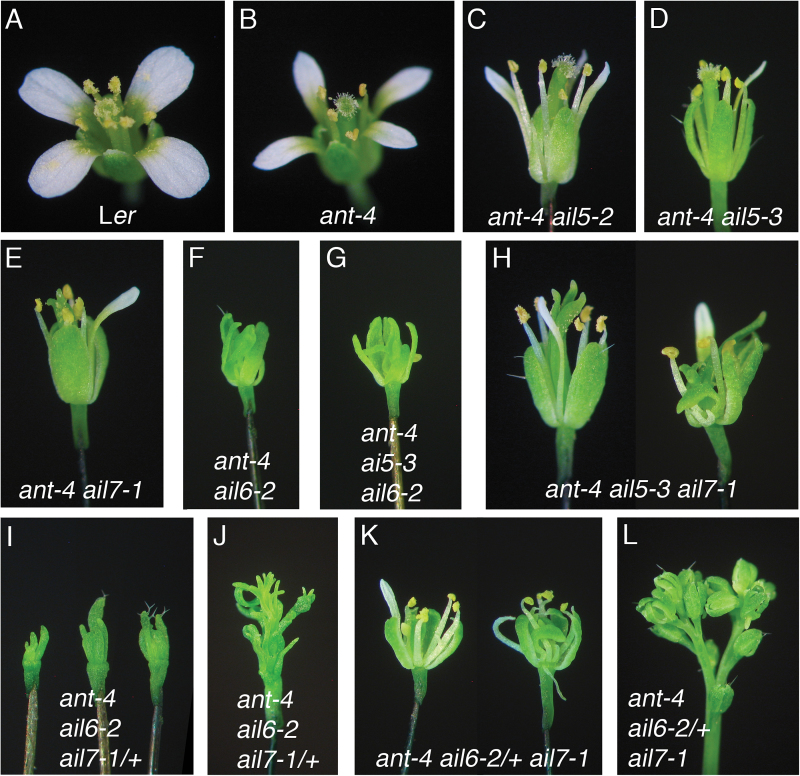
AIL5 and AIL7 have partially overlapping functions with ANT in flower development. (A) Ler flower. (B) ant-4 flower. (C) ant-4 ail5-2 flower. (D) ant-4 ail5-3 flower. (E) ant-4 ail7-1 flower. (F) ant-4 ail6-2 flower. (G) ant-4 ail5-3 ail6-2 flower. (H) Early-arising (left) and later-arising (right) ant-4 ail5-3 ail7-1 flowers. (I) ant-4 ail6-2 ail7-1/+ flowers. (J) ant-4 ail6-2 ail7-1/+ inflorescence. (K) Early-arising (left) and later-arising (right) ant-4 ail6-2/+ ail7-1 flowers. (L) ant-4 ail6-2/+ ail7-1 inflorescence.
Fig. 2.
Fig. 2.
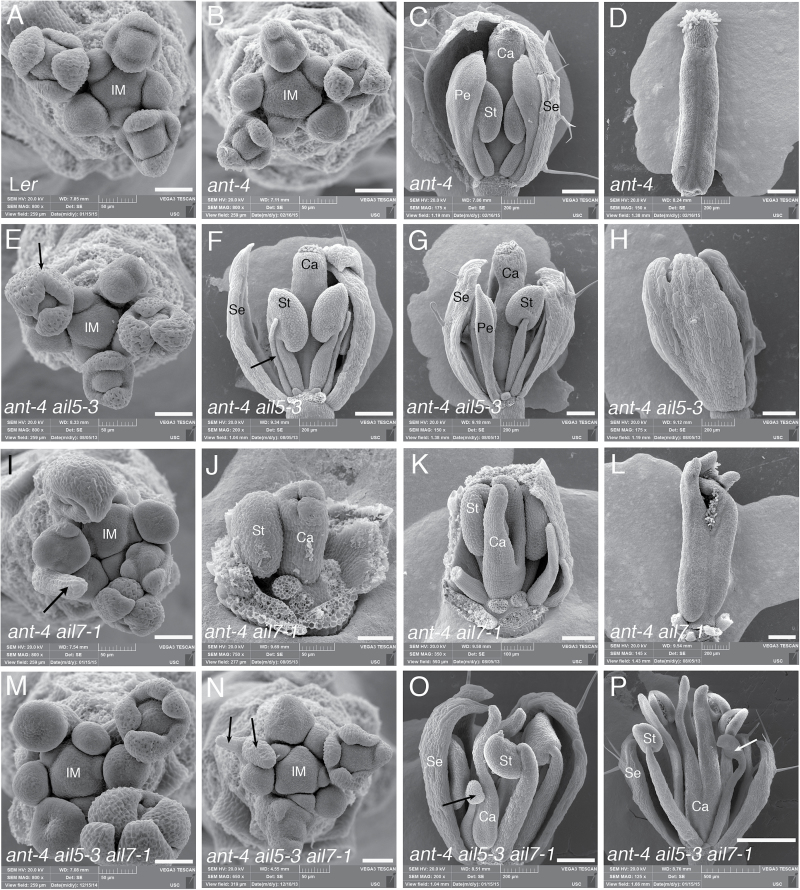
Scanning electron micrographs of Ler, ant-4 and ant-4 ail mutant combinations. (A) Ler inflorescence meristem. (B) ant-4 inflorescence meristem. (C) ant-4 flower. (D) ant-4 carpels. (E) ant-4 ail5-3 inflorescence meristem. Arrow points to the reduced boundary between two adjacent sepal primordia. (F) ant-4 ail5-3 flower with filaments in the second whorl in place of petals. Arrow points to one filament. (G) ant-4 ail5-3 flower with a thin petal in the second whorl. (H) ant-4 ail5-3 flower with fused sepals. (I) ant-4 ail7-1 inflorescence meristem. Arrow points to filament-like structure that arises in place of a flower. (J) Young ant-4 ail7-1 flower showing abnormal development of the fourth whorl carpels. (K) ant-4 ail7-1 flower with two unfused carpels in the fourth whorl. (L) ant-4 ail7-1 carpels in which the valves are unfused at their apex and some stigmatic tissue arises at their edges. (M, N) ant-4 ail5-3 ail7-1 inflorescence meristems. Arrows in (N) point to filament-like structures that arise in place of flowers. (O, P) ant-4 ail5-3 ail7-1 flowers with stamenoid organs (arrows). IM, inflorescence meristem; Se, sepal; Pe, petal; St, stamen; Ca, carpel. Scale bars, 50 μm (A, B, E, I, J, M, N), 100 μm (K) 200 μm (C, D, F–H, L, O), 500 μm (P).
Fig. 3.
Fig. 3.
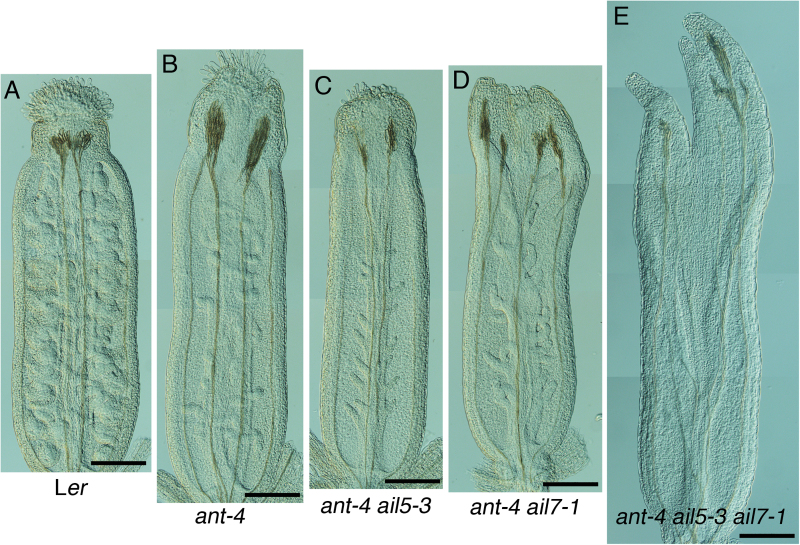
AIL5 and AIL7 contribute to gynoecium development. (A) Ler gynoecium. (B) ant-4 gynoecium. (C) ant-4 ail5-3 gynoecium. (D) ant-4 ail7-1 gynoecium. (E) ant-4 ail5-3 ail7-1 gynoecium. Scale bars, 200 μm.
Fig. 4.
Fig. 4.
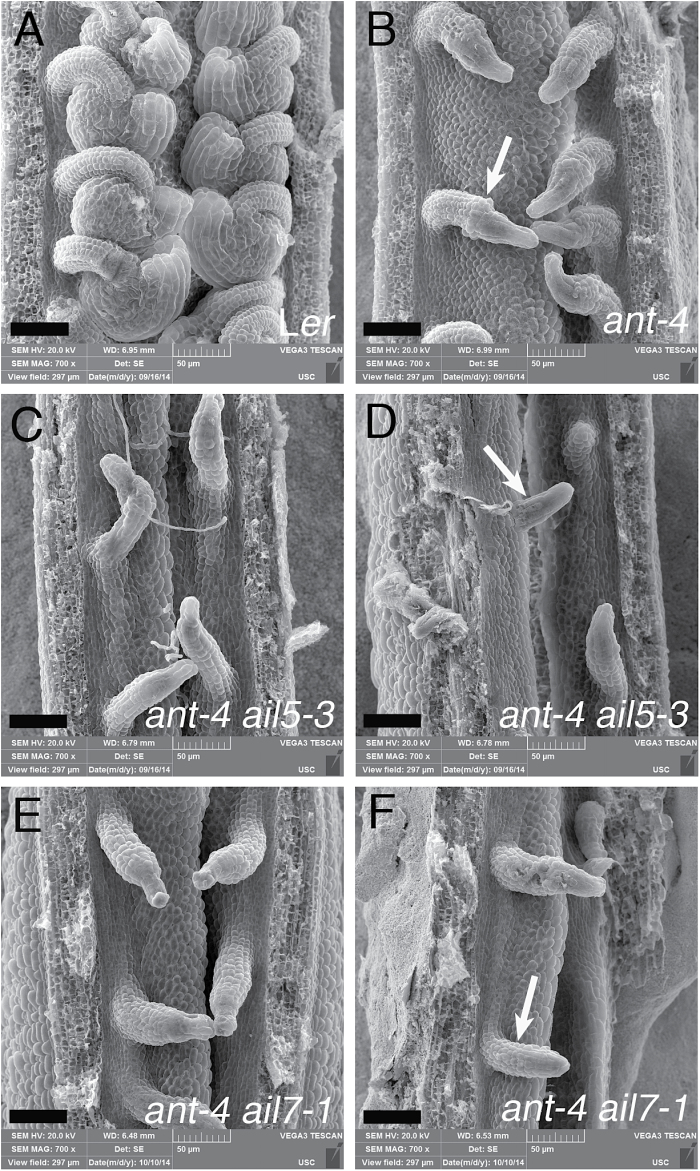
AIL5 and AIL7 contribute to ovule development. (A) Ler ovules. (B) ant-4 ovules. Arrow points to swelling in chalazal region. (C, D) ant-4 ail5-3 ovules. Arrow in (D) points to small ovule primordium that lacks regional distinctions. (E, F) ant-4 ail7-1 ovules. Arrow in (F) points to small ovule primordium that lacks regional distinctions. Scale bars, 50 μm.
Fig. 5.
Fig. 5.
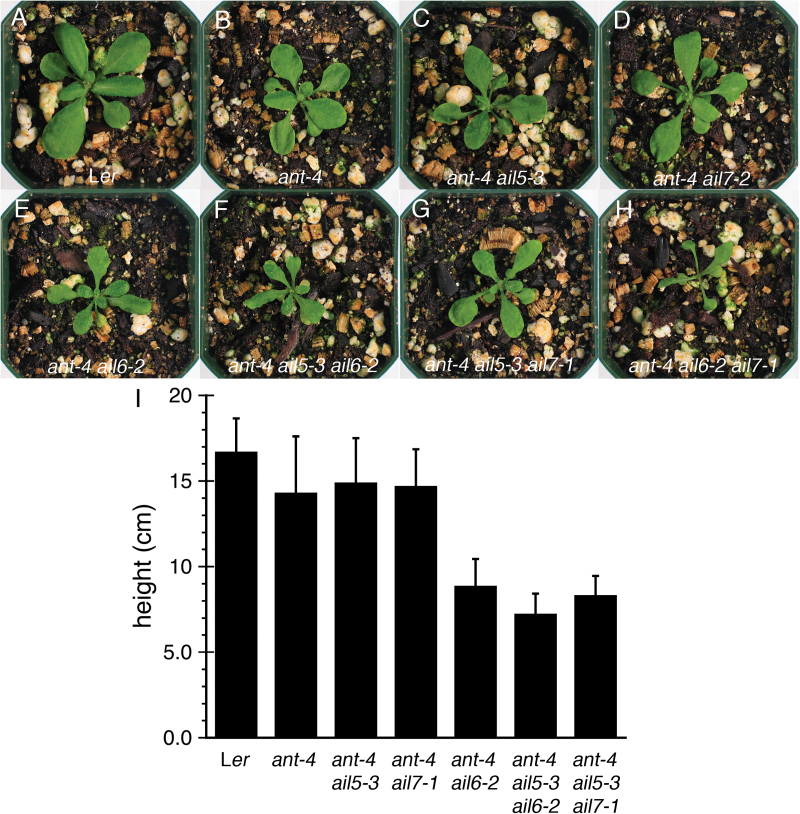
AIL5 and AIL7 contribute to leaf development and shoot growth. (A). Ler plant. (B) ant-4 plant. (C) ant-4 ail5-3 plant. (D) ant-4 ail7-1 plant. (E) ant-4 ail6-2 plant. (F) ant-4 ail5-3 ail6-2 plant. (G) ant-4 ail5-3 ail7-1 plant. (H) ant-4 ail6-2 ail7-1 plant. All plants in (A–H) were 20-d-old. (I) Graph of plant heights. All plants were 42-d-old.
Fig. 6.
Fig. 6.
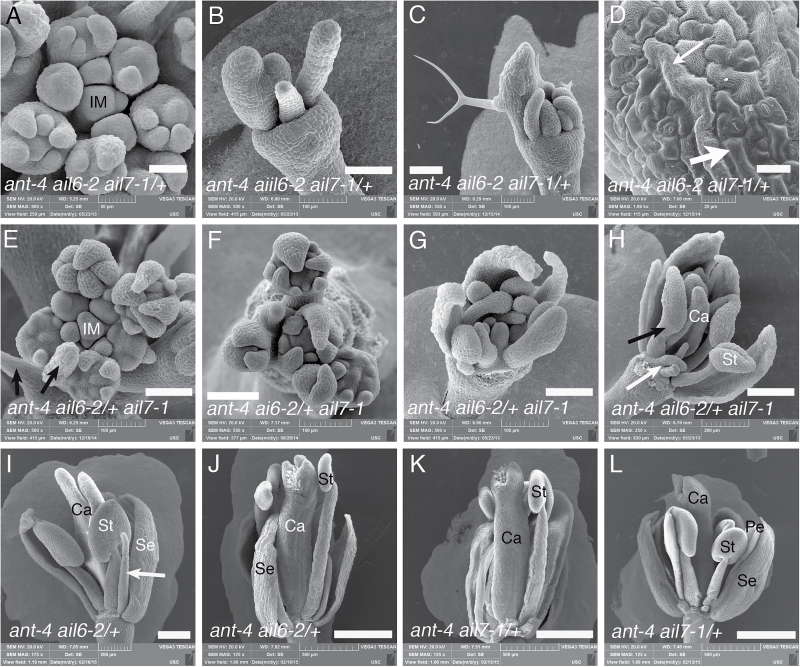
AIL6 and AIL7 act in a dose-dependent manner as shown by scanning electron micrographs. (A) ant-4 ail6-2 ail7-1/+ inflorescence meristem. (B, C) ant-4 ail6-2 ail7-1/+ flowers. (D) Surface of a flat organ arising in the periphery of an ant-4 ail6-2 ail7-1/+ flower. Both giant cells characteristic of sepals (thin white arrow) and leaf-like cells (thick white arrow) are present. (E) ant-4 ail6-2/+ ail7-1 inflorescence meristem. Arrows point to filaments that arise in place of flowers. (F) Inflorescence apex of ant-4 ail6-2/+ ail7-1 plant. No inflorescence meristem is visible. (G) ant-4 ail6-2/+ ail7-1 flower with many organ primordia that arise in altered positions and lack normal morphologies. (H) ant-4 ail6-2/+ ail7-1 flower with stamenoid organ (black arrow). Short filaments are present in this flower (white arrow). (I) ant-4 ail6-2/+ flower with unfused carpel valves and a second whorl filament (arrow). (J) ant-4 ail6-2/+ flower with carpels that are unfused at their apex. (K, L) ant-4 ail7-1/+ flowers showing loss of carpel fusion at the apex of the gynoecium. IM, inflorescence meristem; Se, sepal; Pe, petal; St, stamen; Ca, carpel. Scale bars, 20 μm (D), 50 μm (A), 100 μm (B, C, E–G), 200 μm (H, I), 500 μm in (J–L).
Fig. 7.
Fig. 7.
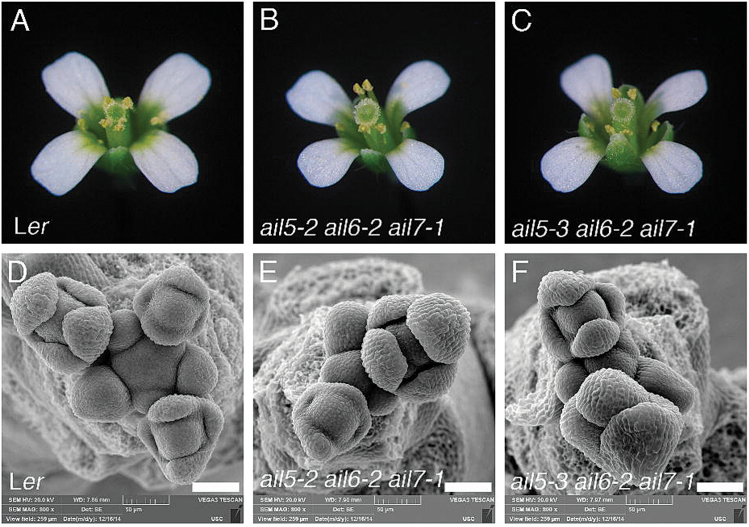
Loss of AIL5, AIL6, and AIL7 together has little effect on floral organ development. (A) Ler flower, (B) ail5-2 ail6-2 ail7-1 er flower. (C) ail5-3 ail6-2 ail7-1 er flower. (D) Scanning electron micrograph of Ler inflorescence. (E) Scanning electron micrograph of ail5-2 ail6-2 ail7-1 er inflorescence. (F) Scanning electron micrograph of ail5-3 ail6-2 ail7-1 er inflorescence. Scale bars, 50 μm.

References

    1. Aida M, Beis D, Heidstra R, Willemsen V, Blilou I, Galinha C, Nussaume L, Noh Y-S, Amasino R, Scheres B. 2004. The PLETHORA genes mediate patterning of the Arabidopsis root stem cell niche. Cell 119, 109–120. - PubMed
    1. Alonso JM, Stepanova AN, Leisse TJ, et al. 2003. Genome-wide insertional mutagenesis of Arabidopsis thaliana . Science 301, 653–657. - PubMed
    1. Baker SC, Robinson-Beers K, Villanueva JM, Gaiser JC, Gasser CS. 1997. Interactions among genes regulating ovule development in Arabidopsis thaliana . Genetics 145, 1109–1124. - PMC - PubMed
    1. Boutilier K, Offringa R, Sharma VK, et al. 2002. Ectopic expression of BABY BOOM triggers a conversion from vegetative to embryonic growth. The Plant Cell 14, 1737–1749. - PMC - PubMed
    1. Briggs GC, Osmont KS, Shindo C, Sibout R, Hardtke CS. 2006. Unequal genetic redundancies in Arabidopsis: a neglected phenomenon? Trends in Plant Sciences 11, 1360–1385. - PubMed

Publication types

MeSH terms

Substances