


Lipid metabolism and Type VII secretion systems dominate the genome scale virulence profile of Mycobacterium tuberculosis in human dendritic cells
- PMID: 25956932
- PMCID: PMC4425887
- DOI: 10.1186/s12864-015-1569-2
Lipid metabolism and Type VII secretion systems dominate the genome scale virulence profile of Mycobacterium tuberculosis in human dendritic cells
Abstract
Background: Mycobacterium tuberculosis continues to kill more people than any other bacterium. Although its archetypal host cell is the macrophage, it also enters, and survives within, dendritic cells (DCs). By modulating the behaviour of the DC, M. tuberculosis is able to manipulate the host's immune response and establish an infection. To identify the M. tuberculosis genes required for survival within DCs we infected primary human DCs with an M. tuberculosis transposon library and identified mutations with a reduced ability to survive.
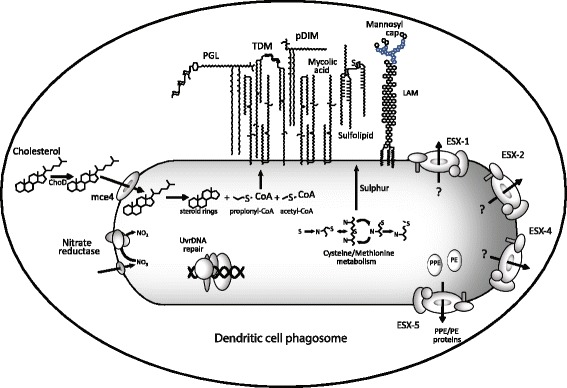
Results: Parallel sequencing of the transposon inserts of the surviving mutants identified a large number of genes as being required for optimal intracellular fitness in DCs. Loci whose mutation attenuated intracellular survival included those involved in synthesising cell wall lipids, not only the well-established virulence factors, pDIM and cord factor, but also sulfolipids and PGL, which have not previously been identified as having a direct virulence role in cells. Other attenuated loci included the secretion systems ESX-1, ESX-2 and ESX-4, alongside many PPE genes, implicating a role for ESX-5. In contrast the canonical ESAT-6 family of ESX substrates did not have intra-DC fitness costs suggesting an alternative ESX-1 associated virulence mechanism. With the aid of a gene-nutrient interaction model, metabolic processes such as cholesterol side chain catabolism, nitrate reductase and cysteine-methionine metabolism were also identified as important for survival in DCs.
Conclusion: We conclude that many of the virulence factors required for survival in DC are shared with macrophages, but that survival in DCs also requires several additional functions, such as cysteine-methionine metabolism, PGLs, sulfolipids, ESX systems and PPE genes.
Figures
References
-
- Dye C, Williams BG. The Population Dynamics and Control of Tuberculosis. Science. 2010;328:856–861. - PubMed
-
- Wolf AJ, Linas B, Trevejo-Nuñez GJ, Kincaid E, Tamura T, Takatsu K, Ernst JD. Mycobacterium tuberculosis Infects Dendritic Cells with High Frequency and Impairs Their Function In Vivo. The Journal of Immunology. 2007;179:2509–2519. - PubMed
-
- Garcia-Romo GS, Pedroza-Gonzalez A, Lambrecht BN, Aquilar-Leon D, Estrada-Garcia I, Hernandez-Pando R, Flores-Romo L. Mycobacterium tuberculosis manipulates pulmonary APCs subverting early immune responses. Immunobiology. 2013;218:393–401. - PubMed
-
- Segal AW, Geisow M, Garcia R, Harper A, Miller R. The respiratory burst of phagocytic cells is associated with a rise in vacuolar pH. Nature. 1981;290:406–409. - PubMed
Publication types
MeSH terms
Substances
Associated data
Grants and funding
LinkOut - more resources
Full Text Sources
Other Literature Sources
Miscellaneous
