


Small-conductance Ca2+ -activated K+ channels and cardiac arrhythmias
- PMID: 25956967
- PMCID: PMC4662728
- DOI: 10.1016/j.hrthm.2015.04.046
Small-conductance Ca2+ -activated K+ channels and cardiac arrhythmias
Abstract
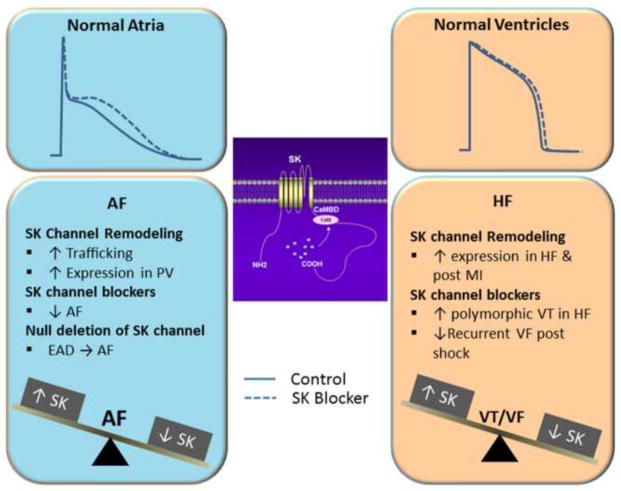
Small-conductance Ca2+ -activated K+ (SK, KCa2) channels are unique in that they are gated solely by changes in intracellular Ca2+ and, hence, function to integrate intracellular Ca2+ and membrane potentials on a beat-to-beat basis. Recent studies have provided evidence for the existence and functional significance of SK channels in the heart. Indeed, our knowledge of cardiac SK channels has been greatly expanded over the past decade. Interests in cardiac SK channels are further driven by recent studies suggesting the critical roles of SK channels in human atrial fibrillation, the SK channel as a possible novel therapeutic target in atrial arrhythmias, and upregulation of SK channels in heart failure in animal models and in human heart failure. However, there remain critical gaps in our knowledge. Specifically, blockade of SK channels in cardiac arrhythmias has been shown to be both antiarrhythmic and proarrhythmic. This contemporary review provides an overview of the literature on the role of cardiac SK channels in cardiac arrhythmias and serves as a discussion platform for the current clinical perspectives. At the translational level, development of SK channel blockers as a new therapeutic strategy in the treatment of atrial fibrillation and the possible proarrhythmic effects merit further considerations and investigations.
Keywords: Antiarrhythmic drug; Atrial arrhythmia; Atrial fibrillation; Calcium-activated potassium channel; Heart failure; Proarrhythmia; Small-conductance calcium-activated potassium channel (SK channel).
Copyright © 2015 Heart Rhythm Society. Published by Elsevier Inc. All rights reserved.
Conflict of interest statement
The authors declare no conflict of interest.
Figures
References
-
- Eisner DA, Vaughan-Jones RD. Do calcium-activated potassium channels exist in the heart? Cell Calcium. 1983 Dec;4:371–386. - PubMed
-
- Xu Y, Tuteja D, Zhang Z, et al. Molecular identification and functional roles of a Ca2+-activated K+ channel in human and mouse hearts. J Biol Chem. 2003 Dec 5;278:49085–49094. - PubMed
-
- Tuteja D, Xu D, Timofeyev V, Lu L, Sharma D, Zhang Z, Xu Y, Nie L, Vazquez AE, Young JN, Glatter KA, Chiamvimonvat N. Differential expression of small-conductance Ca2+-activated K+ channels SK1, SK2, and SK3 in mouse atrial and ventricular myocytes. Am J Physiol Heart Circ Physiol. 2005 Dec;289:H2714–2723. - PubMed
-
- Tuteja D, Rafizadeh S, Timofeyev V, Wang S, Zhang Z, Li N, Mateo RK, Singapuri A, Young JN, Knowlton AA, Chiamvimonvat N. Cardiac small conductance Ca2+-activated K+ channel subunits form heteromultimers via the coiled-coil domains in the C termini of the channels. Circ Res. 2010 Oct 1;107:851–859. - PMC - PubMed
Publication types
MeSH terms
Substances
Grants and funding
LinkOut - more resources
Full Text Sources
Other Literature Sources
Medical
Miscellaneous
