


Identification of dfrA14 in two distinct plasmids conferring trimethoprim resistance in Actinobacillus pleuropneumoniae
- PMID: 25957382
- PMCID: PMC4500777
- DOI: 10.1093/jac/dkv121
Identification of dfrA14 in two distinct plasmids conferring trimethoprim resistance in Actinobacillus pleuropneumoniae
Abstract
Objectives: The objective of this study was to determine the distribution and genetic basis of trimethoprim resistance in Actinobacillus pleuropneumoniae isolates from pigs in England.
Methods: Clinical isolates collected between 1998 and 2011 were tested for resistance to trimethoprim and sulphonamide. The genetic basis of trimethoprim resistance was determined by shotgun WGS analysis and the subsequent isolation and sequencing of plasmids.
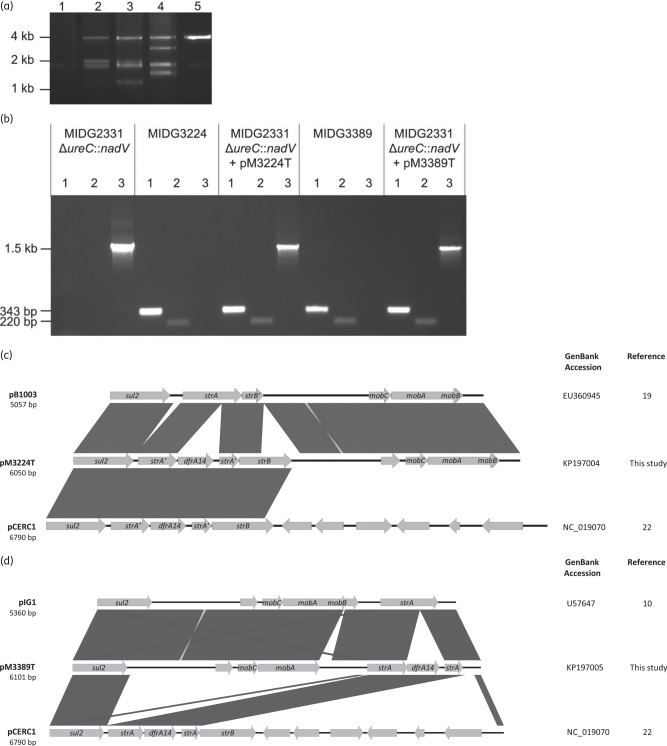
Results: A total of 16 (out of 106) A. pleuropneumoniae isolates were resistant to both trimethoprim (MIC >32 mg/L) and sulfisoxazole (MIC ≥256 mg/L), and a further 32 were resistant only to sulfisoxazole (MIC ≥256 mg/L). Genome sequence data for the trimethoprim-resistant isolates revealed the presence of the dfrA14 dihydrofolate reductase gene. The distribution of plasmid sequences in multiple contigs suggested the presence of two distinct dfrA14-containing plasmids in different isolates, which was confirmed by plasmid isolation and sequencing. Both plasmids encoded mobilization genes, the sulphonamide resistance gene sul2, as well as dfrA14 inserted into strA, a streptomycin-resistance-associated gene, although the gene order differed between the two plasmids. One of the plasmids further encoded the strB streptomycin-resistance-associated gene.
Conclusions: This is the first description of mobilizable plasmids conferring trimethoprim resistance in A. pleuropneumoniae and, to our knowledge, the first report of dfrA14 in any member of the Pasteurellaceae. The identification of dfrA14 conferring trimethoprim resistance in A. pleuropneumoniae isolates will facilitate PCR screens for resistance to this important antimicrobial.
Keywords: animal infections; antibiotic resistance; respiratory tract.
© The Author 2015. Published by Oxford University Press on behalf of the British Society for Antimicrobial Chemotherapy.
Figures
References
-
- Bossé JT, Janson H, Sheehan BJ et al. Actinobacillus pleuropneumoniae: pathobiology and pathogenesis of infection. Microbes Infect 2002; 4: 225–35. - PubMed
-
- Borriello SP. UK Veterinary Antibiotic Resistance and Sales Surveillance Report 2013. www.vmd.defra.gov.uk/pdf/varss.pdf.
-
- Huovinen P. Resistance to trimethoprim-sulfamethoxazole. Clin Infect Dis 2001; 32: 1608–14. - PubMed
Publication types
MeSH terms
Substances
Associated data
- Actions
- Actions
- Actions
- Actions
- Actions
- Actions
- Actions
- Actions
- Actions
- Actions
- Actions
- Actions
- Actions
- Actions
- Actions
- Actions
- Actions
- Actions
- Actions
- Actions
- Actions
- Actions
- Actions
- Actions
- Actions
- Actions
- Actions
- Actions
- Actions
- Actions
Grants and funding
- BB/G018553/1/BB_/Biotechnology and Biological Sciences Research Council/United Kingdom
- BB/G019177/1/BB_/Biotechnology and Biological Sciences Research Council/United Kingdom
- BB/G019274/1/BB_/Biotechnology and Biological Sciences Research Council/United Kingdom
- 098051/WT_/Wellcome Trust/United Kingdom
- BB/G020744/1/BB_/Biotechnology and Biological Sciences Research Council/United Kingdom
LinkOut - more resources
Full Text Sources
Other Literature Sources
