


Thematic Minireview Series: The State of the Cytoskeleton in 2015
- PMID: 25957399
- PMCID: PMC4498052
- DOI: 10.1074/jbc.R115.663716
Thematic Minireview Series: The State of the Cytoskeleton in 2015
Abstract
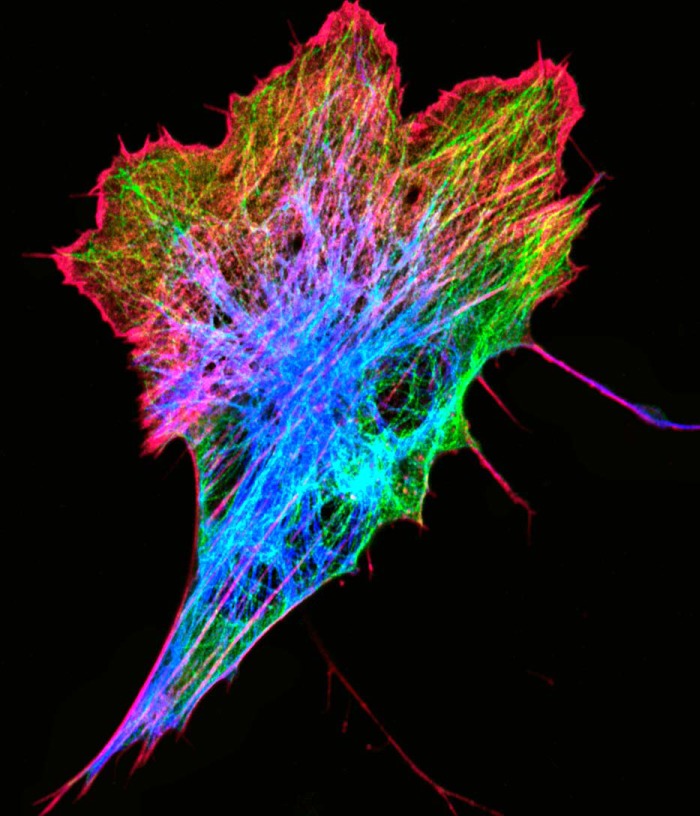
The study of cytoskeletal polymers has been an active area of research for more than 70 years. However, despite decades of pioneering work by some of the brightest scientists in biochemistry, cell biology, and physiology, many central questions regarding the polymers themselves are only now starting to be answered. For example, although it has long been appreciated that the actin cytoskeleton provides contractility and couples biochemical responses with mechanical stresses in cells, only recently have we begun to understand how the actin polymer itself responds to mechanical loads. Likewise, although it has long been appreciated that the microtubule cytoskeleton can be post-translationally modified, only recently have the enzymes responsible for these modifications been characterized, so that we can now begin to understand how these modifications alter the polymerization and regulation of microtubule structures. Even the septins in eukaryotes and the cytoskeletal polymers of prokaryotes have yielded new insights due to recent advances in microscopy techniques. In this thematic series of minireviews, these topics are covered by some of the very same scientists who generated these recent insights, thereby providing us with an overview of the State of the Cytoskeleton in 2015.
Keywords: actin; bacterial cytoskeleton; cytoskeleton; intermediate filament; microtubule; polymer dynamics; polymer mechanics; septins; tubulin; vimentin.
© 2015 by The American Society for Biochemistry and Molecular Biology, Inc.
Figures
References
-
- Straub F. B. (1942) Actin. in Studies from the Institute of Medical Chemistry University Szeged, (Szent-Györgyi A., ed) Vol. II, pp. 3–15, S. Karger, Basel, New York
-
- Huneeus F. C., Davison P. F. (1970) Fibrillar proteins from squid axons. I. Neurofilament protein. J. Mol. Biol. 52, 415–428 - PubMed
Publication types
MeSH terms
Substances
Grants and funding
LinkOut - more resources
Full Text Sources
