Review
. 2015 May 7;161(4):714-23.
doi: 10.1016/j.cell.2015.04.014.

Making sense of transcription networks

Affiliations
Review

Making sense of transcription networks

Trevor R Sorrells et al. Cell. .

Abstract

When transcription regulatory networks are compared among distantly related eukaryotes, a number of striking similarities are observed: a larger-than-expected number of genes, extensive overlapping connections, and an apparently high degree of functional redundancy. It is often assumed that the complexity of these networks represents optimized solutions, precisely sculpted by natural selection; their common features are often asserted to be adaptive. Here, we discuss support for an alternative hypothesis: the common structural features of transcription networks arise from evolutionary trajectories of "least resistance"--that is, the relative ease with which certain types of network structures are formed during their evolution.


Figures

Fig. 1
Fig. 1
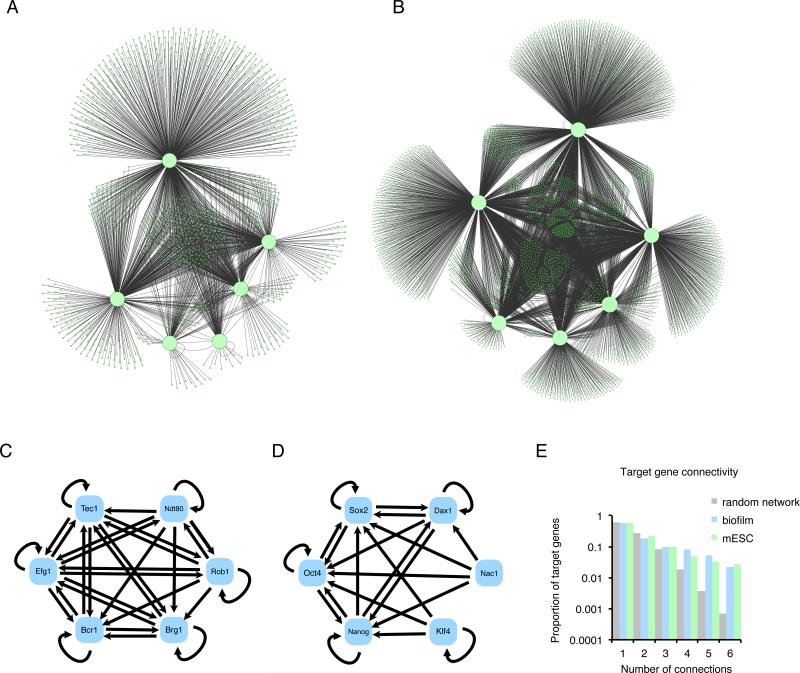
Typical depictions of transcription regulatory networks. (A) The C. albicans biofilm network (Nobile et al., 2012) and (B) the M. musculus embryonic stem cell network (Kim et al., 2008) are depicted as graphs where balls represent genes and lines represent the binding of transcription regulators to intergenic regions. Master transcription regulators (defined in the text) are shown as large balls and “target genes” are shown as small balls. For the stem cell network, only the six most heavily connected transcription regulators are shown. (C and D) Close-up of the core of each network, showing only the binding connections between the master transcription regulators. Directionality of the connection is indicated by arrows. Note that the arrows refer only to binding connections and do not imply that the connection activates the recipient gene. (C) C. albicans biofilm, (D) mouse stem cell networks. (E) The degree of connectivity for nodes in the two networks. The two biological networks show a larger proportion of nodes with high connectivity than would be found in a random network (Lee et al., 2002).
Fig. 2
Fig. 2
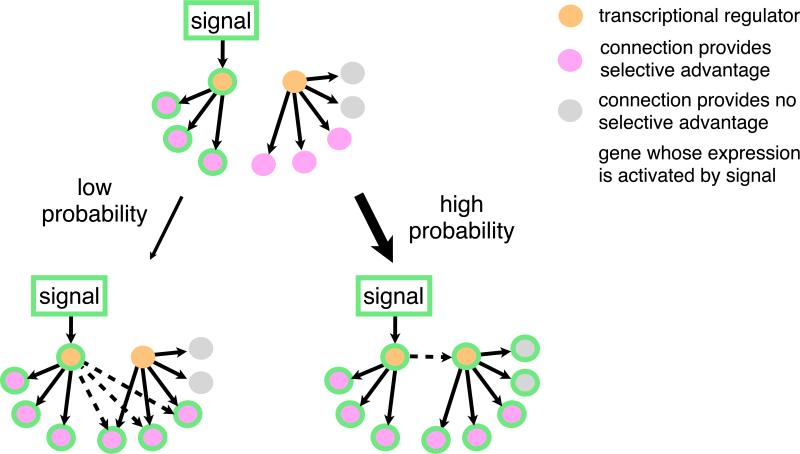
Pathways for evolving a new transcriptional response to a signal. In this hypothetical scenario, incorporation of three additional genes into the signaling pathway confers a selective advantage. Two alternative paths are possible: (1) The genes could be incorporated one by one through independent changes in their cis-regulatory sequences. (2) The new genes could be incorporated through a single incorporation of the transcription regulator that already controls them. If the incorporation of multiple target genes is needed to confer an increase in fitness, gain of regulation of the transcription regulator will be more probable than the gain of each individual target. As the number of target genes increases, the difference in probability will be greater. Note that the second scenario will likely incorporate additional genes non-adaptively.
Fig. 3
Fig. 3
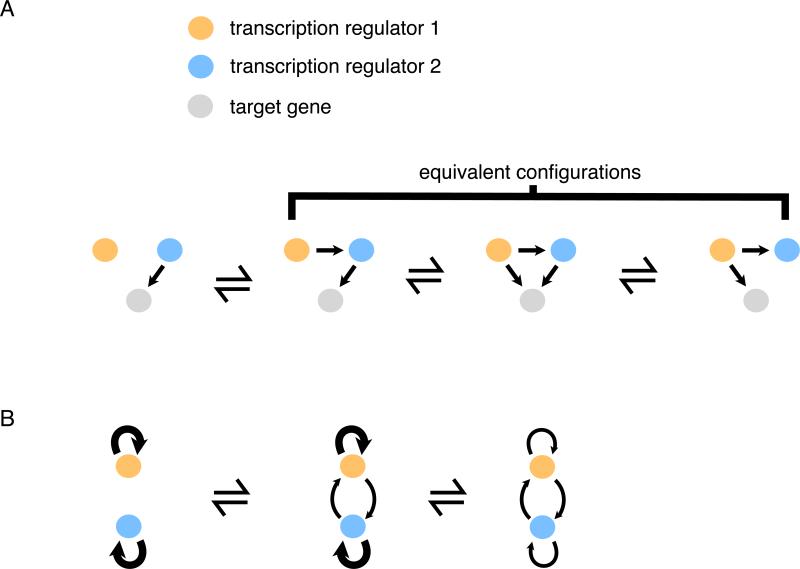
The tendency for co-expressed regulators to become interconnected. (A) Once the orange regulator gains control of the blue regulator, causing them to be expressed at the same time, target genes can, through neutral evolution, rapidly gain and lose binding sites for the two regulators. (B) Two regulators expressed at the same time each have positive feedback. Subsequently, neutral gains of reciprocal regulation between the regulators can occur while preserving the overall positive feedback control. Over evolutionary time, positive feedback distributed over both regulators (rather than purely autonomous loops) is predicted to occur.
Fig. 4
Fig. 4
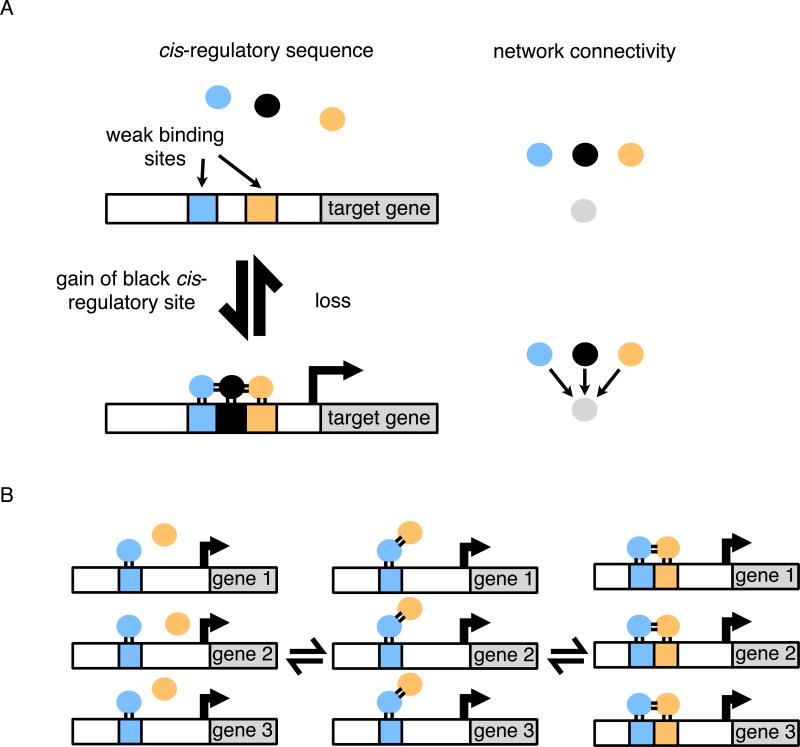
Gain of multiple regulatory connections through cooperative binding. (A) Cooperativity between regulators allows binding energy to be shared between protein-DNA and protein-protein interactions. When a strong binding site is gained for one regulator, this may increase the occupancy of regulators on nearby weak binding sites that would otherwise be unoccupied. The effect is a concerted increase in connectivity of that target gene. (B) The gain of a protein-protein interaction between the blue and orange regulators results in a concerted rewiring of the entire set of genes. As shown in the third panel, direct binding sites for the orange regulator can be gained step-wise at each gene individually without disrupting the circuit. Finally (not shown), the circuit can diversify by moving between equivalent configurations.
Fig. 5
Fig. 5
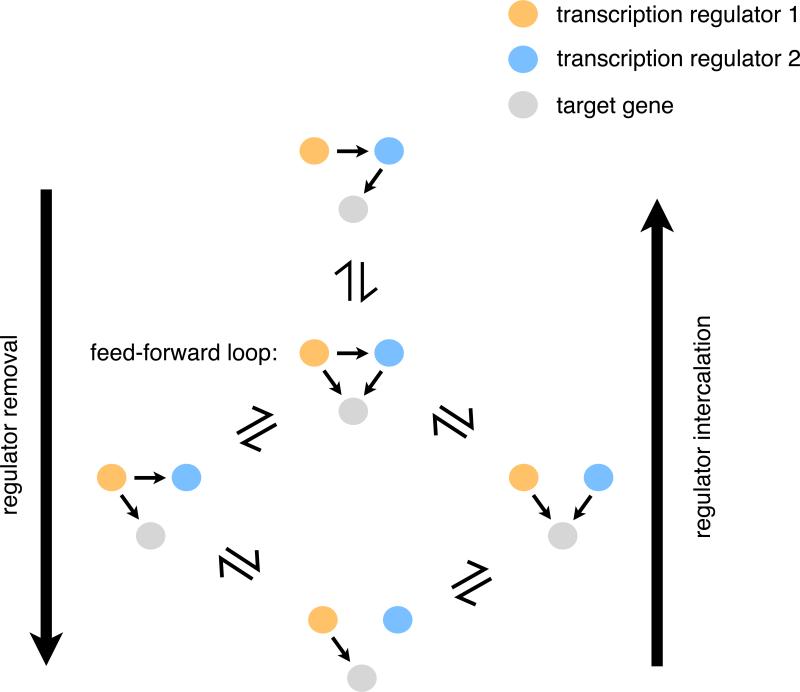
Pathways for incorporation or removal of a transcription regulator without breaking the network. Removal of the blue regulator from the linear regulatory pathway shown in the top network diagram can proceed by first forming a feed-forward loop. Subsequent loss of the connections between the red and blue regulator and between the blue regulator and the target gene will completely remove the blue regulator from the network as shown in the bottom diagram. The opposite process starting from the bottom diagram and proceeding to the top results in intercalation of the blue regulator into the pathway. If the functions of the blue and red regulators are redundant in the context of the network, the network can drift between these configurations over evolutionary time without compromising the output of the circuit.

References

    1. Alon U. Network motifs: theory and experimental approaches. Nat Rev Genet. 2007;8:450–461. - PubMed
    1. Baker CR, Booth LN, Sorrells TR, Johnson AD. Protein modularity, cooperative binding, and hybrid regulatory States underlie transcriptional network diversification. Cell. 2012;151:80–95. - PMC - PubMed
    1. Baker CR, Tuch BB, Johnson AD. Extensive DNA-binding specificity divergence of a conserved transcription regulator. Proc Natl Acad Sci USA. 2011;108:7493–7498. - PMC - PubMed
    1. Bateman E. Autoregulation of eukaryotic transcription factors. Prog Nucleic Acid Res Mol Biol. 1998;60:133–168. - PubMed
    1. Borneman AR, Leigh-Bell JA, Yu H, Bertone P, Gerstein M, Snyder M. Target hub proteins serve as master regulators of development in yeast. Genes Dev. 2006;20:435–448. - PMC - PubMed

Publication types