


Self-hypnosis for intrapartum pain management in pregnant nulliparous women: a randomised controlled trial of clinical effectiveness
- PMID: 25958769
- PMCID: PMC4690197
- DOI: 10.1111/1471-0528.13433
Self-hypnosis for intrapartum pain management in pregnant nulliparous women: a randomised controlled trial of clinical effectiveness
Abstract
Objective: (Primary) To establish the effect of antenatal group self-hypnosis for nulliparous women on intra-partum epidural use.
Design: Multi-method randomised control trial (RCT).
Setting: Three NHS Trusts.
Population: Nulliparous women not planning elective caesarean, without medication for hypertension and without psychological illness.
Methods: Randomisation at 28-32 weeks' gestation to usual care, or to usual care plus brief self-hypnosis training (two × 90-minute groups at around 32 and 35 weeks' gestation; daily audio self-hypnosis CD). Follow up at 2 and 6 weeks postnatal.
Main outcome measures: Primary: epidural analgesia. Secondary: associated clinical and psychological outcomes; cost analysis.
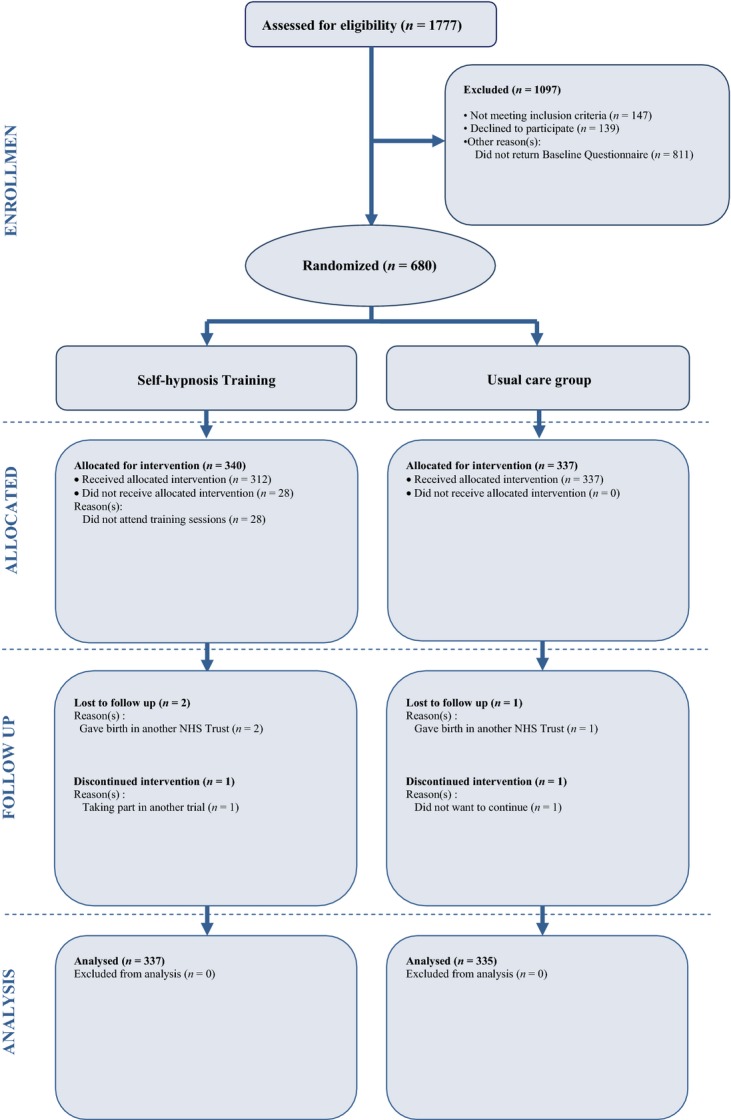
Results: Six hundred and eighty women were randomised. There was no statistically significant difference in epidural use: 27.9% (intervention), 30.3% (control), odds ratio (OR) 0.89 [95% confidence interval (CI): 0.64-1.24], or in 27 of 29 pre-specified secondary clinical and psychological outcomes. Women in the intervention group had lower actual than anticipated levels of fear and anxiety between baseline and 2 weeks post natal (anxiety: mean difference -0.72, 95% CI -1.16 to -0.28, P = 0.001); fear (mean difference -0.62, 95% CI -1.08 to -0.16, P = 0.009) [Correction added on 7 July 2015, after first online publication: 'Mean difference' replaced 'Odds ratio (OR)' in the preceding sentence.]. Postnatal response rates were 67% overall at 2 weeks. The additional cost in the intervention arm per woman was £4.83 (CI -£257.93 to £267.59).
Conclusions: Allocation to two-third-trimester group self-hypnosis training sessions did not significantly reduce intra-partum epidural analgesia use or a range of other clinical and psychological variables. The impact of women's anxiety and fear about childbirth needs further investigation.
Keywords: Cost-analysis; epidural; group antenatal training; hypnosis; labour pain; psychological outcomes; randomised trial.
© 2015 The Authors. BJOG An International Journal of Obstetrics and Gynaecology published by John Wiley & Sons Ltd on behalf of Royal College of Obstetricians and Gynaecologists.
References
-
- Hospital Episode Statistics: NHS Maternity Statistics 2012–13. [ http://www.hscic.gov.uk/catalogue/PUB12744]. Accessed 27 May 2014.
-
- Declercq ER, Sakala C, Corry MP, Applebaum S, Herrlich A. Listening to Mothers SM III: Pregnancy and Birth. New York: Childbirth Connection; 2013. [ http://transform.childbirthconnection.org/wp-content/uploads/2013/06/LTM...]. Accessed 17 July 2014.
-
- Anim-Somuah M, Smyth R, Howell C. Epidural versus non-epidural or no analgesia in labour. Cochrane Database Syst Rev. 2005;(4):CD000331. 1469-93. - PubMed
-
- Scotland GS, McNamee P, Cheyne H, Hundley V, Barnett C. Preferences for aspects of labor management: results from a discrete choice experiment. Birth. 2011;38:36–46. - PubMed
Publication types
MeSH terms
Grants and funding
LinkOut - more resources
Full Text Sources
Other Literature Sources
Medical
