. 2015 Sep;36(18):2269-2285.
doi: 10.1002/elps.201500011. Epub 2015 Jun 25.

Multiplatform characterization of dynamic changes in breast milk during lactation

Affiliations

Multiplatform characterization of dynamic changes in breast milk during lactation

Nicholas J Andreas et al. Electrophoresis. 2015 Sep.

Abstract

The multicomponent analysis of human breast milk (BM) by metabolic profiling is a new area of study applied to determining milk composition, and is capable of associating BM composition with maternal characteristics, and subsequent infant health outcomes. A multiplatform approach combining HPLC-MS and ultra-performance LC-MS, GC-MS, CE-MS, and 1 H NMR spectroscopy was used to comprehensively characterize metabolic profiles from seventy BM samples. A total of 710 metabolites spanning multiple molecular classes were defined. The utility of the individual and combined analytical platforms was explored in relation to numbers of metabolites identified, as well as the reproducibility of the methods. The greatest number of metabolites was identified by the single phase HPLC-MS method, while CE-MS uniquely profiled amino acids in detail and NMR was the most reproducible, whereas GC-MS targeted volatile compounds and short chain fatty acids. Dynamic changes in BM composition were characterized over the first 3 months of lactation. Metabolites identified as altering in abundance over lactation included fucose, di- and triacylglycerols, and short chain fatty acids, known to be important for infant immunological, neurological, and gastrointestinal development, as well as being an important source of energy. This extensive metabolic coverage of the dynamic BM metabolome provides a baseline for investigating the impact of maternal characteristics, as well as establishing the impact of environmental and dietary factors on the composition of BM, with a focus on the downstream health consequences this may have for infants.

Keywords: Breast milk; MS; Metabolomics; Metabonomics; NMR.


Figures

Figure 1
Figure 1
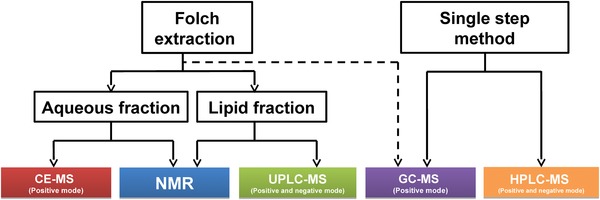
Workflow displaying the different metabonomic techniques selected to analyze the aqueous and lipid fraction of BM extractions.
Figure 2
Figure 2
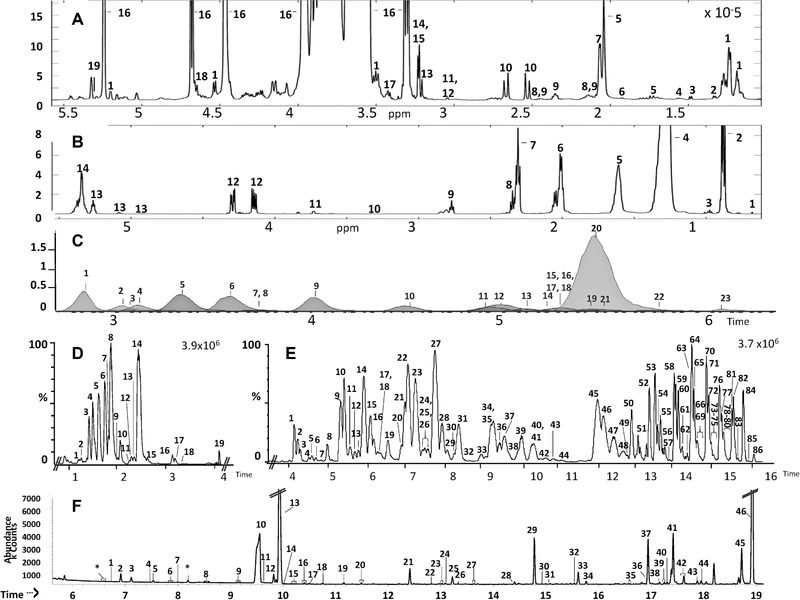
Profiles of BM analyzed via: (A) Median 1H NMR spectrum of aqueous fraction of BM, 1 = Fucose, 2 = Lactate, 3 = Alanine, 4 = Butyrate, 5 = N‐acetyl glutamine, 6 = Acetate, 7 = N‐acetyl neuraminic acid, 8 = Glutamine, 9 = Glutamate, 10 = Citrate, 11 = Creatine, 12 = Creatinine, 13 = Choline, 14 = Phosphocholine, 15 = Glycerophosphocholine, 16 = Lactose, 17 = Taurine, 18 = Glucose, 19 = Galactose. (B) Median 1H NMR spectrum of lipid fraction of BM 1 = Cholesterol, 2 = Terminal CH3, 3 = Omega 3 terminal CH3, 4 = Saturated CH2, 5 = CH 2‐CH2‐COOH, 6 = Unsaturated fatty acids CH 2‐CH = CH, 7 = CH 2‐COOH, 8 = Docosahexaenoic acid, = CH‐CH 2‐CH 2‐COOH, 9 = Polyunsaturated fatty acid, = CH‐CH2‐CH = , 10 = Phosphatidylcholine, ‐N(CH 3)3, 11 = Phospholipid, 12 = Glyceryl C1,3, 13 = Glyceryl C2, 14 = Unsaturated fatty acids, ‐CH = CH‐. (C) Aqueous fraction of BM analysed using CE‐MS in positive ionization mode; 1 = Creatinine, 2 = Lysine, 3 = Nicotinamide, 4 = Arginine, 5 = Carnitine, 6 = Acetyl‐L Carnitine, 7 = Cytosine, 8 = Cytidine, 9 = Creatine, 10 = Alanine, 11 = 5‐amino Valeric acid/valine, 12 = N‐methyl‐L‐Valine/leucine/isoleucine, 13 = Serine, 14 = Tryptophan, 15 = Threonine, 16 = Glycyl‐glycine, 17 = Methionine, 18 = Citrulline, 19 = Phenylalanine, 20 = Glutamic acid, 21 = Tyrosine, 22 = Cystine, 23 = Aspartic acid. (D) UPLC‐MS; lipid fraction of BM analysed in negative ionization mode, tentative identifications are shown in Supporting Information Table 4. (E) UPLC‐MS; lipid fraction analyzed using positive mode, tentative identifications are shown in Supporting Information Table 4. (F) GC‐MS single phase assignments from 6–19 min 1 = Pyruvic acid, 2 = Lactic acid (Standard confirmed), 3 = Glycolic acid, 4 = Valine 1, 5 = Alanine 1, 6 = 2‐Hydroxybutyric acid, 7 = 2‐Furoic acid, 8 = Isoleucine 1, 9 = Valine 2, 10 = Urea (Standard confirmed), 11 = Benzoic acid, 12 = Caprylic acid, 13 = Glycerol (Standard confirmed), 14 = Phosphoric acid, 15 = Proline 2 (Standard confirmed), 16 = Glycine, 17 = Succinic acid, 18 = Glyceric acid, 19 = Serine 2 (Standard confirmed), 20 = Threonine 2, 21 = Capric acid, 22 = Malic acid, 23 = Adipic acid, 24 = Threitol, 25 = Pyroglutamic acid, 26 = Glutamic acid 1, 27 = Creatinine, 28 = Glutamic acid 2 (Standard confirmed), 29 = Lauric acid, 30 = Lyxose 1/Lyxosylamine 1, 31 = Lyxose 2/Lyxosylamine 2/Ribose, 32 = Xylitol, 33 = Fucose 1, 34 = Fucose 2, 35 = Citric acid (Standard confirmed), 36 = Hippuric acid 2, 37 = Myristic acid, 38 = Tagatose 1/Sorbose 2/Sorbose 1/Fructose 1, 39 = Tagatose 2/Fructose 2/Fructose 1, 40 = Galactose 1/ Mannose 1/Allose 1/Gluconic acid lactone 1, 41 = Glucose 1/Talose 1 (Standard confirmed), 42 = Altrose 2/Mannose 2/Glucose 2/Allose 2/Talose 2, 43 = Mannitol/Sorbitol, 44 = 1‐Hexadecanol, 45 = Palmitoleic acid, 46 = Palmitic acid.

References

    1. Menjo, A. , Mizuno, K. , Murase, M. , Nishida, Y. , Taki, M. , Itabashi, K. , Shimono, T. , Namba, K. , Acta Paediatr. 2009, 98, 380–384. - PubMed
    1. Ilcol, Y. O. , Ozbek, R. , Hamurtekin, E. , Ulus, I. H. , J. Nutr. Biochem. 2005, 16, 489–499. - PubMed
    1. Wharton, B. A. , Morley, R. , Isaacs, E. B. , Cole, T. J. , Lucas, A. , Arch. Dis. Childhood 2004, 89, F497–F498. - PMC - PubMed
    1. Michaelsen, K. F. , Skafte, L. , Badsberg, J. H. , Jorgensen, M. , J. Pediatric Gastroenterol. Nutr. 1990, 11, 229–239. - PubMed
    1. German, J. B. , Freeman, S. L. , Lebrilla, C. B. , Mills, D. A. , Nestle Nutr. Workshop Series Paediatr. Prog. 2008, 62, 205–218; discussion 218–222. - PMC - PubMed