


Impact of KIR and HLA Genotypes on Outcomes after Reduced-Intensity Conditioning Hematopoietic Cell Transplantation
- PMID: 25960307
- PMCID: PMC4537837
- DOI: 10.1016/j.bbmt.2015.05.002
Impact of KIR and HLA Genotypes on Outcomes after Reduced-Intensity Conditioning Hematopoietic Cell Transplantation
Abstract
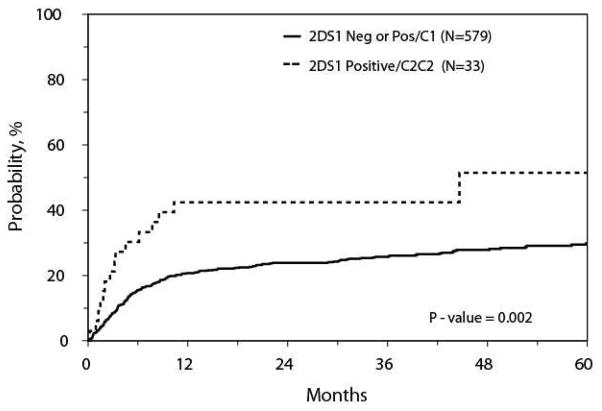
Natural killer cells are regulated by killer cell immunoglobulin-like receptor (KIR) interactions with HLA class I ligands. Several models of natural killer cell reactivity have been associated with improved outcomes after myeloablative allogeneic hematopoietic cell transplantation (HCT), but this issue has not been rigorously addressed in reduced-intensity conditioning (RIC) unrelated donor (URD) HCT. We studied 909 patients undergoing RIC-URD HCT. Patients with acute myeloid leukemia (AML, n = 612) lacking ≥ 1 KIR ligands experienced higher grade III to IV acute graft-versus-host disease (GVHD) (HR, 1.6; 95% CI, 1.16 to 2.28; P = .005) compared to those with all ligands present. Absence of HLA-C2 for donor KIR2DL1 was associated with higher grade II to IV (HR, 1.4; P = .002) and III to IV acute GVHD (HR, 1.5; P = .01) compared with HLA-C2(+) patients. AML patients with KIR2DS1(+), HLA-C2 homozygous donors had greater treatment-related mortality compared with others (HR, 2.4; 95% CI, 1.4 to 4.2; P = .002) but did not experience lower relapse. There were no significant associations with outcomes for AML when assessing donor-activating KIRs or centromeric KIR content or for any donor-recipient KIR-HLA assessments in patients with myelodysplastic syndrome (n = 297). KIR-HLA combinations in RIC-URD HCT recapitulate some but not all KIR-HLA effects observed in myeloablative HCT.
Keywords: AML/MDS; Killer immunoglobulin-like receptor (KIR); Reduced-intensity conditioning HCT.
Copyright © 2015 American Society for Blood and Marrow Transplantation. Published by Elsevier Inc. All rights reserved.
Conflict of interest statement
Figures
References
-
- Molldrem JJ, Lee PP, Wang C, et al. Evidence that specific T lymphocytes may participate in the elimination of chronic myelogenous leukemia. Nature medicine. 2000;6:1018–1023. - PubMed
-
- Hercend T, Takvorian T, Nowill A, et al. Characterization of natural killer cells with antileukemia activity following allogeneic bone marrow transplantation. Blood. 1986;67:722–728. - PubMed
-
- Ruggeri L, Capanni M, Urbani E, et al. Effectiveness of donor natural killer cell alloreactivity in mismatched hematopoietic transplants. Science. 2002;295:2097–2100. - PubMed
-
- Farag SS, Fehniger TA, Ruggeri L, Velardi A, Caligiuri MA. Natural killer cell receptors: new biology and insights into the graft-versus-leukemia effect. Blood. 2002;100:1935–1947. - PubMed
-
- Boyington JC, Sun PD. A structural perspective on MHC class I recognition by killer cell immunoglobulin-like receptors. Molecular immunology. 2002;38:1007–1021. - PubMed
Publication types
MeSH terms
Substances
Grants and funding
LinkOut - more resources
Full Text Sources
Other Literature Sources
Medical
Research Materials
Miscellaneous
