Review
. 2015 Apr 22:10:3097-114.
doi: 10.2147/IJN.S70488. eCollection 2015.

Magnetic particle imaging: current developments and future directions

Affiliations
Review

Magnetic particle imaging: current developments and future directions

Nikolaos Panagiotopoulos et al. Int J Nanomedicine. .

Abstract

Magnetic particle imaging (MPI) is a novel imaging method that was first proposed by Gleich and Weizenecker in 2005. Applying static and dynamic magnetic fields, MPI exploits the unique characteristics of superparamagnetic iron oxide nanoparticles (SPIONs). The SPIONs' response allows a three-dimensional visualization of their distribution in space with a superb contrast, a very high temporal and good spatial resolution. Essentially, it is the SPIONs' superparamagnetic characteristics, the fact that they are magnetically saturable, and the harmonic composition of the SPIONs' response that make MPI possible at all. As SPIONs are the essential element of MPI, the development of customized nanoparticles is pursued with the greatest effort by many groups. Their objective is the creation of a SPION or a conglomerate of particles that will feature a much higher MPI performance than nanoparticles currently available commercially. A particle's MPI performance and suitability is characterized by parameters such as the strength of its MPI signal, its biocompatibility, or its pharmacokinetics. Some of the most important adjuster bolts to tune them are the particles' iron core and hydrodynamic diameter, their anisotropy, the composition of the particles' suspension, and their coating. As a three-dimensional, real-time imaging modality that is free of ionizing radiation, MPI appears ideally suited for applications such as vascular imaging and interventions as well as cellular and targeted imaging. A number of different theories and technical approaches on the way to the actual implementation of the basic concept of MPI have been seen in the last few years. Research groups around the world are working on different scanner geometries, from closed bore systems to single-sided scanners, and use reconstruction methods that are either based on actual calibration measurements or on theoretical models. This review aims at giving an overview of current developments and future directions in MPI about a decade after its first appearance.

Keywords: cardiovascular interventions; magnetic particle imaging; magnetic particle spectrometer; peripheral nerve stimulation; superparamagnetic iron oxide nanoparticles.


Figures
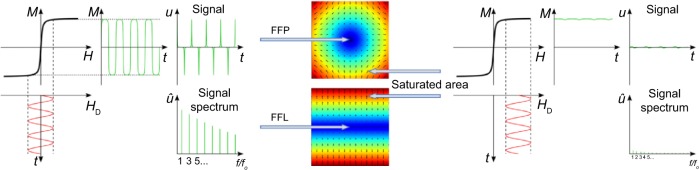
Figure 1
Figure 1
MPI, basic concept. Notes: Left: response of SPIONs within the FFP/FFL. The response consists of the excitation frequency f and higher harmonics of it. Middle: a graphical depiction of an FFP and an FFL. Only SPIONs within and in close vicinity to the nonsaturated areas respond to the excitation field. The signals’ origin can be allocated to the FFP/FFL. Right: SPIONs outside the FFP/FFL are magnetically saturated and do not respond to the excitation field in a significant way. Abbreviations: M, magnetization of SPIONs; H, magnetic field strength; HD, magnetic field strength of the drive field; t, time; u, voltage; û, Fourier transform of voltage signal; f/f0, higher harmonics of excitation frequency; MPI, magnetic particle imaging; SPION, superparamagnetic iron oxide nanoparticle; FFP, field-free point; FFL, field-free line.
Figure 2
Figure 2
Four different methods of FFP movement to achieve a spatial coverage of the FOV. Notes: From left to right: (A) The single-voxel method, where for each voxel an FFP has to be generated. (B) The Lissajous trajectory, providing a good coverage of the FOV and therefore used for fast electromagnetic movement of the FFP via drive and focus fields in many current MPI systems. (C) An 1D movement of the FFP, with the excitation field as performed by scanners of the Berkeley group.,– (D) The whole FOV is covered by a mechanical movement of the object of interest. The traveling wave method, where the FFP is moved electromagnetically in one direction. With a shift of the FFP within the analyzed plane, several line scans can be obtained. Abbreviations: FFP, field-free point; FOV, field of view; MPI, magnetic particle imaging; 1D, one dimensional.
Figure 3
Figure 3
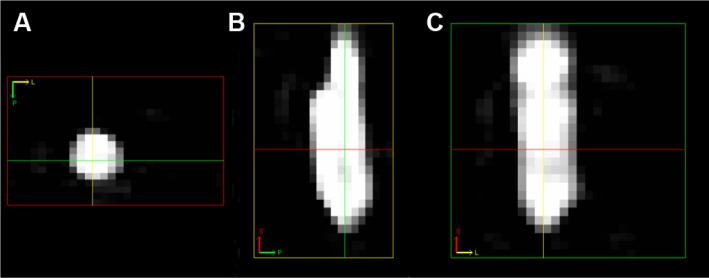
MPI image of a balloon catheter filled with SPIONs. Notes: From left to right: An image of a commercially available and routinely used interventional device in axial (A), sagittal (B), and coronal (C) plane reconstruction. The contour of the catheter is clearly distinguishable. Abbreviations: MPI, magnetic particle imaging; SPION, superparamagnetic iron oxide nanoparticle.
Figure 4
Figure 4
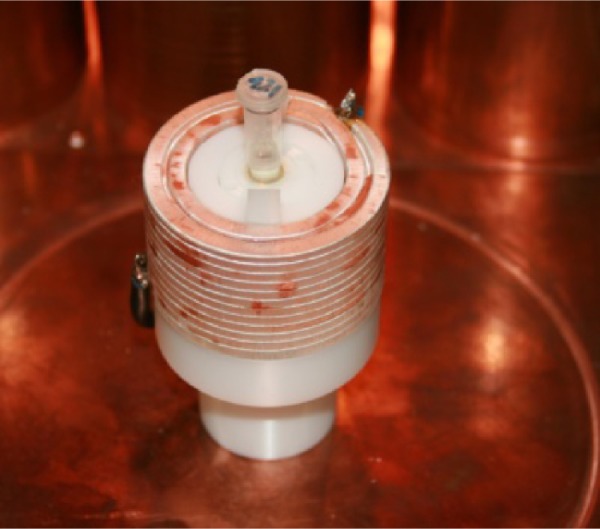
Transmit and receive setup of a magnetic particle spectrometer. Notes: The nanoparticle samples are placed in the center of the send and the receive coil. The coils are manufactured of a high frequency litz wire and are glued and pressed to avoid vibrations.
Figure 5
Figure 5
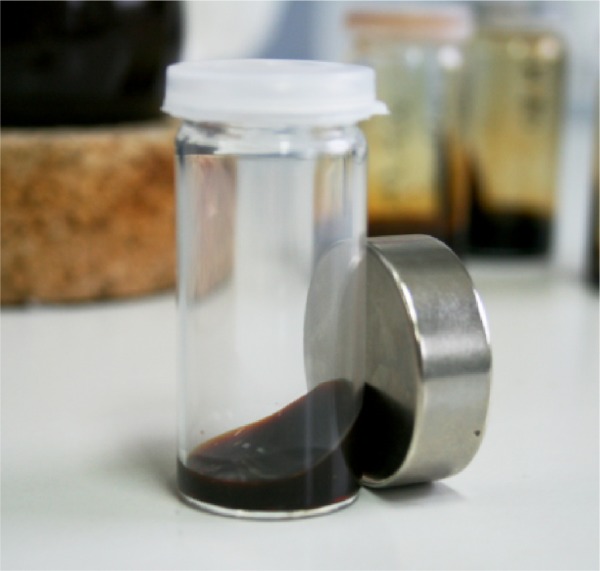
Magnetic nanoparticles synthesized at the Institute of Medical Engineering of the Universität zu Lübeck. Notes: The fluidal sample shown here is magnetized by a permanent magnet due to a parallel orientation of the SPIONs’ magnetization. Without this external magnetic field the SPIONs would return to a random orientation of each particle’s magnetization. Abbreviation: SPION, superparamagnetic iron oxide nanoparticle.
Figure 6
Figure 6
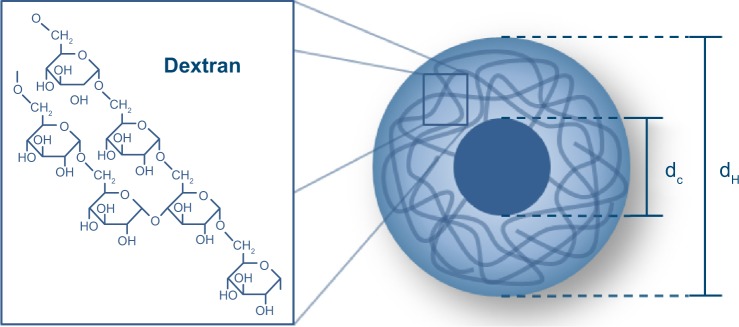
Schematic drawing of a spherical and dextran-coated magnetic nanoparticle. Notes: The magnetic core (with core diameter dC) is surrounded by a magnetically neutral coating (with hydrodynamic diameter dH), which is necessary to prevent agglomeration of the particles.
Figure 7
Figure 7
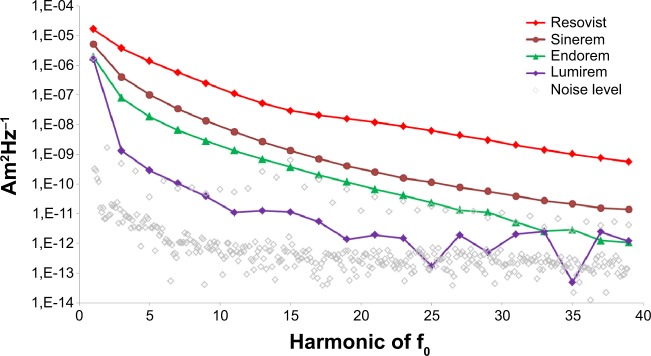
MPI performance of SPION contrast agents for MRI. Notes: Resovist shows the highest MPI signal of all commercially available SPION tracers. On the axis of abscissae, the higher harmonics of the excitation frequency of f0 =25 kHz are stated. The signal strength (spectral magnetic moment/Am2Hz−1) is shown on the axis of ordinates. Measurements were performed as described by Lüdtke-Buzug et al. Abbreviations: MPI, magnetic particle imaging; MRI, magnetic resonance imaging; SPION, superparamagnetic iron oxide nanoparticle.
Figure 8
Figure 8
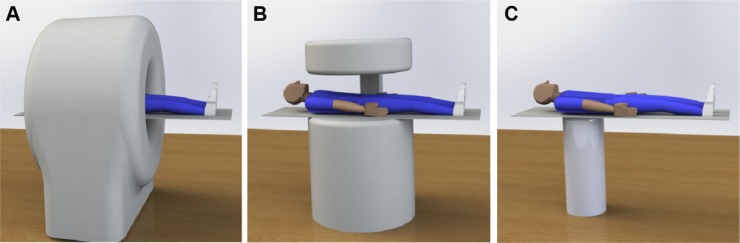
Concept of the three main scanner geometries. Notes: (A) Closed-bore scanner. (B) Open-bore scanner. (C) Single-sided scanner.
Figure 9
Figure 9
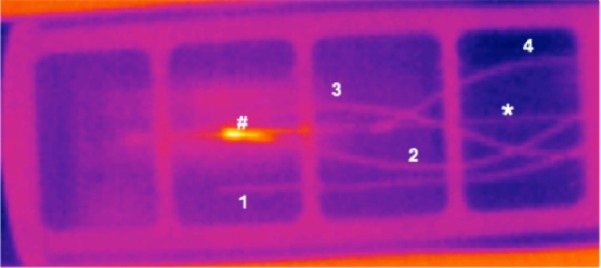
Thermal image of an interventional device seconds after removing it from an MPI scanner. Notes: Phantom (pink frame) allows exact positioning of instruments (*) and temperature sensors (1 to 4) inside the bore of the MPI scanner. Reference sensor has no contact to instruments. The other sensors measured heating at the FFP (2) and also distal (3) and proximal (4) of the FFP. Hotspot of punctual heating is shown at the FFP (#) in an instrument with ferromagnetic characteristics. Abbreviations: MPI, magnetic particle imaging; FFP, field-free point.

References

    1. Gleich B, Weizenecker J. Tomographic imaging using the nonlinear response of magnetic particles. Nature. 2005;435(7046):1214–1217. - PubMed
    1. Knopp T, Buzug TM. Magnetic Particle Imaging: An Introduction to Imaging Principles and Scanner Instrumentation. Heidelberg, Germany: Springer; 2012.
    1. Goodwill PW, Tamrazian A, Croft LR, et al. Ferrohydrodynamic relaxometry for magnetic particle imaging. Appl Phys Lett. 2011;98:262502.
    1. Borgert J, Schmidt JD, Schmale I, et al. Fundamentals and applications of magnetic particle imaging. J Cardiovasc Comput Tomogr. 2012;6(3):149–153. - PubMed
    1. Goodwill PW, Saritas EU, Croft LR, et al. X-Space MPI: Magnetic Nanoparticles for Safe Medical Imaging. Adv Mater. 2012;24(28):3870–3877. - PubMed

Publication types

MeSH terms

Substances