


Association between anxiety and hypertension: a systematic review and meta-analysis of epidemiological studies
- PMID: 25960656
- PMCID: PMC4411016
- DOI: 10.2147/NDT.S77710
Association between anxiety and hypertension: a systematic review and meta-analysis of epidemiological studies
Abstract
Background: Epidemiological studies have repeatedly investigated the association between anxiety and hypertension. However, the results have been inconsistent. This study aimed to summarize the current evidence from cross-sectional and prospective studies that evaluated this association.
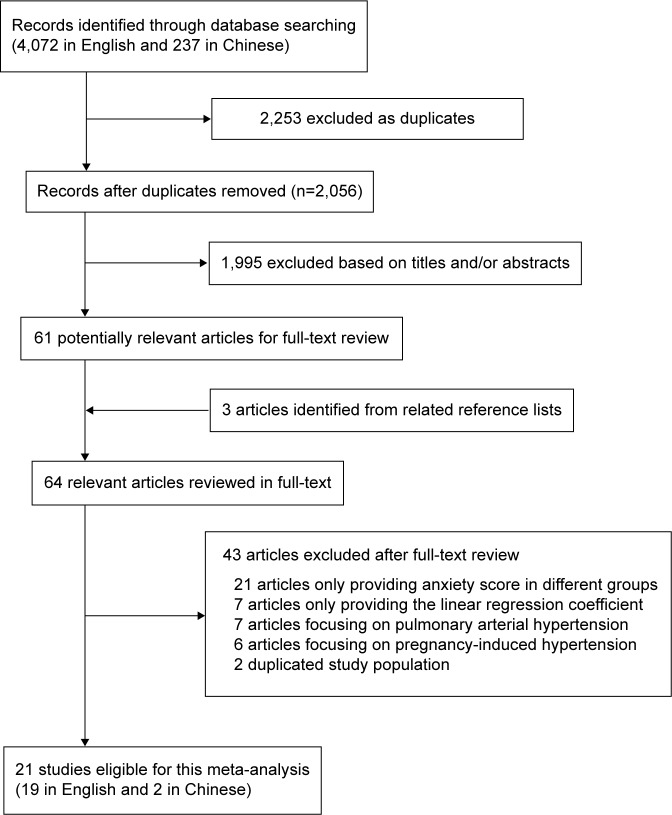
Methods: Seven common databases were searched for articles published up to November 2014. Cross-sectional and prospective studies that reported an association between the two conditions in adults were included. Data on prevalence, incidence, unadjusted or adjusted odds ratios or hazard ratios, and 95% confidence intervals (CIs) were extracted or calculated by the authors. The pooled odds ratio was calculated separately for cross-sectional and prospective studies using random-effects models. The Q test and I2 statistic was used to assess heterogeneity. A funnel plot and modified Egger linear regression test were used to estimate publication bias.
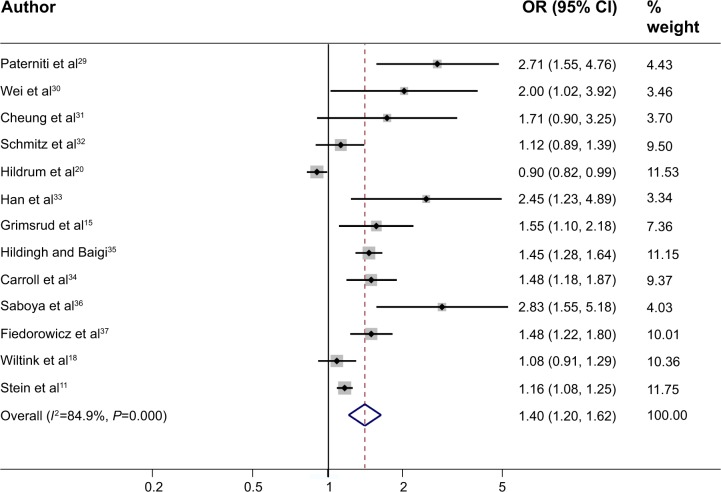
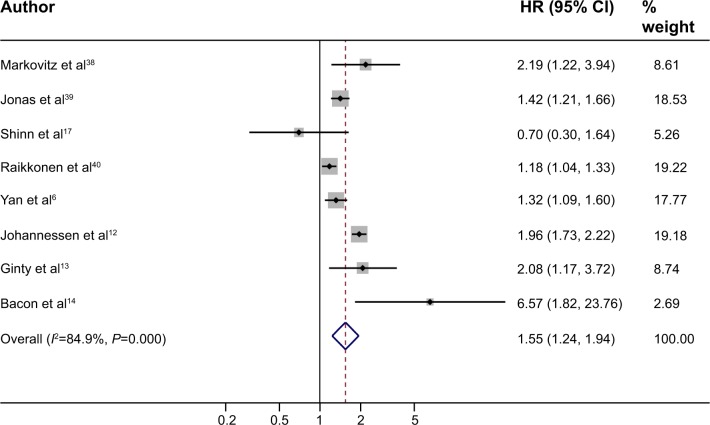
Results: The search yielded 13 cross-sectional studies (n=151,389), and the final pooled odds ratio was 1.18 (95% CI 1.02-1.37; P Q<0.001; I (2)=84.9%). Eight prospective studies with a total sample size of 80,146 and 2,394 hypertension case subjects, and the pooled adjusted hazard ratio was 1.55 (95% CI 1.24-1.94; P Q<0.001; I (2)=84.6%). The meta-regression showed that location, diagnostic criteria for anxiety, age, sex, sample size, year of publication, quality, and years of follow-up (for prospective study) were not sources of heterogeneity.
Conclusion: Our results suggest that there is an association between anxiety and increased risk of hypertension. These results support early detection and management of anxiety in hypertensive patients.
Keywords: anxiety disorder; epidemiological association; human; hypertension; meta-analysis.
Figures
References
-
- World Health Organization Global health risks: mortality and burden of disease attributable to selected major risks. [Accessed January, 19 2015]. Available from: http://www.who.int/healthinfo/global_burden_disease/GlobalHealthRisks_re....
-
- Kearney PM, Whelton M, Reynolds K, Muntner P, Whelton PK, He J. Global burden of hypertension: analysis of worldwide data. Lancet. 2005;365(9455):217–223. - PubMed
-
- Fava C, Danese E, Montagnana M, et al. Serine/threonine kinase 39 is a candidate gene for primary hypertension especially in women: results from two cohort studies in Swedes. J Hypertens. 2011;29(3):484–491. - PubMed
-
- Kowalik M. Psychosomatic aspects of arterial hypertension in women. Ann Univ Mariae Curie Sklodowska Med. 2004;59(1):245–249. - PubMed
-
- Markovitz JH, Jonas BS, Davidson K. Psychologic factors as precursors to hypertension. Curr Hypertens Rep. 2001;3(1):25–32. - PubMed
LinkOut - more resources
Full Text Sources
Other Literature Sources
Medical
