


Development of non-alcoholic fatty liver disease scoring system among adult medical check-up patients: a large cross-sectional and prospective validation study
- PMID: 25960672
- PMCID: PMC4410820
- DOI: 10.2147/DMSO.S80364
Development of non-alcoholic fatty liver disease scoring system among adult medical check-up patients: a large cross-sectional and prospective validation study
Abstract
Background: Non-alcoholic fatty liver disease (NAFLD) is the most common liver disease in the community. However, NAFLD remains undiagnosed in most people with limited access to imaging facilities in most developing countries.
Objective: To examine the prevalence of NAFLD and to develop the risk scoring model for predicting the presence of NAFLD among adult medical check-up patients.
Method: A large prospective cross-sectional study was conducted among medical check-up patients who underwent transabdominal ultrasound examination between January and December 2013 in Medistra Hospital, Jakarta. Data were obtained from the patients' medical records. Logistic regression analyses were undertaken to identify the best combination of risk factors for predicting fatty liver using the backward (likelihood ratio) approach. The adjusted odds ratio and 95% confidence interval were estimated using the logistic regression coefficient. The prediction model was assessed using the receiver operating characteristic curve and the Hosmer-Lemeshow goodness-of-fit test and was validated on a new, prospective cohort. Statistical analysis was done using SPSS version 17.
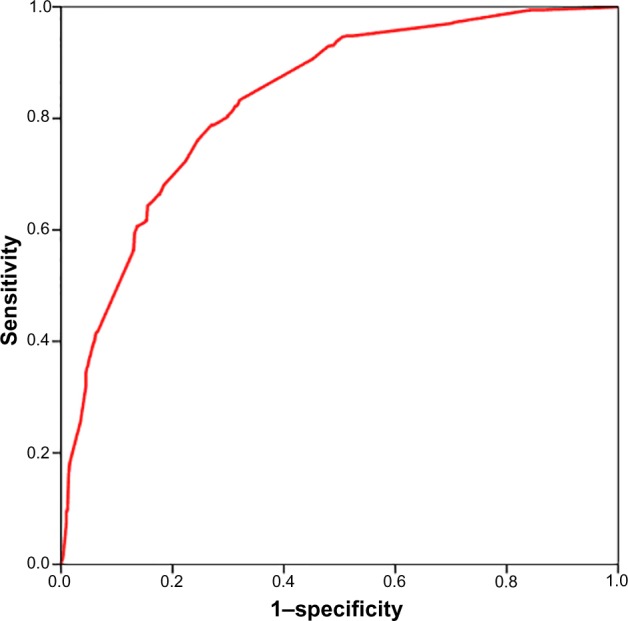
Results: A total of 1,054 cases was included in this study. Fatty liver was present in 538 (51.0%) patients. Bivariate analyses found associations among fatty liver and several risk factors. Six risk factors were incorporated to build the final prediction model. All scores were summed up to obtain the total score. A probability equation was developed by applying linear regression analysis on the total score. The prediction model had good diagnostic performance with an area under the receiver operating characteristic curve =0.833 (95% confidence interval =0.809-0.857). The Hosmer-Lemeshow goodness-of-fit P-value was 0.232, which indicated the appropriateness of the logistic regression model to predict fatty liver. On the validation set, the scoring system proved to be moderately accurate and can potentially be applied to larger population setting.
Conclusion: The presence of fatty liver in NAFLD patients can be predicted using our proposed fatty liver scoring system.
Keywords: community; developing countries; diagnostic performance; fatty liver; scoring model; ultrasound.
Figures
References
-
- Amarapurkar D, Hashimoto E, Lesmana LA, et al. How common is non-alcoholic fatty liver disease in the Asia-Pacific region and are there local differences? J Gastroenterol. 2007;22(6):788–793. - PubMed
-
- Fan JG, Saibara T, Chitturi S, et al. What are the risk factors and settings for non-alcoholic fatty liver disease in Asia-Pacific? J Gastroenterol Hepatol. 2007;22(6):794–800. - PubMed
-
- Ratziu V, Bellentani S, Cortez-Pinto H, Day C, Marchesini G. A position statement on NAFLD/NASH based on the EASL 2009 special conference. J Hepatol. 2010;53(2):372–384. - PubMed
-
- Bedogni G, Miglioli L, Masutti F, Tiribelli C, Marchesini G, Bellentani S. Prevalence of and risk factors for nonalcoholic fatty liver disease: the Dionysos nutrition and liver study. Hepatology. 2005;42(1):44–52. - PubMed
LinkOut - more resources
Full Text Sources
