Review
. 2015;8(6):18.
doi: 10.1007/s12410-015-9334-0.

Management of Coronary Artery Calcium and Coronary CTA Findings

Affiliations
Review

Management of Coronary Artery Calcium and Coronary CTA Findings

Dustin M Thomas et al. Curr Cardiovasc Imaging Rep. 2015.

Abstract

Coronary artery calcium (CAC) testing and coronary computed tomography angiography (CTA) have significant data supporting their ability to identify coronary artery disease (CAD) and classify patient risk for atherosclerotic cardiovascular disease (ASCVD). Evidence regarding CAC use for screening has established an excellent prognosis in patients with no detectable CAC, and the ability to risk re-classify the majority of asymptomatic patients considered intermediate risk by traditional risk scores. While data regarding the ideal management of CAC findings are limited, evidence supports statin consideration in patients with CAC > 0 and individualized aspirin therapy accounting for CAD risk factors, CAC severity, and factors which increase a patient's risk of bleeding. In patients with stable or acute symptoms undergoing coronary CTA, a normal CTA predicts excellent prognosis, allowing reassurance and disposition without further testing. When CTA identifies nonobstructive CAD (<50 % stenosis), observational data support consideration of statin use/intensification in patients with extensive plaque (at least four coronary segments involved) and patients with high-risk plaque features. In patients with both nonobstructive and obstructive CAD, multiple studies have now demonstrated an ability of CTA to guide management and improve CAD risk factor control. Still, significant under-treatment of cardiovascular risk factors and high-risk image findings remain, among concerns that CTA may increase invasive angiography and revascularization. To fully realize the impact of atherosclerosis imaging for ASCVD prevention, patient engagement in lifestyle changes and the modification of ASCVD risk factors remain the foundation of care. This review provides an overview of available data and recommendations in the management of CAC and CTA findings.

Keywords: Acute coronary syndrome; Cardiovascular disease; Chest pain; Coronary CTA; Coronary artery calcium; High risk plaque; Ischemic heart disease; Major adverse cardiac events; Management; Prognosis; atherosclerosis.


Figures
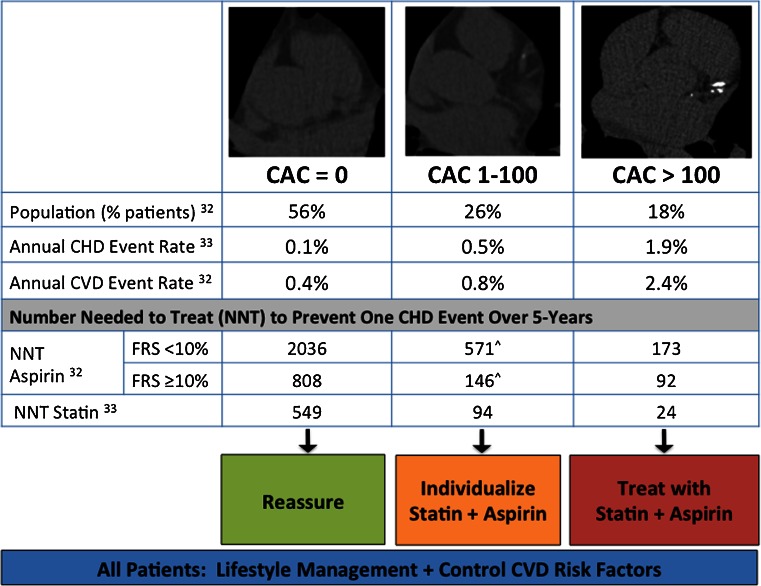
Fig. 1
Fig. 1
CAC score prognosis and recommended treatment strategy. ^Note that the estimated number needed to harm with aspirin use is 442 patients to cause one major bleeding episode over a 5-year period [32]. Thus, consider aspirin use in patients with CAC 1-100 when anticipated benefit exceeds risk (e.g., when FRS ≥ 10 %). CAC, coronary artery calcium (Agatston units); CHD, coronary heart disease; CVD, cardiovascular disease; FRS, Framingham risk score; NNT, number needed to treat. Adapted with permission from Divakaran et al. [26]
Fig. 2
Fig. 2
Coronary CTA identified CAD severity. Recommended quantitative stenosis grading of CAD assessed by coronary CTA [40]. Following stenosis assessment, recommend grading of CTA-identified plaque features and CAD extent (see Fig. 3). CAD, coronary artery disease; CTA, computed tomographic angiography
Fig. 3
Fig. 3
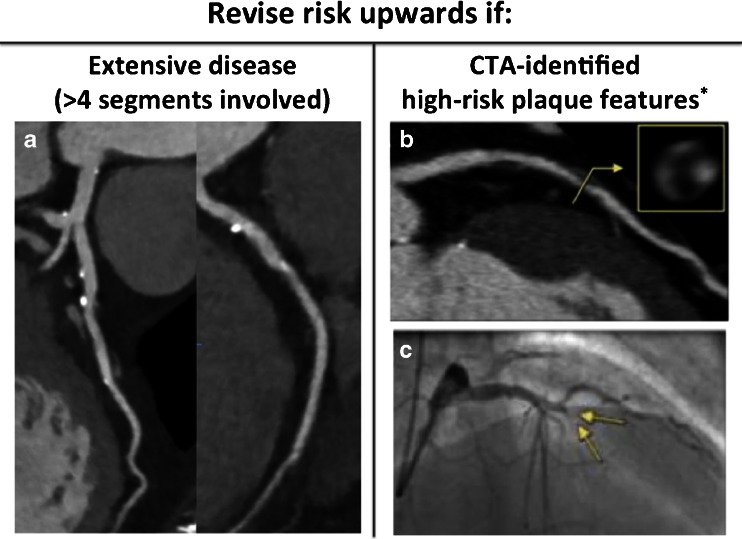
Coronary CTA features associated with an increased risk of major adverse cardiac events. a Extensive nonobstructive calcified plaque in the left main, proximal-mid LAD, proximal left circumflex, and first obtuse marginal arteries. b An atherosclerotic plaque with positive remodeling, low-attenuation plaque, and napkin-ring sign in the proximal LAD on coronary CTA*. c Invasive coronary angiography demonstrating occlusion of the proximal LAD at the site of high-risk plaque 10 months after coronary CTA (arrows). *Reproduced with permission from Otsuka et al. [41]. CTA, computed tomographic angiography; LAD, left anterior descending
Fig. 4
Fig. 4
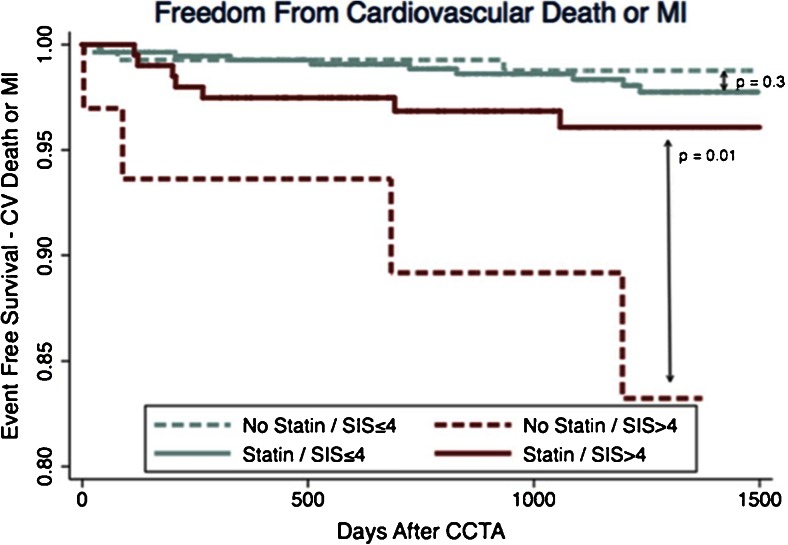
Event-free survival from cardiovascular (CV) death or myocardial infarction (MI) according to presence or absence of statin therapy post-CCTA among those with nonobstructive coronary artery disease (CAD), stratified by extent of disease according to Segment Involvement Score (SIS). Reproduced with permission from Hulten et al. [•]
Fig. 5
Fig. 5
Rate of cardiovascular (CV) death or myocardial infarction (MI) according to the presence, severity, and extent of coronary artery disease (CAD). There is a significant difference (p < 0.01) in rates for all comparisons except nonobstructive CAD with segment involvement score (SIS) > 4 and obstructive CAD with SIS ≤ 4. Reproduced with permission from Bittencourt et al. [58]
Fig. 6
Fig. 6
Management of coronary CTA findings. Patients with a normal coronary CTA have a very low (<1 %/year) rate of MACE and can be reassured while ED patients may be safely discharged. In patients with nonobstructive CAD, follow-up lifestyle modification and preventive therapy is recommended. Number sign revise risk upwards if diffuse nonobstructive CAD (e.g., segment involvement score > 4) and/or high-risk plaque features present (see Fig. 3). *For acute chest pain, consider repeat biomarkers prior to discharge if extensive nonobstructive CAD present. In obstructive CAD with symptoms concerning for stable ischemic heart disease, first-line optimal medical therapy is recommended with consideration for further testing according to appropriate use criteria for testing after CTA (see Table 3) [••]. ^In patients with acute chest pain and obstructive CAD, follow guidelines for the diagnosis and management of unstable angina/non-ST-segment elevation myocardial infarction to guide an early invasive versus conservative strategy [66]. CAD, coronary artery disease; CTA, computed tomographic angiography; OMT, optimal medical therapy

References

    1. Xu J, Kochanek KD, Murphy SL, Arias E. Mortality in the United States, 2012. NCHS Data Brief. 2014;(168):1–8. - PubMed
    1. Crescioni M, Gorina Y, Bilheimer L, Gillum RF. Trends in health status and health care use among older men. Natl Health Stat Report. 2010;(24):1–18. - PubMed
    1. Bavry AA, Kumbhani DJ, Rassi AN, Bhatt DL, Askari AT. Benefit of early invasive therapy in acute coronary syndromes: a meta-analysis of contemporary randomized clinical trials. J Am Coll Cardiol. 2006;48(7):1319–25. doi: 10.1016/j.jacc.2006.06.050. - DOI - PubMed
    1. Baigent C, Blackwell L, Emberson J, Holland LE, Reith C, Bhala N, et al. Efficacy and safety of more intensive lowering of LDL cholesterol: a meta-analysis of data from 170,000 participants in 26 randomised trials. Lancet. 2010;376(9753):1670–81. doi: 10.1016/S0140-6736(10)61350-5. - DOI - PMC - PubMed
    1. Lewington S, Clarke R, Qizilbash N, Peto R, Collins R. Age-specific relevance of usual blood pressure to vascular mortality: a meta-analysis of individual data for one million adults in 61 prospective studies. Lancet. 2002;360(9349):1903–13. doi: 10.1016/S0140-6736(02)11911-8. - DOI - PubMed