


A Model of Cancer Clinical Trial Decision-making Informed by African-American Cancer Patients
- PMID: 25960945
- PMCID: PMC4420720
- DOI: 10.1007/s40615-014-0063-x
A Model of Cancer Clinical Trial Decision-making Informed by African-American Cancer Patients
Abstract
Background: Clinical trials are critical to advancing cancer treatment. Minority populations are underrepresented among trial participants, and there is limited understanding of their decision-making process and key determinants of decision outcomes regarding trial participation.
Methods: To understand research decision-making among clinical trial-eligible African-American cancer patients at Johns Hopkins, we conducted seven focus groups (n=32) with trial-offered patients ≥ 18 years diagnosed with lung, breast, prostate, or colorectal cancer ≤ 5 years. Three "acceptor" and four "decliner" focus groups were conducted. Questions addressed: attitudes towards clinical trials, reasons for accepting or declining participation, and recommendations to improve minority recruitment and enrollment. Data were transcribed and analyzed using traditional approaches to content and thematic analysis in NVivo 9.0. Data coding resulted in themes that supported model construction.
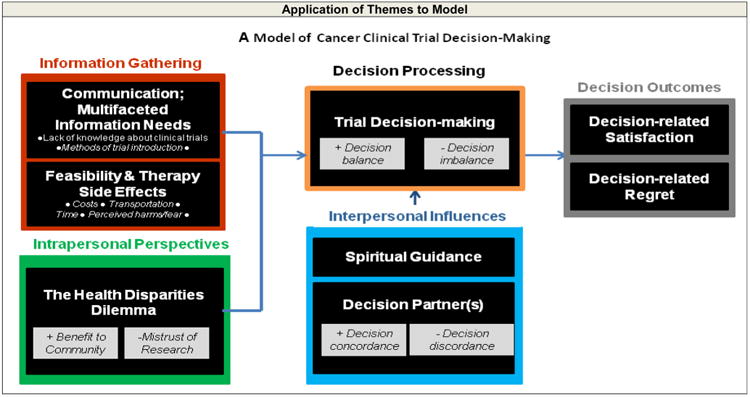
Results: Participant experiences revealed the following themes when describing the decision-making process: Information gathering, Intrapersonal perspectives, and Interpersonal influences. Decision outcomes included the presence or absence of decision regret and satisfaction. From these themes, we generated a Model of Cancer Clinical Trial Decision-making.
Conclusion: Our model should be tested in hypothesis-driven research to elucidate factors and processes influencing decision balance and outcomes of trial-related decision-making. The model should also be tested in other disparities populations and for diagnoses other than cancer.
Keywords: African-Americans; Cancer disparities; Clinical trials; Decision balance; Decision regret.
Conflict of interest statement
Figures
References
-
- Siegel R, Ward E, Brawley O, Jemal A. Cancer statistics. CA Cancer J Clin. 2011;61(4):212–36. - PubMed
-
- Adams-Campbell LL, Ahaghotu C, Gaskins M, et al. Enrollment of African Americans onto clinical treatment trials: study design barriers. J Clin Oncol. 2004;22(4):730–4. - PubMed
-
- Goss E, Lopez AM, Brown CL, Wollins DS, Brawley OW, Raghavan D. American society of clinical oncology policy statement: disparities in cancer care. J Clin Oncol. 2009;27(17):2881–5. - PubMed
Publication types
MeSH terms
Grants and funding
LinkOut - more resources
Full Text Sources
Other Literature Sources
Medical