Review
. 2015 Jun;125(6):2220-7.
doi: 10.1172/JCI78087. Epub 2015 May 11.

T cell signaling abnormalities contribute to aberrant immune cell function and autoimmunity

Review

T cell signaling abnormalities contribute to aberrant immune cell function and autoimmunity

Vaishali R Moulton et al. J Clin Invest. 2015 Jun.

Abstract

Systemic lupus erythematosus (SLE) is a prototype systemic autoimmune disease that results from a break in immune tolerance to self-antigens, leading to multi-organ destruction. Autoantibody deposition and inflammatory cell infiltration in target organs such as kidneys and brain lead to complications of this disease. Dysregulation of cellular and humoral immune response elements, along with organ-defined molecular aberrations, form the basis of SLE pathogenesis. Aberrant T lymphocyte activation due to signaling abnormalities, linked to defective gene transcription and altered cytokine production, are important contributors to SLE pathophysiology. A better understanding of signaling and gene regulation defects in SLE T cells will lead to the identification of specific novel molecular targets and predictive biomarkers for therapy.


Figures
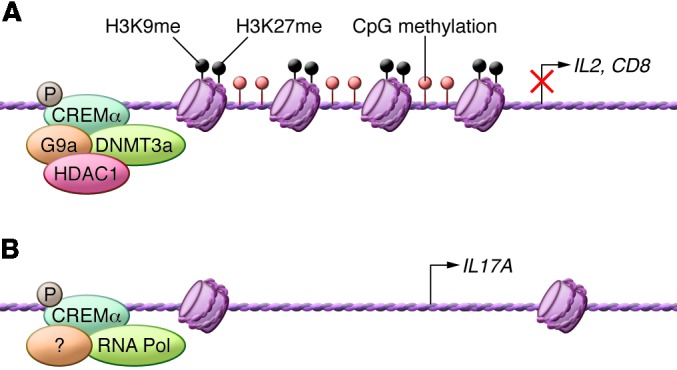
Figure 3
Figure 3. Epigenetic role of CREMα in the transcriptional regulation of IL2, IL17A, and CD8.
(A) Through binding to the promoters of IL2 and CD8 (and other sites throughout their loci), CREMα recruits DNMT3a, HDAC1, and H3K27, which render these loci inaccessible. (B) In contrast, binding of CREMα to the IL17A promoter does not result in the recruitment of locus-closing molecules.
Figure 2
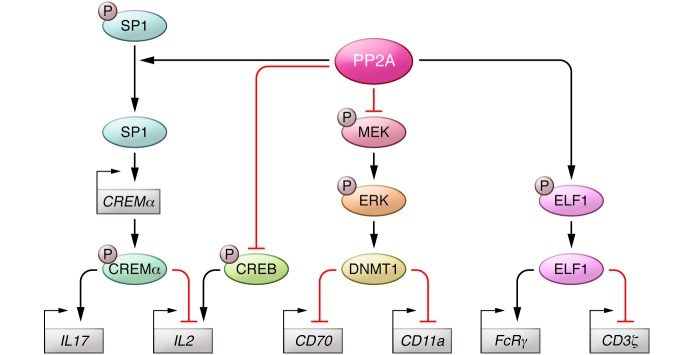
Figure 2. Role of serine threonine phosphatase PP2A in SLE T cell pathophysiology.
PP2A dephosphorylates and activates SP1 to increase expression of CREMα, which enhances expression of IL-17 and represses expression of IL-2. IL-2 expression is increased by binding of phospho-CREB, which is also dephosphorylated/deactivated by PP2A. Phospho-CREB and phospho-CREMα both bind to the –180 bp position within the IL2 promoter; thus, the ratio of these proteins determine overall IL-2 expression. PP2A dephosphorylates and activates the transcriptional enhancer ELF1, which increase expression of CD3ζ and decreases expression of FcRγ.PP2A dephosphorylates MEK1/2 to block activity of the methyltransferase DNMT1, leading to hypomethylation and increased expression of CD70 and CD11a.
Figure 1
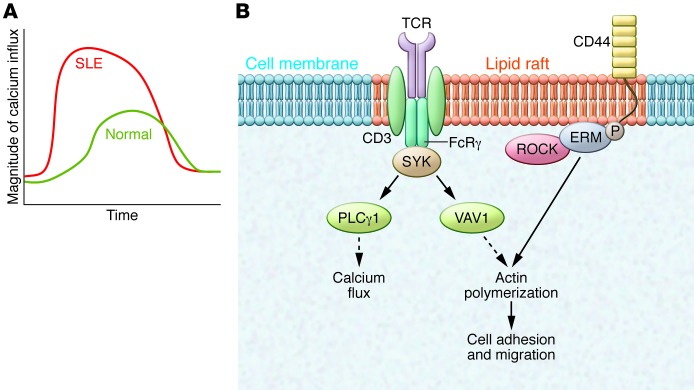
Figure 1. Altered TCR/CD3 complex and lipid raft composition in SLE T cells.
(A) Engagement of the CD3/TCR complex in SLE T cells leads to a heightened and earlier proximal signaling response characterized by increased free intracytoplasmic calcium concentration and cytosolic protein tyrosine phosphorylation. The graph shows the magnitude and kinetics of intracellular calcium flux in normal and SLE T cells. (B) Lipid rafts in SLE T cells are preclustered and display altered arrangement of signaling molecules. The TCR/CD3 complex undergoes rewiring to express FcRγ and Syk kinase in place of CD3ζ and ZAP70, respectively, sending a stronger downstream signal and increasing intracellular calcium flux. Signaling through VAV1 leads to actin polymerization and cellular migration. SLE T cells express higher levels of the surface adhesion molecule CD44. Upon activation of CD44, ROCK phosphorylates the ERM proteins, thereby inducing actin polymerization to increase adhesion and migration.

References

    1. Tsokos GC. Systemic lupus erythematosus. N Engl J Med. 2011;365(22):2110–2121. doi: 10.1056/NEJMra1100359. - DOI - PubMed
    1. Moulton VR, Tsokos GC. Abnormalities of T cell signaling in systemic lupus erythematosus. Arthritis Res Ther. 2011;13(2):207. doi: 10.1186/ar3251. - DOI - PMC - PubMed
    1. Krishnan S, Farber DL, Tsokos GC. T cell rewiring in differentiation and disease. J Immunol. 2003;171(7):3325–3331. doi: 10.4049/jimmunol.171.7.3325. - DOI - PubMed
    1. Krishnan S, et al. Differential expression and molecular associations of Syk in systemic lupus erythematosus T cells. J Immunol. 2008;181(11):8145–8152. doi: 10.4049/jimmunol.181.11.8145. - DOI - PMC - PubMed
    1. Nambiar MP, et al. Reconstitution of deficient T cell receptor zeta chain restores T cell signaling and augments T cell receptor/CD3-induced interleukin-2 production in patients with systemic lupus erythematosus. Arthritis Rheum. 2003;48(7):1948–1955. doi: 10.1002/art.11072. - DOI - PubMed

Publication types