Clinical Trial
. 2015 May 11:5:10096.
doi: 10.1038/srep10096.

Interferon gamma-induced protein 10 is associated with insulin resistance and incident diabetes in patients with nonalcoholic fatty liver disease

Affiliations
Clinical Trial

Interferon gamma-induced protein 10 is associated with insulin resistance and incident diabetes in patients with nonalcoholic fatty liver disease

Chia-Chu Chang et al. Sci Rep. .

Abstract

Nonalcoholic fatty liver disease (NAFLD) is an important risk factor for the development of type 2 diabetes mellitus. Interferon gamma-induced protein 10 (IP-10), a proinflammatory chemokine, plays a crucial role in inflammatory diseases. This cross-sectional pilot study investigated whether circulating IP-10 is associated with the progression of liver disease, and prediabetes in patients with NAFLD. A total of 90 patients with NAFLD alone (n = 48) or NAFLD with incident diabetes (n = 42) and 43 controls participated in this study. Fasting plasma was used to assess metabolic parameters, inflammatory factors, endotoxin levels, and malondialdehyde (MDA) concentrations. Insulin resistance was estimated using homeostatic model assessment (HOMA-IR). IP-10 levels were significantly higher in patients with NAFLD alone (median (interquartile range): 369.44 (309.30-418.97) pg/mL) and in those with incident diabetes (418.99 (330.73-526.04) pg/mL) than in controls (293.37 (214.10-331.57) pg/mL) (P < 0.001). IP-10 levels were positively correlated with levels of alanine aminotransferase, hs-CRP, MDA, MCP-1, and TNF-α as well as HOMA-IR values. Ordinal logistic regression analysis revealed IP-10 was an independent risk factor associated with progressive liver injury, insulin resistance and incident diabetes. Circulating IP-10 may be a non-invasive biomarker for disease progression and subsequent diabetes development of NAFLD.


Figures
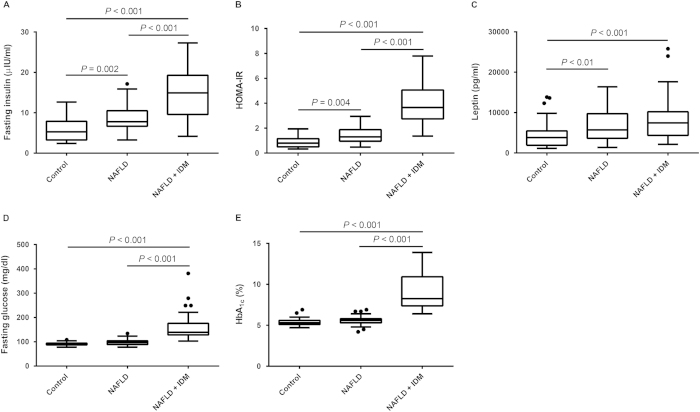
Figure 1
Figure 1
Clinical characteristics among the three groups. (A) Fasting insulin level, (B) HOMA-IR value and (C) leptin concentration were significantly higher in patients with NAFLD alone and in NAFLD patients with incident diabetes than in subjects without NAFLD (control group). (A) Fasting insulin, (B) HOMA-IR, (D) fasting glucose and (E) HbA1c were significantly higher in subjects with NAFLD and incident diabetes than in subjects in the control and NAFLD alone groups. (A, B) An escalating trend in fasting insulin and HOMA-IR was observed among the three groups. (A - E) Box-and-whisker plots. The top and bottom of each box indicate the 1st and 3rd quartiles (interquartile range, IQR), and the band inside the box is the median. The ends of the whiskers represent the minima and maxima without outliers. The dot indicates an outlier more than 1.5 times the IQR below the 25th percentile, or more than 1.5 times the IOR above the 75th percentile of all of the data.
Figure 2
Figure 2
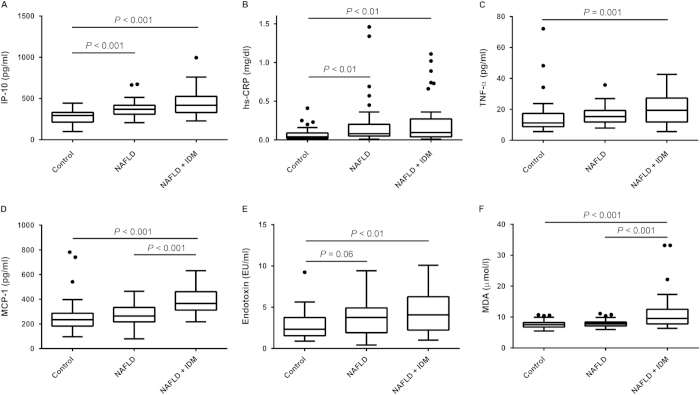
Circulating high-sensitivity CRP, proinflammatory cytokines, endotoxin and oxidative stress in the three groups. (A) IP-10 and (B) hs-CRP levels were significantly higher in patients with NAFLD alone and in NAFLD patients with incident diabetes than in subjects in the control group. (C) TNF-α and (E) endotoxin levels were significantly higher in patients with NAFLD and incident diabetes than in subjects in the control group. (D) MCP-1 and (F) MDA levels were significantly higher in NAFLD patients with incident diabetes than in patients with NAFLD alone and in control subjects. (E) An increasing trend in endotoxin was observed in patients with NAFLD alone.
Figure 3
Figure 3
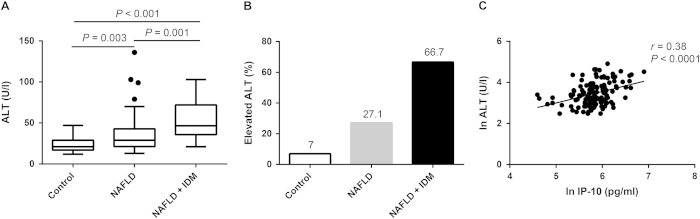
The relationship between liver function tests and circulating IP-10. (A) An escalating trend in serum ALT levels was observed among the three groups. (B) There were significant differences in proportions of participants with elevated liver enzymes among the three groups (P < 0.001 by chi-square test for trend). (C) Plasma IP-10 level was positively correlated with serum ALT in all participants.
Figure 4
Figure 4
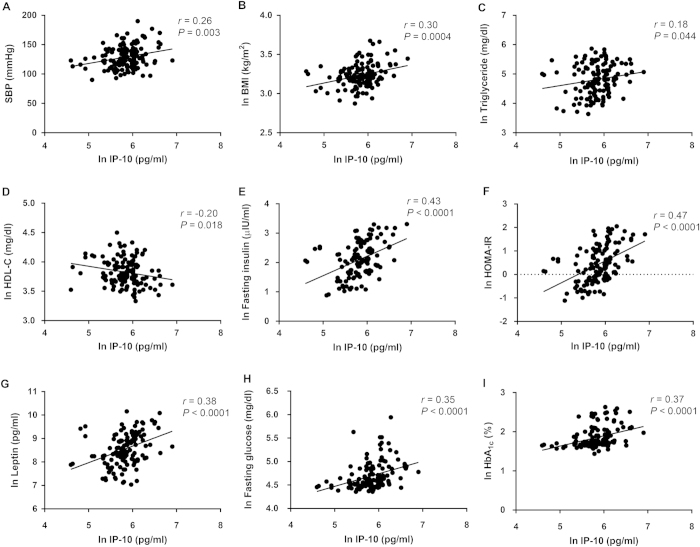
Circulating IP-10 correlates with metabolic syndrome. Univariate analysis of the correlation of plasma IP-10 level with (A) systolic blood pressure, (B) body mass index, (C) triglyceride, (D) HDL-C, (E) fasting insulin, (F) HOMA-IR, (G) leptin, (H) fasting glucose, and (I) HbA1c. The plasma or serum levels of IP-10, triglyceride, HDL-C, fasting insulin, HOMA-IR, leptin, fasting glucose, HbA1c and BMI were expressed as the natural logarithm (ln).
Figure 5
Figure 5
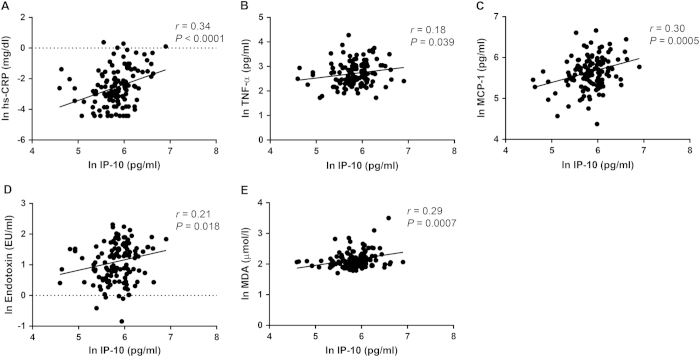
Circulating IP-10 correlates with inflammation marker, proinflammatory cytokines, endotoxinemia and oxidative stress. Positive associations between circulating IP-10 and (A) hs-CRP, (B) TNF-α, (C) MCP-1, (D) endotoxin and (E) MDA.
Figure 6
Figure 6
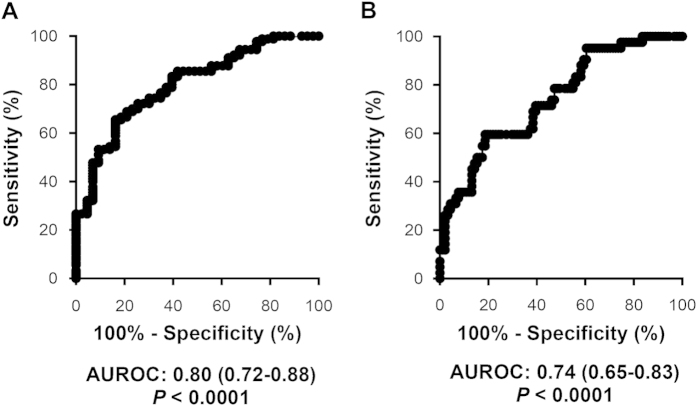
Values of IP-10 for the diagnosis of NAFLD and incident diabetes mellitus. Receiver-operating characteristic curves of plasma IP-10 in diagnosing (A) NAFLD and (B) incident diabetes in all subjects.

References

    1. Clark J. M., Brancati F. L. & Diehl A. M. The prevalence and etiology of elevated aminotransferase levels in the United States. Am. J. Gastroenterol 98, 960–967 (2003). - PubMed
    1. Farrell G. C., Wong V. W. & Chitturi S. NAFLD in Asia--as common and important as in the West. Nat. Rev. Gastroenterol Hepatol. 10, 307–318 (2013). - PubMed
    1. Hu K. C. et al. Nonalcoholic fatty liver disease: updates in noninvasive diagnosis and correlation with cardiovascular disease. World J. Gastroenterol 20, 7718–7729 (2014). - PMC - PubMed
    1. Matteoni C. A. et al. Nonalcoholic fatty liver disease: a spectrum of clinical and pathological severity. Gastroenterology 116, 1413–1419 (1999). - PubMed
    1. Tiniakos D.G., Vos M.B. & Brunt E.M. Nonalcoholic fatty liver disease: pathology and pathogenesis. Annu. Rev. Pathol. 5, 145–171 (2010). - PubMed

Publication types