


doi: 10.1038/srep09749.
Four-state ferroelectric spin-valve
Affiliations
- PMID: 25961513
- PMCID: PMC4426701
- DOI: 10.1038/srep09749
Item in Clipboard
Four-state ferroelectric spin-valve
Sci Rep.
.
Abstract
Spin-valves had empowered the giant magnetoresistance (GMR) devices to have memory. The insertion of thin antiferromagnetic (AFM) films allowed two stable magnetic field-induced switchable resistance states persisting in remanence. In this letter, we show that, without the deliberate introduction of such an AFM layer, this functionality is transferred to multiferroic tunnel junctions (MFTJ) allowing us to create a four-state resistive memory device. We observed that the ferroelectric/ferromagnetic interface plays a crucial role in the stabilization of the exchange bias, which ultimately leads to four robust electro tunnel electro resistance (TER) and tunnel magneto resistance (TMR) states in the junction.
Figures
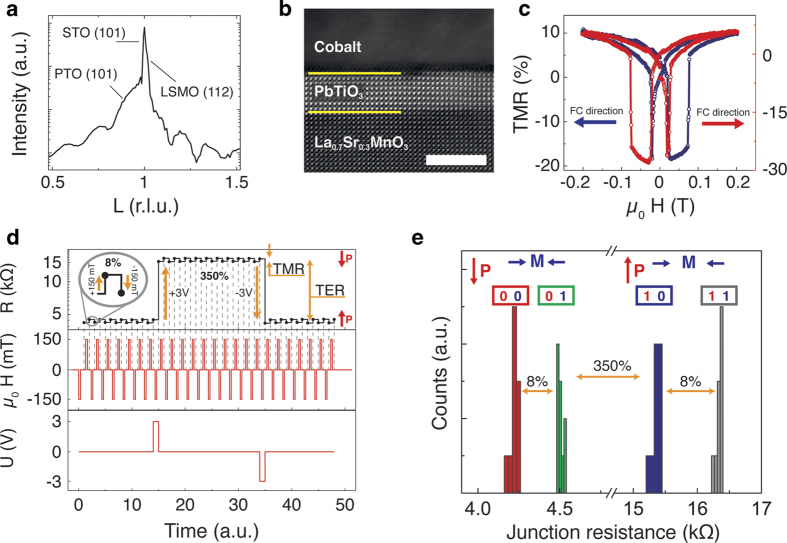
(a) SXRD data from (10 L) crystal truncation rods (CTRs). Reflections coming from STO, PTO and LSMO are indicated. (b) HAADF/STEM image of the tunnel junction, scale bar 5 nm. (c) TMR loops at 5 Kelvin of a LSMO/PTO/Co tunnel device, cooled down in a magnetic field (-800 mT for the blue, +800 mT for red curve, respectively). Exchange bias is visible on the crossing of the butterfly curves at non-zero magnetic field. (d) Resistance measured at full remanence (zero electric field, zero magnetic field) after the application of 150 mT, and ±3 V. (e) Event-counting histogram after 40 measurements showing the separation between the four resistive states.
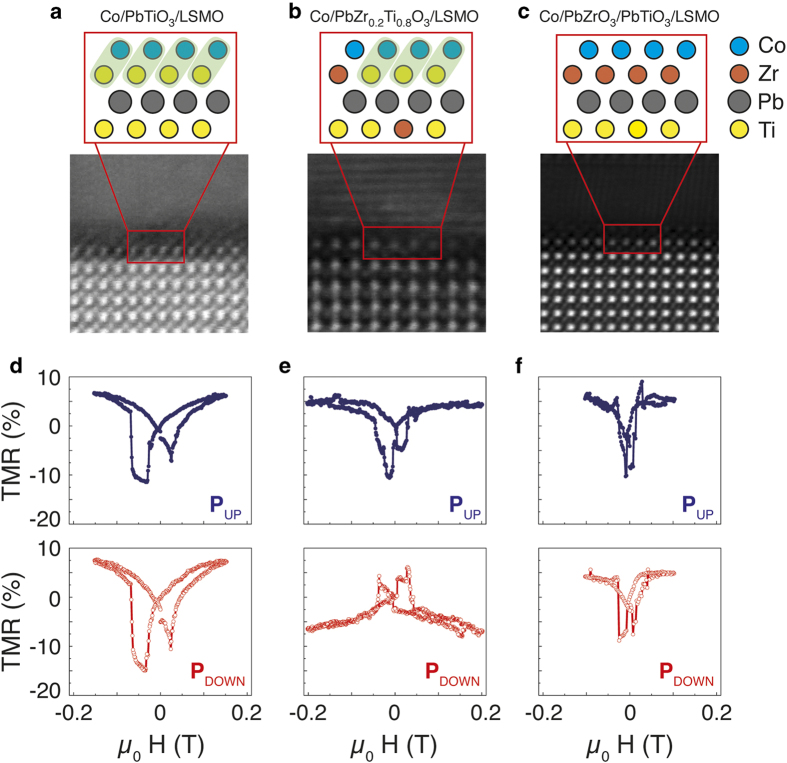
(a, b, c) Schematics and HAADF/STEM images of the FE-FM interfaces, illustrating the dilution of the titanium at the interfaces by zirconium for Co/PTO/LSMO, Co/PZT/LSMO and Co/PZO/PTO/LSMO, respectively. Shadowed atoms are those Co and Ti ones that are magnetically coupled. (d, e, f) TMR loops for ferroelectric polarization states pointing towards the LSMO electrode (red) and the cobalt electrode (blue).
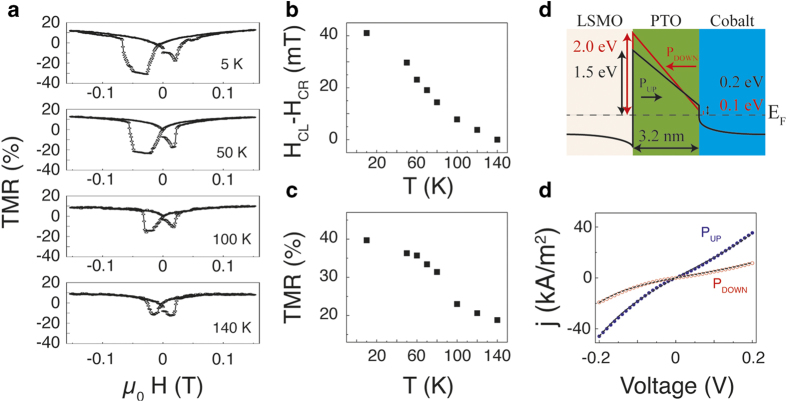
(a) TMR loops for different temperatures, showing a decrease in asymmetry until it becomes symmetric around 140 Kelvin. (b, c) Dependence of the asymmetry (coercive field “left” side (HCL) minus coercive field “right” side (HCR)) and TMR on temperature. (d) Schematics of the band structure according to the results obtained from the fitting parameters in e. (e) IV- characteristic curves after switching the ferroelectric polarization with electric pulses of 3 V and 100 μs. The blue and red points represent measurements for low and high resistance states of the respective junctions with ferroelectric polarization pointing towards and away from the cobalt electrode, respectively. The black dashed lines inside the figures are fits on the data with the Brinkman model. All measurements were performed at 5 Kelvin.
References
-
- Binasch G., Grünberg P., Saurenbach F. & Zinn W. Enhanced magnetoresistance in layered magnetic structures with antiferromagnetic interlayer exchange. Phys. Rev. B. 39, 4828–4830 (1989). - PubMed
-
- Baibich M. N. et al. Giant Magnetoresistance of (001)Fe/(001)Cr Magnetic Superlattices. Phys. Rev. Lett. 61, 2472 (1988). - PubMed
-
- Fert A. & Grünberg P. The Nobel Prize in Physics. (2007) Available at: Nobelprize.org. (Accessed: 1st May 2014).
-
- Dieny B. et al. Giant magnetoresistive in soft ferromagnetic multilayers. Phys. Rev. B. 43, 1297 (1991). - PubMed
-
- Tang D. D., Wang P. K., Speriosu V. S., Le S. & Kung K. K. Spin-valve RAM cell. IEEE Trans. Magn. 31, 3206–3208 (1995).
Publication types
LinkOut - more resources
Full Text Sources
Other Literature Sources
Molecular Biology Databases
Research Materials
Miscellaneous
