. 2016 Feb;17(2):247-60.
doi: 10.1111/mpp.12275. Epub 2015 Jun 7.

Tomato plant cell death induced by inhibition of HSP90 is alleviated by Tomato yellow leaf curl virus infection

Affiliations

Tomato plant cell death induced by inhibition of HSP90 is alleviated by Tomato yellow leaf curl virus infection

Adi Moshe et al. Mol Plant Pathol. 2016 Feb.

Abstract

To ensure a successful long-term infection cycle, begomoviruses must restrain their destructive effect on host cells and prevent drastic plant responses, at least in the early stages of infection. The monopartite begomovirus Tomato yellow leaf curl virus (TYLCV) does not induce a hypersensitive response and cell death on whitefly-mediated infection of virus-susceptible tomato plants until diseased tomatoes become senescent. The way in which begomoviruses evade plant defences and interfere with cell death pathways is still poorly understood. We show that the chaperone HSP90 (heat shock protein 90) and its co-chaperone SGT1 (suppressor of the G2 allele of Skp1) are involved in the establishment of TYLCV infection. Inactivation of HSP90, as well as silencing of the Hsp90 and Sgt1 genes, leads to the accumulation of damaged ubiquitinated proteins and to a cell death phenotype. These effects are relieved under TYLCV infection. HSP90-dependent inactivation of 26S proteasome degradation and the transcriptional activation of the heat shock transcription factors HsfA2 and HsfB1 and of the downstream genes Hsp17 and Apx1/2 are suppressed in TYLCV-infected tomatoes. Following suppression of the plant stress response, TYLCV can replicate and accumulate in a permissive environment.

Keywords: HSP90; cell death; geminivirus; heat stress transcription factor.


Figures

Figure 1
Figure 1
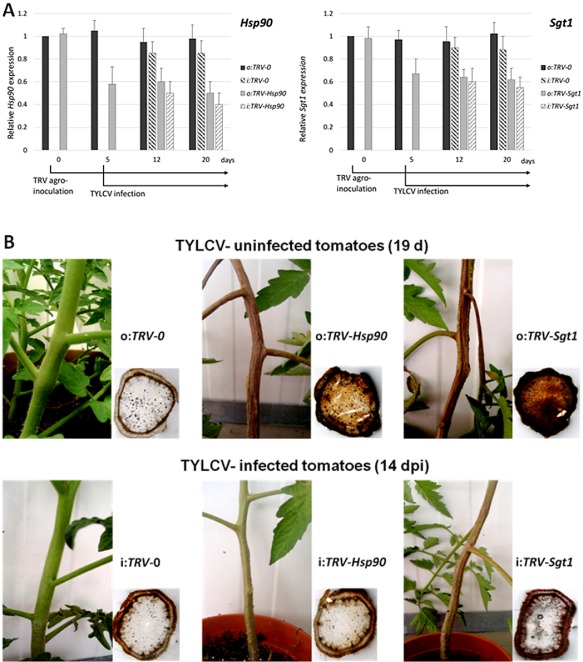
Silencing of tomato Hsp90/Sgt1 genes induces cell death (CD), which is alleviated in Tomato yellow leaf curl virus (TYLCV)‐infected plants. (A) Quantitative reverse transcription‐polymerase chain reaction (qRTPCR)‐based expression analyses of Hsp90 (left panel) and Sgt1 (right panel) in tomato leaves agro‐infiltrated with the Tobacco rattle virus (TRV) vector alone (TRV‐0), and with the TRVHsp90 and Sgt1 silencing constructs (TRVHsp90 and TRVSgt1), uninfected (o) and infected (i) with TYLCV. In TYLCV‐uninfected plants, qRTPCR was performed immediately before TRV inoculation (0), and 5, 12 and 20 days thereafter. Another set of tomato plants was infected with TYLCV 5 days after TRV inoculation; qRTPCR was performed 7 and 15 days (7, 15 dpi) thereafter (12 and 20 days after TRV inoculation). The relative expression of each gene was calculated in relation to TRV‐0 plants before TRV inoculation. The results were normalized using β‐actin as an internal marker. Bars represent the average and standard deviation of the relative expression from three technical repeats of three independent biological repeats. (B) Top panel: stems of tomato plants 19 days after agroinfiltration with TRV‐0, and with TRVHsp90 and TRVSgt1, not infected with TYLCV; bottom panel: stems of tomato plants 14 days after infection with TYLCV/19 days after agroinfiltration with TRV‐0, and with TRVHsp90 and TRVSgt1. 3,3′‐Diaminobenzidine (DAB) staining was performed on stem cross‐sections.
Figure 2
Figure 2
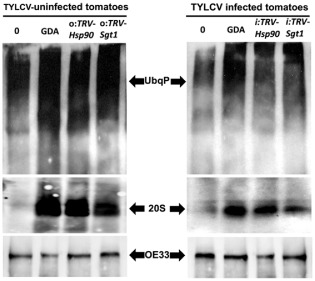
Inhibition of heat shock protein 90 (HSP90) and silencing of Hsp90/Sgt1 inactivate the ubiquitin–proteasome system (UPS); Tomato yellow leaf curl virus (TYLCV) infection down‐regulates proteasome inactivation. Western blot was applied to immunodetect ubiquitinated proteins (UbqP), the 20S core subunit of the 26S proteasome (20S) and OE33 chloroplast protein (OE33) as unrelated control in proteins extracted from tomato leaves [uninfected and TYLCV infected (21 days post‐infection, dpi)]. Protein patterns of detached leaves, treated with dimethylsulfoxide (DMSO) (0) and geldanamycin (GDA), were compared with proteins extracted from Hsp90‐ and Sgt1‐silenced tomatoes (TRVHsp90 and TRVSgt1).
Figure 3
Figure 3
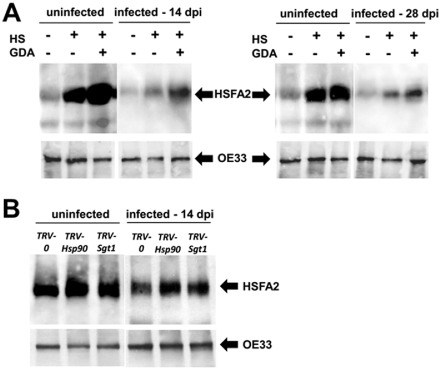
Impairment of heat shock protein 90 (HSP90) function increases the accumulation of HSFA2 in heat‐treated tomatoes; Tomato yellow leaf curl virus (TYLCV) infection mitigates this increase. Immunodetection of the transcription factor HSFA2 in leaf protein extracts following heat shock (HS) and TYLCV infection [uninfected and at 14 and 28 days post‐infection (dpi)]. The OE33 chloroplast protein (OE33) was used as unrelated control. (A) Detached leaves were treated with dimethylsulfoxide (DMSO) (GDA–) and with the HSP90 inhibitor geldanamycin (GDA+) and were subjected to heat shock (HS+) or incubated at room temperature (HS–) for 2 h. (B) Leaves of Hsp90 and Sgt‐silenced plants and Tobacco rattle virus (TRV)‐inoculated plants (TRVHsp90 and TRVSgt1; TRV‐0: empty vector) were subjected to HS.
Figure 4
Figure 4
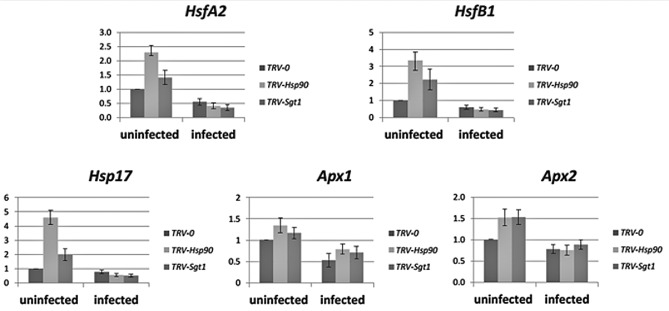
Silencing of the tomato Hsp90 and Sgt1 genes induces the accumulation of HsfA2 transcripts; Tomato yellow leaf curl virus (TYLCV) infection mitigates the accumulation of HsfA2 and the activation of HsfA2‐dependent gene expression. A quantitative reverse transcription‐polymerase chain reaction (qRTPCR) approach was used to analyse gene expression in uninfected and TYLCV‐infected (14 days post‐infection, dpi) tomatoes with Hsp90‐ and Sgt1‐silenced genes (TRVHsp90 and TRVSgt1); control plants were inoculated with the Tobacco rattle virus (TRV) vector alone (TRV‐0). For heat shock, the leaves were incubated at 42 °C for 2 h. The relative expression of each gene was calculated in relation to the TRV‐0TYLCV‐uninfected sample. The results were normalized using the β‐actin gene as an internal marker. Bars represent the average and standard deviation of the relative expression from five independent biological repeats.
Figure 5
Figure 5
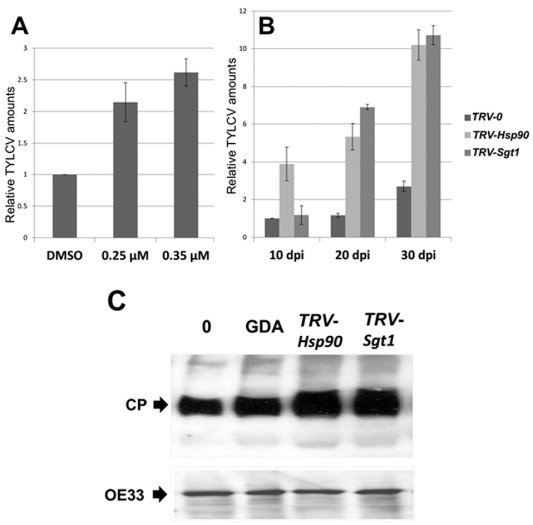
Heat shock protein 90 (HSP90) inactivation results in enhanced accumulation of Tomato yellow leaf curl virus (TYLCV). (A) Quantitative polymerase chain reaction (qPCR) estimation of TYLCV DNA amounts. The results were normalized using the tomato Expressed gene as an internal DNA marker. Bars represent the average and standard deviation of the relative expression from five independent biological repeats. Detached leaflets of TYLCV‐infected tomatoes (21 days post‐infection, dpi) were incubated for 24 h with 0.25 and 0.35 μm geldanamycin (GDA) to inhibit HSP90 [dimethylsulfoxide (DMSO) was used as the control without GDA]; TYLCV DNA amounts were estimated immediately thereafter. (B) Accumulation of TYLCV with time, estimated after 10, 20 and 30 dpi in tomatoes in which Hsp90 and Sgt1 had been silenced (TRVHsp90 and TRVSgt1); plants inoculated with the Tobacco rattle virus (TRV) vector alone (TRV‐0) served as control. (C) Immunodetection of TYLCV coat protein (CP) at 30 dpi in untreated tomato plants (0), in GDA‐inhibited HSP90 (GDA) plants and in tomatoes in which the Hsp90 and Sgt1 genes had been silenced (TRVHsp90 and TRV‐Sgt1); the OE33 chloroplast protein (OE33) was used as unrelated control.
Figure 6
Figure 6
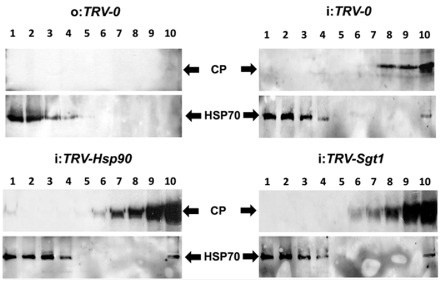
Heat shock protein 90 (HSP90) inactivation enhances the aggregation of Tomato yellow leaf curl virus (TYLCV) coat protein (CP). Immunodetection of TYLCV CP in tomato leaves (at 21 days post‐infection, dpi) distributed in a linear 10%–50% sucrose gradient; gradients were divided into 10 fractions, 1 (top) to 10 (bottom), and aliquots were subjected to sodium dodecylsulfate‐polyacrylamide gel electrophoresis (SDS‐PAGE). HSP70 was used as a marker of protein loading changes. No CP signal was detected in uninfected Tobacco rattle virus (TRV)‐inoculated tomatoes (o:TRV‐0); aggregated CP patterns were changed in Hsp90 (i:TRVHsp90)‐ and Sgt1 (i:TRVSgt1)‐silenced versus TRV‐inoculated (i:TRV‐0) plants.
Figure 7
Figure 7
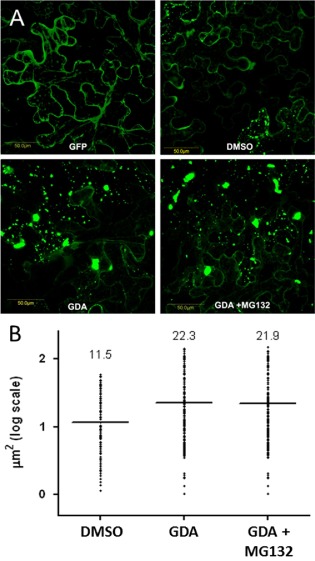
Heat shock protein 90 (HSP90) inactivation results in an increase in size of V2:GFP aggregates. (A) Expression of fusion V2:GFP in epidermal cells of Nicotiana benthamiana leaves infiltrated with Agrobacterium tumefaciens carrying the V2:GFP expression plasmid as observed with a laser confocal microscope. GFP, green fluorescent protein expression in leaves; DMSO, leaves infiltrated with dimethylsulfoxide as a control; GDA, leaves treated with geldanamycin to inhibit HSP90 activity; GDA + MG132, leaves treated with GDA and MG132 to inhibit HSP90 and 26S proteasome activities. Bar, 50 μm. (B) Sizes of aggregates. The microscope fields obtained in (A) were analysed with ImageJ; bars and numbers indicate the mean sizes of aggregates as measured for leaf areas of 50 mm2 in five independent experiments for each treatment.
Figure 8
Figure 8
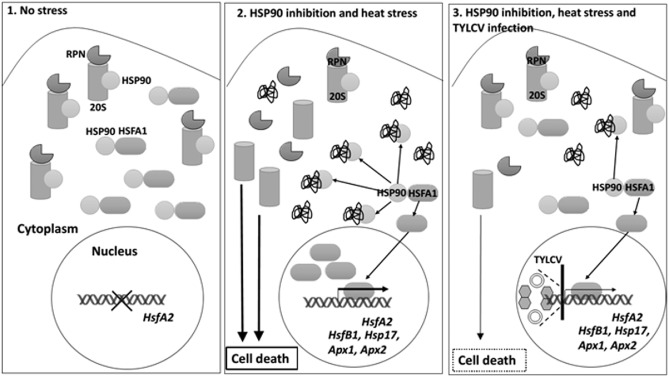
Summary of the key processes of stress response regulation by heat shock protein 90 (HSP90) in tomato plants, and down‐regulation by Tomato yellow leaf curl virus (TYLCV) infection. 1. In the absence of any stress, HSP90 binds HSFA1, one of the key regulators of the plant stress response, keeping it inactive; HSP90's substrate 26S proteasome (RPN regulatory subunits and the 20S catalytic subunit) is active. Therefore, there is no ubiquitin–proteasome system (UPS) inactivation, and consequently no cell death (CD) and no activation of HsfA2 signalling. 2. In heat‐stressed Hsp90‐silenced tomato plants, there is a massive appearance of damaged proteins, which sequester HSP90, causing the release of free HSFA1, which activates HsfA2 and downstream gene expression. The inhibition of HSP90 function also results in a dissociation of the 26S proteasome and a decrease in its peptidase activity. Inhibition of the 26S proteasome is accompanied by CD. 3. TYLCV infection (represented as virions and viral DNA) suppresses HSP90‐dependent 26S proteasome inactivation, CD and HSFA2 signal transduction pathways. Furthermore, loss of HSP90 function effects positively TYLCV accumulation: there are higher levels of viral DNA and CP, and the enrichment of CP/V2 in large aggregates, markers of a successful TYLCV infection.

References

    1. Alvarez, M.E. , Pennell, R.I. , Meijer, P.J. , Ishikawa, A. , Dixon, R.A. and Lamb, C. (1998) Reactive oxygen intermediates mediate a systemic signal network in the establishment of plant immunity. Cell, 92, 773–784. - PubMed
    1. Ascencio‐Ibanez, J.T. , Sozzani, R. , Lee, T.J. , Chu, T.M. , Wolfinger, R.D. , Cella, R. and Hanley‐Bowdoin, L. (2008) Global analysis of Arabidopsis gene expression uncovers a complex array of changes impacting pathogen response and cell cycle during geminivirus infection. Plant Physiol. 148, 436–454. - PMC - PubMed
    1. Asurmendi, S. , Berg, R.H. , Smith, T.J. , Bendahmane, M. and Beachy, R.N. (2007) Aggregation of TMV CP plays a role in CP functions and in coat‐protein‐mediated resistance. Virology, 366, 98–106. - PMC - PubMed
    1. Baliji, S. , Lacatus, G. and Sunter, G. (2010) The interaction between geminivirus pathogenicity proteins and adenosine kinase leads to increased expression of primary cytokinin‐responsive genes. Virology, 402, 238–247. - PMC - PubMed
    1. Baniwal, S.K. , Bharti, K. , Chan, K.Y. , Fauth, M. , Ganguli, A. , Kotak, S. , Mishra, S.K. , Nover, L. , Port, M. , Scharf, K.D. , Tripp, J. , Weber, C. , Zielinski, D. and von Koskull‐Döring, P. (2004) Heat stress response in plants: a complex game with chaperones and more than twenty heat stress transcription factors. J. Biosci. 29, 471–487. - PubMed

Publication types

MeSH terms

LinkOut - more resources