


Deubiquitinating enzymes as oncotargets
- PMID: 25962961
- PMCID: PMC4496387
- DOI: 10.18632/oncotarget.3922
Deubiquitinating enzymes as oncotargets
Abstract
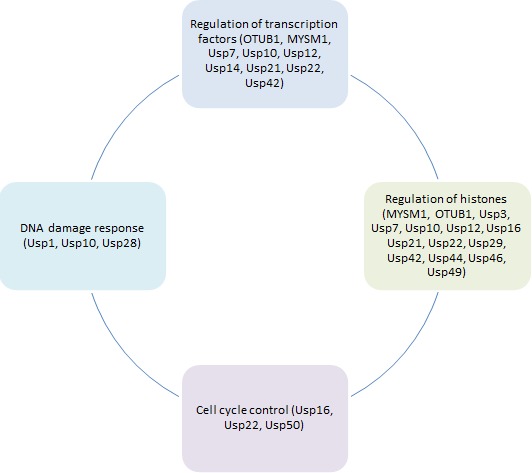
Carcinogenesis is a complex process tightly regulated at multiple levels by post-translational modifications. Epigenetics plays a major role in cancer development, all stable changes to the gene expression process that are not a result of a direct change in the DNA code are described as epigenetics. Epigenetic processes are regulated by post-translational modifications including ubiquitination which can directly affect either histones or transcription factors or may target their co-factors and interacting partners exerting an indirect effect. Deubiquitination of these target proteins is equally important and alterations in this pathway can also lead to cancer development, progression and metastasis. Only the correct, unaltered balance between ubiquitination and deubiquitination ensures healthy cellular homeostasis. In this review we focus on the role of deubiquitinating (DUB) enzymes in various aspects of epigenetics including the regulation of transcription factors, histone modifications, DNA damage repair pathways and cell cycle regulation. We discuss the impact of those processes on tumourigenesis and potential therapeutic applications of DUBs for cancer treatment.
Keywords: DUBs; androgen receptor; cancer; chromatin; deubiquitination; epigenetics; histones.
Conflict of interest statement
Authors have no conflict of interest.
Figures
References
-
- Blumenfeld N, Gonen H, Mayer A, Smith CE, Siegel NR, Schwartz AL, Ciechanover A. Purification and characterization of a novel species of ubiquitin-carrier protein, E2, that is involved in degradation of non-”N-end rule” protein substrates. The Journal of biological chemistry. 1994;269:9574–9581. - PubMed
-
- Komander D. The emerging complexity of protein ubiquitination. Biochemical Society transactions. 2009;37:937–953. - PubMed
-
- Martinez-Forero I, Rouzaut A, Palazon A, Dubrot J, Melero I. Lysine 63 polyubiquitination in immunotherapy and in cancer-promoting inflammation. Clinical cancer research: an official journal of the American Association for Cancer Research. 2009;15:6751–6757. - PubMed
Publication types
MeSH terms
Substances
Grants and funding
LinkOut - more resources
Full Text Sources
Other Literature Sources
Miscellaneous
