


The patient-breast cancer care pathway: how could it be optimized?
- PMID: 25963161
- PMCID: PMC4430872
- DOI: 10.1186/s12885-015-1417-4
The patient-breast cancer care pathway: how could it be optimized?
Abstract
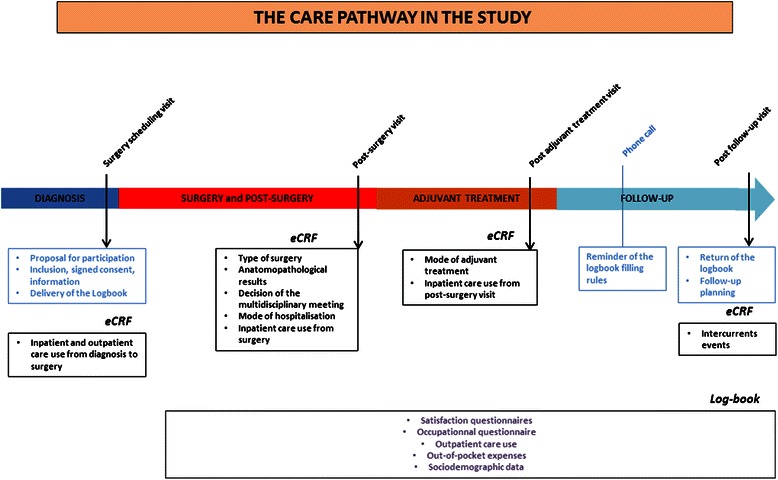
Background: A care pathway is defined as patient-focused global care that addresses temporal (effective and coordinated management throughout the illness) and spatial issues (treatment is provided near the health territory in or around the patient's home). Heterogeneity of the care pathways in breast cancer (BC) is presumed but not well evaluated. The OPTISOINS01 study aims to assess every aspect of the care pathway for early BC patients using a temporal and spatial scope.
Methods/design: An observational, prospective, multicenter study in a regional health territory (Ile-de-France, France) in different types of structures: university or local hospitals and comprehensive cancer centers. We will include and follow during 1 year 1,000 patients. The study consists of 3 work-packages: - Cost of pathway The aim of this WP is to calculate the overall costs of the early BC pathway at 1 year from different perspectives (society, health insurance and patient) using a cost-of-illness analysis. Using a bottom-up method, we will assess direct costs, including medical direct costs and nonmedical direct costs (transportation, home modifications, home care services, and social services), and indirect costs (loss of production). - Patient satisfaction and work reintegration Three questionnaires will assess the patients' satisfaction and possible return to work: the occupational questionnaire for employed women; the questionnaire on the need for supportive care, SCNS-SF34 ('breast cancer' module, SCNS-BR8); and the OUTPASSAT-35 questionnaire. - Quality, coordination and access to innovation Quality will be evaluated based on visits and treatment within a set period, whether the setting offers a multidisciplinary consultative framework, the management by nurse coordinators, the use of a personalized care plan, the provision of information via documents about treatments and the provision of supportive care. The coordination between structures and caregivers will be evaluated at several levels. Day surgery, home hospitalization and one-stop breast clinic visits will be recorded to assess the patient's access to innovation.
Discussion: The assessment of care pathways encourages the implementation of new payment models. Our approach could help health care professionals and policymakers to establish other cost-of-illness studies and plan the allocation of resources on a patient basis rather than a visit basis.
References
-
- Ferlay, J, Héry C, Autier P, Sankaranarayanan R. Global burden of breast cancer. Breast cancer epidemiology. C. Li, Springer-Verlag New York 2010; 1–19.
-
- Loi 2004–810 du 13 août 2004 relative à l’Assurance Maladie, Code de la Sécurité Sociale, France
-
- LOI n° 2009–879 du 21 juillet 2009 portant réforme de l’hôpital et relative aux patients, à la santé et aux territoires, JORF N°0167 2009;12184.
Publication types
MeSH terms
LinkOut - more resources
Full Text Sources
Other Literature Sources
Medical
