Review
. 2015 Jun;16(6):359-71.
doi: 10.1038/nrg3936. Epub 2015 May 12.

Evidence for archaic adaptive introgression in humans

Affiliations
Review

Evidence for archaic adaptive introgression in humans

Fernando Racimo et al. Nat Rev Genet. 2015 Jun.

Abstract

As modern and ancient DNA sequence data from diverse human populations accumulate, evidence is increasing in support of the existence of beneficial variants acquired from archaic humans that may have accelerated adaptation and improved survival in new environments - a process known as adaptive introgression. Within the past few years, a series of studies have identified genomic regions that show strong evidence for archaic adaptive introgression. Here, we provide an overview of the statistical methods developed to identify archaic introgressed fragments in the genome sequences of modern humans and to determine whether positive selection has acted on these fragments. We review recently reported examples of adaptive introgression, grouped by selection pressure, and consider the level of supporting evidence for each. Finally, we discuss challenges and recommendations for inferring selection on introgressed regions.


Figures
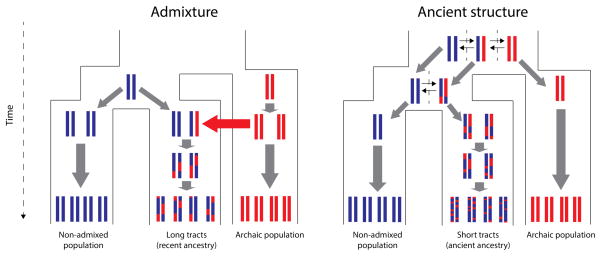
Figure 1
Figure 1. Expected length of archaic tracts under admixture and ancestral structure scenarios
Schematic comparison of expected tract length of archaic-like tracts for a scenario of admixture (left panel) and a scenario of ancestral population structure (right panel). Because there is less time for recombination to break down the migrant tracts (red) in the admixed population, the expected tract length in this case will be longer than in the case of ancestral structure.
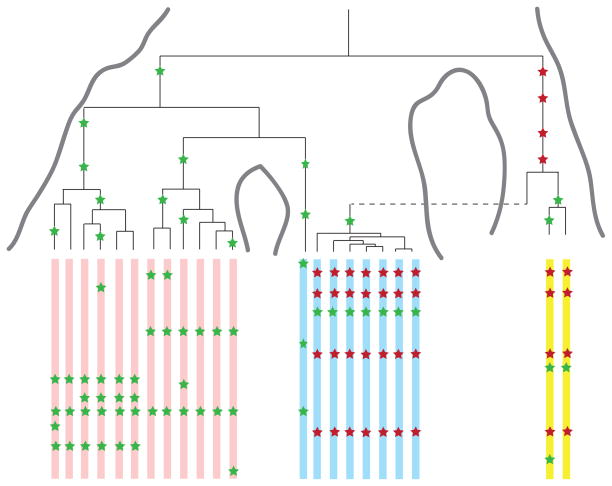
Figure 2
Figure 2. Example coalescent genealogy of uniquely shared mutations
Several DNA fragments from two modern populations (pink and light-blue chromosomes) are sequenced. A diploid sequence is also obtained from an extinct archaic population (yellow chromosomes) that split from the population tree more anciently than the two modern populations split from each other. Uniquely shared mutations (red stars) occur in the archaic population, but are passed on to the ancestors of the light-blue modern population via admixture (dashed line). These are then are swept to high frequency by selection, producing a shallow local coalescent genealogy. This process results in sites with high-frequency derived alleles in the light-blue samples that are present in the archaic sample but not the pink samples from the other modern population. Mutations in the genealogy that are not uniquely shared are shown as green stars.

References

    1. Green RE, et al. A draft sequence of the Neandertal genome. Science. 2010;328:710–22. The draft sequence of a Neanderthal genome. Analysis of this sequence provided the first estimates of the proportion of archaic admixture in present-day human genomes. - PMC - PubMed
    1. Reich D, et al. Genetic history of an archaic hominin group from Denisova Cave in Siberia. Nature. 2010;468:1053–60. - PMC - PubMed
    1. Meyer M, et al. A high-coverage genome sequence from an archaic Denisovan individual. Science. 2012;338:222–6. - PMC - PubMed
    1. Prüfer K, et al. The complete genome sequence of a Neanderthal from the Altai Mountains. Nature. 2014;505:43–9. Release of the first high coverage sequence of a Neanderthal genome. Analysis of this sequence allowed for the identification of Neanderthal segments in present-day humans. - PMC - PubMed
    1. Abi-Rached L, et al. The shaping of modern human immune systems by multiregional admixture with archaic humans. Science. 2011;334:89–94. - PMC - PubMed

Online Resources

    1. Hawks J. John Hawks Weblog. 2011 ( http://johnhawks.net/weblog/reviews/denisova/denisova-mcph1-2011.html.
    1. Waddell PJ, Tan X. New g%AIC, g%AICc, g%BIC, and Power Divergence Fit Statistics Expose Mating between Modern Humans, Neanderthals and other Archaics. arXiv. 2012 ( http://arxiv.org/abs/1212.6820)
    1. Waddell PJ. Happy New Year Homo erectus? More evidence for interbreeding with archaics predating the modern human/Neanderthal split. 2013 arXiv. http://arxiv.org/abs/1312.7749.

Publication types