


Effect of warming temperatures on US wheat yields
- PMID: 25964323
- PMCID: PMC4460489
- DOI: 10.1073/pnas.1415181112
Effect of warming temperatures on US wheat yields
Abstract
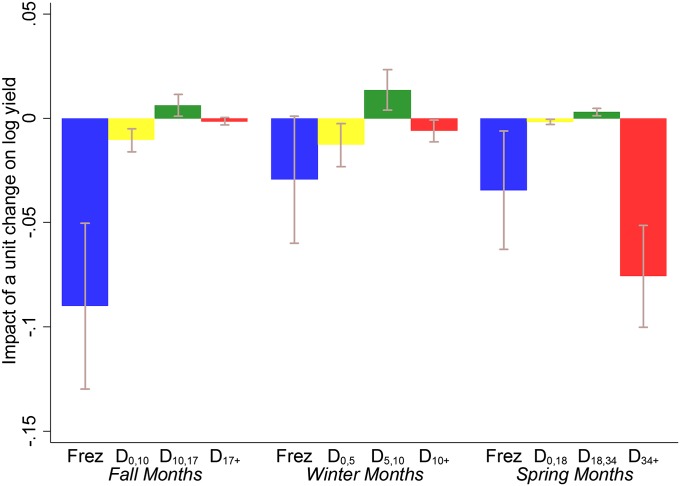
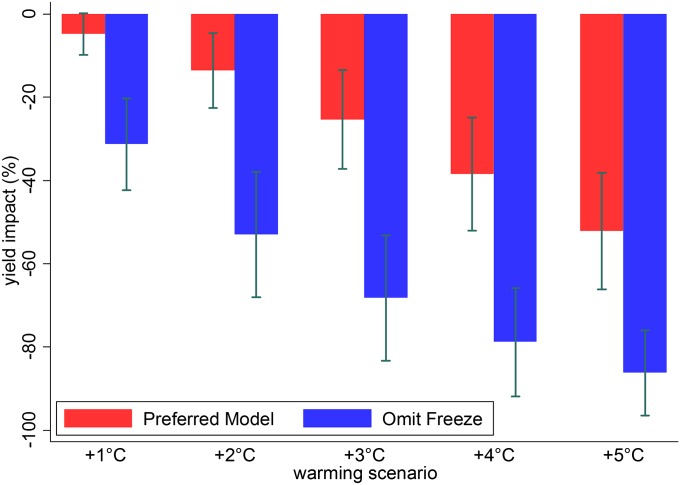
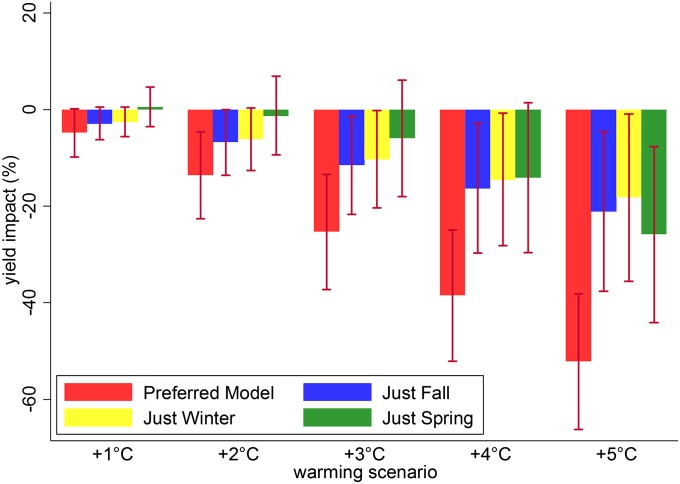
Climate change is expected to increase future temperatures, potentially resulting in reduced crop production in many key production regions. Research quantifying the complex relationship between weather variables and wheat yields is rapidly growing, and recent advances have used a variety of model specifications that differ in how temperature data are included in the statistical yield equation. A unique data set that combines Kansas wheat variety field trial outcomes for 1985-2013 with location-specific weather data is used to analyze the effect of weather on wheat yield using regression analysis. Our results indicate that the effect of temperature exposure varies across the September-May growing season. The largest drivers of yield loss are freezing temperatures in the Fall and extreme heat events in the Spring. We also find that the overall effect of warming on yields is negative, even after accounting for the benefits of reduced exposure to freezing temperatures. Our analysis indicates that there exists a tradeoff between average (mean) yield and ability to resist extreme heat across varieties. More-recently released varieties are less able to resist heat than older lines. Our results also indicate that warming effects would be partially offset by increased rainfall in the Spring. Finally, we find that the method used to construct measures of temperature exposure matters for both the predictive performance of the regression model and the forecasted warming impacts on yields.
Keywords: agriculture; climate change; global warming; wheat; yield.
Conflict of interest statement
The authors declare no conflict of interest.
Figures
References
-
- Hsiang SM, Burke M. Climate, conflict, and social stability: What does the evidence say? Clim Change. 2014;123(1):39–55.
-
- Hsiang SM, Burke M, Miguel E. Quantifying the influence of climate on human conflict. Science. 2013;341(6151):1235367. - PubMed
-
- Scheffran J, Brzoska M, Kominek J, Link PM, Schilling J. Climate change and violent conflict. Science. 2012;336(6083):869–871. - PubMed
Publication types
MeSH terms
LinkOut - more resources
Full Text Sources
Other Literature Sources
