Review
. 2015 Apr 24:6:156.
doi: 10.3389/fgene.2015.00156. eCollection 2015.

Genomic imprinting effects on complex traits in domesticated animal species

Affiliations
Review

Genomic imprinting effects on complex traits in domesticated animal species

Alan M O'Doherty et al. Front Genet. .

Abstract

Monoallelically expressed genes that exert their phenotypic effect in a parent-of-origin specific manner are considered to be subject to genomic imprinting, the most well understood form of epigenetic regulation of gene expression in mammals. The observed differences in allele specific gene expression for imprinted genes are not attributable to differences in DNA sequence information, but to specific chemical modifications of DNA and chromatin proteins. Since the discovery of genomic imprinting some three decades ago, over 100 imprinted mammalian genes have been identified and considerable advances have been made in uncovering the molecular mechanisms regulating imprinted gene expression. While most genomic imprinting studies have focused on mouse models and human biomedical disorders, recent work has highlighted the contributions of imprinted genes to complex trait variation in domestic livestock species. Consequently, greater understanding of genomic imprinting and its effect on agriculturally important traits is predicted to have major implications for the future of animal breeding and husbandry. In this review, we discuss genomic imprinting in mammals with particular emphasis on domestic livestock species and consider how this information can be used in animal breeding research and genetic improvement programs.

Keywords: complex traits; epigenetics; epigenome; genomic imprinting; livestock.


Figures
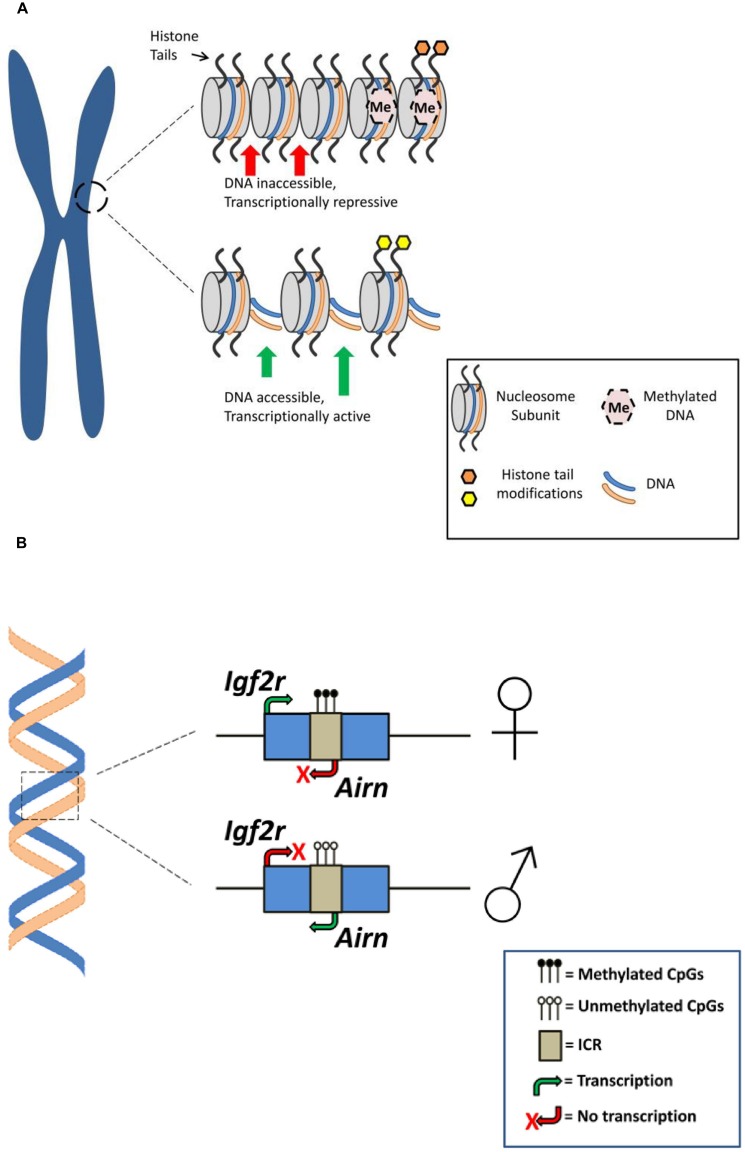
FIGURE 1
FIGURE 1
Epigenetic mechanisms associated with genomic imprinting. (A) Histone modifications and DNA methylation for different chromatin configurations. Top: Repressive chromatin state associated with histone modification (e.g., histone methylation; orange shading) and dense DNA methylation resulting in gene silencing or attenuated gene expression. Bottom: Active/permissive chromatin state associated with histone modification (e.g., histone acetylation; yellow shading) and reduced DNA methylation rendering DNA accessible for transcription resulting in gene expression (for a comprehensive overview of histone modifications see Bannister and Kouzarides, 2011). (B) Genomic arrangement at an imprinted gene. A simplified schematic of the murine Igf2r locus demonstrating parent-of-origin specific DNA methylation is presented. The imprinting control region (ICR) on the maternal Igf2r allele is methylated, preventing expression of an antisense ncRNA (Airn) and resulting in expression of the maternal Igf2r allele. Alternatively, expression of Airn from the unmethylated paternal allele attenuates paternal Igf2r expression (for a more comprehensive overview of DNA methylation at the Igf2r locus and genomic imprinting see Autuoro et al., 2014).
FIGURE 2
FIGURE 2
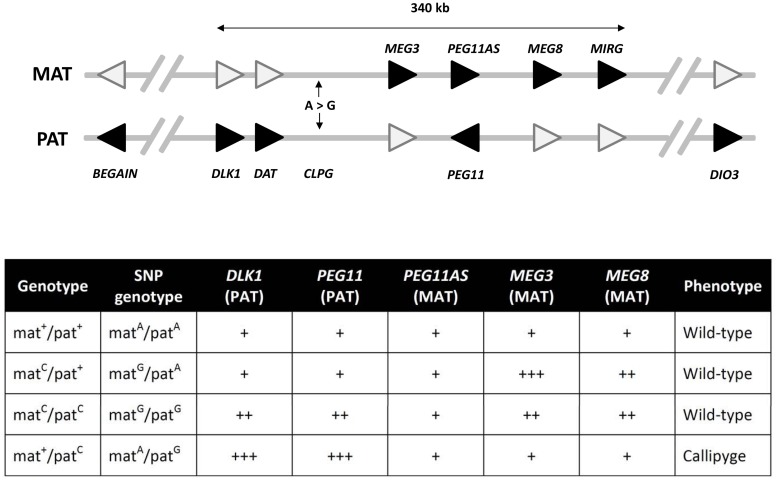
The DLK1-DIO3 imprinting domain on ovine chromosome 18. This domain contains the genes whose expression is perturbed upon inheritance of the callipyge mutation (CLPG; an A-to-G SNP). The genes shaded in black represent the expressed imprinted alleles within this domain while white shading indicates the silenced/attenuated imprinted allele on either the maternal (MAT) or paternal (PAT) chromosomes. The arrowhead denotes the direction of transcription of each gene. Genes are not drawn to scale and introns are not shown. The core imprinted genes that have been shown to play a role in the callipyge phenotype occur within a 340 kb region. The expression of the core genes for each of the four possible callipyge genotypes at the CLPG SNP and the observed is summarized in the accompanying table. The relative RNA transcript abundance for the paternally (DLK1, PEG11) and maternally (PEG11AS, MEG3, MEG8, and MIRG) expressed genes are shown (not to scale) for each callipyge genotype. Callipyge animals (mat+/patC) exhibit overexpression of DLK1 and PEG11 and an absence of MEG3 and MEG8 overexpression suggesting that DLK1 and/or PEG11 encodes the primary effector of the callipyge phenotype. Overexpression of the maternal non-coding RNA genes and the absence of muscle hypertophy in matC/patC animals suggest that these transcripts exert their effect via post-transcriptional suppression of the effector. The microRNAs encoded by MIRG have been postulated to also play a role in post-transcriptional suppression of the paternally expressed effector (Georges et al., 2003; Bidwell et al., 2004, 2014; Murphy et al., 2006).
FIGURE 3
FIGURE 3
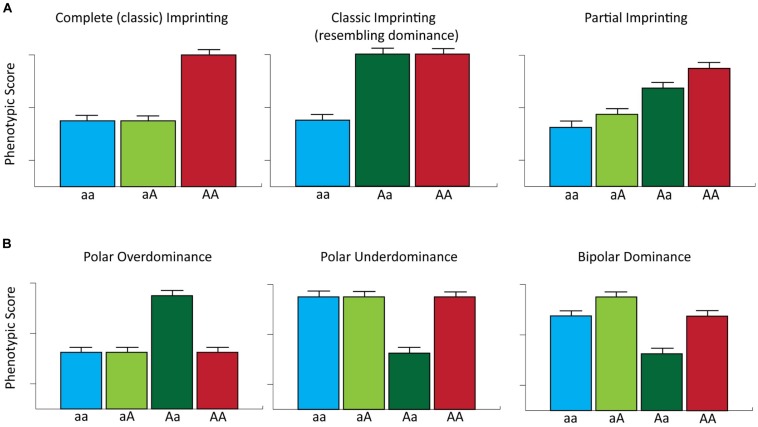
Genomic imprinting and parent-of-origin effects on complex phenotypes. (A) The phenotypic effects of complete and partial imprinting are considered for a single locus with two alleles. For complete imprinting, the first listed allele represents the expressed allele and the A allele has a greater effect on phenotype relative to the a allele. Note that in this example the Aa heterozygote displays a phenotypic score that resembles that expected for a locus with a dominance effect. For partial imprinting, aA and Aa represent reciprocal heterozygote genotypes, where the first listed allele is fully expressed and the second listed allele is partially expressed. In addition, the ‘A’ allele has the greatest effect on phenotype. Partial imprinting results in the generation of four potential phenotypic classes. (B) The phenotypic effects of a single locus for which there are two alleles displaying polar overdominance, polar underdominance and bipolar dominance modes of inheritance [modified from Lawson et al. (2011)].

References

    1. Abramowitz L. K., Bartolomei M. S. (2012). Genomic imprinting: recognition and marking of imprinted loci. Curr. Opin. Genet. Dev. 22 72–78 10.1016/j.gde.2011.12.001 - DOI - PMC - PubMed
    1. Adalsteinsson B. T., Ferguson-Smith A. C. (2014). Epigenetic control of the genome-lessons from genomic imprinting. Genes (Basel) 5 635–655 10.3390/genes5030635 - DOI - PMC - PubMed
    1. Akers R. M. (2006). Major advances associated with hormone and growth factor regulation of mammary growth and lactation in dairy cows. J. Dairy Res. 89 1222–1234 10.3168/jds.S0022-0302(06)72191-9 - DOI - PubMed
    1. Alexopoulos N. I., Maddox-Hyttel P., Tveden-Nyborg P., D’Cruz N. T., Tecirlioglu T. R., Cooney M. A., et al. (2008). Developmental disparity between in vitro-produced and somatic cell nuclear transfer bovine days 14 and 21 embryos: implications for embryonic loss. Reproduction 136 433–445 10.1530/REP-07-0392 - DOI - PubMed
    1. Ashbrook D. G., Hager R. (2013). Empirical testing of hypotheses about the evolution of genomic imprinting in mammals. Front. Neuroanat. 7:6 10.3389/fnana.2013.00006 - DOI - PMC - PubMed

LinkOut - more resources