


Vitrectomy for idiopathic macular hole
- PMID: 25965055
- PMCID: PMC6669239
- DOI: 10.1002/14651858.CD009080.pub2
Vitrectomy for idiopathic macular hole
Abstract
Background: A macular hole is an anatomic opening in the retina that develops at the fovea. Macular holes can be seen in highly myopic eyes or following ocular trauma, but the great majority are idiopathic. Pars plana vitrectomy was introduced to treat full-thickness macular holes, which if left untreated have a poor prognosis since spontaneous closure and visual recovery are rare.Vitrectomy is a surgical technique involving the removal of the vitreous body that fills the eye. The surgeon inserts thin cannulas into the eyes through scleral incisions to relieve traction exerted by the vitreous or epiretinal membranes to the central retina and to induce glial tissue to bridge and close the hole.
Objectives: The primary objective of this review was to examine the effects of vitrectomy for idiopathic macular hole on visual acuity. A secondary objective was to investigate anatomic effects on hole closure and other dimensions of visual function, as well as to report on adverse effects recorded in included studies.
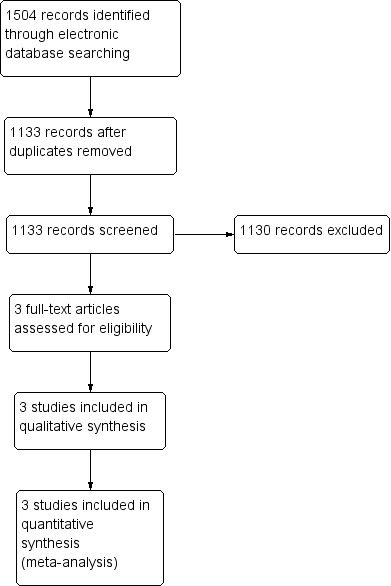
Search methods: We searched the Cochrane Eyes and Vision Group Trials Register (4 March 2015), the Cochrane Central Register of Controlled Trials (CENTRAL; 2015, Issue 2), Ovid MEDLINE, Ovid MEDLINE In-Process and Other Non-Indexed Citations, Ovid MEDLINE Daily, Ovid OLDMEDLINE (January 1946 to March 2015), EMBASE (January 1980 to March 2015), Latin American and Caribbean Health Sciences Literature Database (LILACS) (January 1982 to March 2015), the Web of Science Conference Proceedings Citation Index-Science (CPCI-S) (January 1980 to March 2015), the ISRCTN registry (www.isrctn.com/editAdvancedSearch), ClinicalTrials.gov (www.clinicaltrials.gov) and the World Health Organization (WHO) International Clinical Trials Registry Platform (ICTRP) (www.who.int/ictrp/search/en). We did not use any date or language restrictions in the electronic searches for trials. We last searched the electronic databases on 4 March 2015.
Selection criteria: We included randomised controlled trials comparing vitrectomy (with or without internal limiting membrane peeling) to no treatment (that is observation) for macular holes.
Data collection and analysis: We used standard methodological procedures expected by Cochrane. Two review authors independently extracted the data. We estimated best corrected visual acuity and macular hole closure at 6 to 12 months of follow-up.
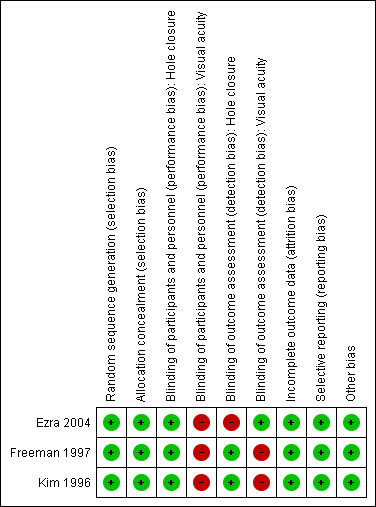
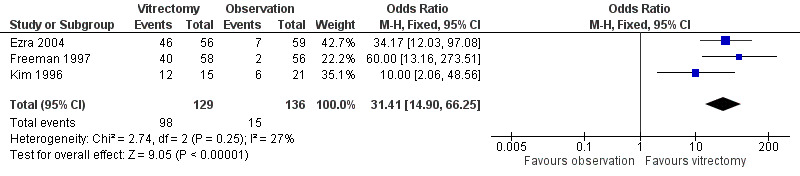
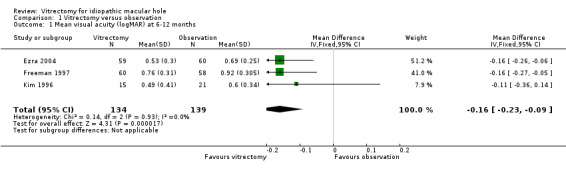
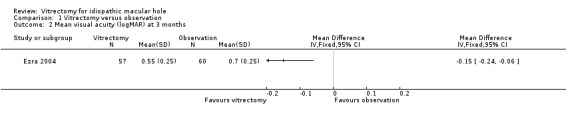
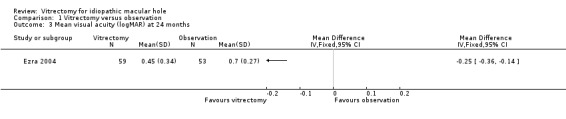
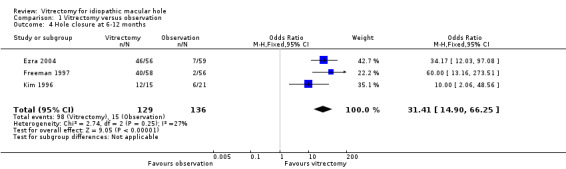
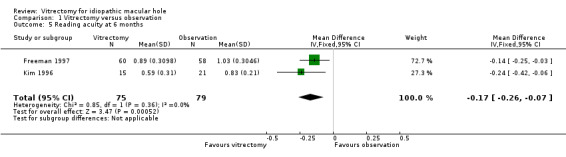
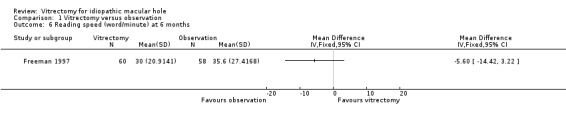
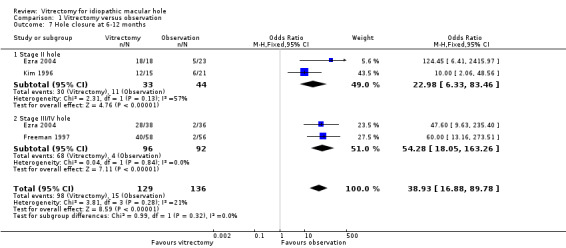
Main results: Three studies provided data on the comparison between vitrectomy and observation in eyes with macular hole and visual acuity less than 20/50. Two studies, conducted in the USA and published in 1996 and 1997, used a similar protocol and included participants with stage II macular hole (42 eyes randomised, 36 analysed, number of participants not reported) or participants with stage III/IV hole (129 eyes of 120 participants, 115 eyes in analyses). The third study, conducted in the UK and published in 2004, included 185 eyes of 174 participants with full-thickness macular hole (41 eyes with stage II holes and 74 eyes with stage III/IV holes in analyses). Studies were of good quality for randomisation and allocation concealment, whereas visual acuity measurement was unmasked.At 6 to 12 months, visual acuity was improved by about 1.5 Snellen lines (-0.16 logMAR, 95% confidence intervals -0.23 to -0.09 logMAR, 270 eyes, moderate-quality evidence). The chances of macular hole closure at 6 to 12 months were greatly increased using vitrectomy, yielding an odds ratio of 31.4 (95% confidence intervals 14.9 to 66.3, 265 eyes, high-quality evidence; raw sum data: 76% vitrectomy, 11% observation). Vitrectomy was beneficial both in smaller (stage II) and in larger (stage III/IV) macular holes.The largest study reported that cataract surgery was needed in about half of cases at two years after operation and that retinal detachment occurred in about 5% of operated eyes.
Authors' conclusions: Vitrectomy is effective in improving visual acuity, resulting in a moderate visual gain, and in achieving hole closure in people with macular hole. However, these results may not apply to modern surgery due to technological improvements in vitrectomy techniques.
Conflict of interest statement
None
Figures

Update of
References
References to studies included in this review
Ezra 2004 {published data only}
-
- Ezra E, Gregor ZJ, Moorfields Macular Hole Study Group Report No. 1. Surgery for idiopathic full‐thickness macular hole: two‐year results of a randomized clinical trial comparing natural history, vitrectomy, and vitrectomy plus autologous serum: Moorfields Macular Hole Study Group Report No. 1. Archives of Ophthalmology 2004;122(2):224‐36. - PubMed
Freeman 1997 {published data only}
-
- Freeman WR, Azen SP, Kim JW, el‐Haig W, Mishell DR 3rd, Bailey I, et al. Vitrectomy for the treatment of full‐thickness stage 3 or 4 macular holes. Results of a multicentered randomized clinical trial. Vitrectomy for Treatment of Macular Hole Study Group. Archives of Ophthalmology 1997;115(7):11‐21. - PubMed
Kim 1996 {published data only}
-
- Kim JW, Freeman WR, Azen SP, el‐Haig W, Klein DJ, Bailey IL. Prospective randomized trial of vitrectomy or observation for stage 2 macular holes. Vitrectomy for Macular Hole Study Group. American Journal of Ophthalmology 1996;121(6):605‐14. - PubMed
Additional references
Altaweel 2003
-
- Altaweel M, Ip M. Macular hole: improved understanding of pathogenesis, staging, and management based on optical coherence tomography. Seminars in Ophthalmology 2003;18(2):58‐66. - PubMed
Azzolini 2001
-
- Azzolini C, Patelli F, Brancato R. Correlation between optical coherence tomography data and biomicroscopic interpretation of idiopathic macular hole. American Journal of Ophthalmology 2001;132(3):348‐55. - PubMed
Banker 1999
-
- Banker AS, Freeman WR, Azen SP, Lai MY. A multicentered clinical study of serum as adjuvant therapy for surgical treatment of macular holes. Vitrectomy for Macular Hole Study Group. Archives of Ophthalmology 1999;117(11):1499‐502. - PubMed
Blumenkranz 2001
-
- Blumenkranz MS, Ohana E, Shaikh S, Chang S, Coll G, Morse LS, et al. Adjuvant methods in macular hole surgery: Intraoperative plasma‐thrombin mixture and postoperative fluid‐gas exchange. Ophthalmic Surgery and Lasers 2001;32(3):197‐207. - PubMed
Borm 2009
-
- Borm GF, Lemmers O, Fransen J, Donders R. The evidence provided by a single trial is less reliable than its statistical analysis suggests. Journal of Clinical Epidemiology 2009;62(7):711‐5. - PubMed
Brooks 2000
-
- Brooks HL Jr. Macular hole surgery with and without internal limiting membrane peeling. Ophthalmology 2000;107(10):1939‐48. - PubMed
Casuso 2001
-
- Casuso LA, Scott IU, Flynn HW Jr, Gass JD, Smiddy WE, Lewis ML, et al. Long‐term follow‐up of unoperated macular holes. Ophthalmology 2001;108(6):1150‐5. - PubMed
Chew 1999
-
- Chew EY, Sperduto RD, Hiller R, Nowroozi L, Seigel D, Yanuzzi LA, et al. Clinical course of macular holes: the Eye Disease Case‐Control Study. Archives of Ophthalmology 1999;117(2):242‐6. - PubMed
Christensen 2009
-
- Christensen UC, Krøyer K, Sander B, Larsen M, Henning V, Villumsen J. Value of internal limiting membrane peeling in surgery for idiopathic macular hole stage 2 and 3: a randomised clinical trial. British Journal of Ophthalmology 2009;93(8):1005‐15. - PubMed
Da Mata 2001
-
- Mata AP, Burk SE, Riemann CD, Rosa Jr RH, Snyder ME, Petersen MR, et al. Indocyanine green‐assisted peeling of the retinal internal limiting membrane during vitrectomy surgery for macular hole repair. Ophthalmology 2001;108(7):1187‐92. - PubMed
de Bustros 1994
-
- Bustros S. Vitrectomy for prevention of macular holes. Results of a randomized multicenter clinical trial. Vitrectomy for Prevention of Macular Hole Study Group. Ophthalmology 1994;101(6):1055‐9. - PubMed
Deeks 2011
-
- Deeks JJ, Higgins JPT, Altman DG (editors). Chapter 9: Analysing data and undertaking meta‐analyses. In: Higgins JPT, Green S (editors). Cochrane Handbook for Systematic Reviews of Interventions Version 5.1.0 (updated March 2011). The Cochrane Collaboration, 2011. Available from www.cochrane‐handbook.org.
Ezra 1998
-
- Ezra E, Wells JA, Gray RH, Kinsella FM, Orr GM, Grego J, et al. Incidence of idiopathic full‐thickness macular holes in fellow eyes. A 5‐year prospective natural history study. Ophthalmology 1998;105(2):353‐9. - PubMed
Gass 1988
-
- Gass JD. Idiopathic senile macular hole. Its early stages and pathogenesis. Archives of Ophthalmology 1988;106(5):629‐39. - PubMed
Gass 1995
-
- Gass JD. Reappraisal of biomicroscopic classification of stages of development of a macular hole. American Journal of Ophthalmology 1995;119(6):752‐9. - PubMed
Gaudric 1999
-
- Gaudric A, Haouchine B, Massin P, Paques M, Blain P, Erginay A. Macular hole formation: new data provided by optical coherence tomography. Archives of Ophthalmology 1999;117(6):744‐51. - PubMed
Glanville 2006
Glaser 1992
-
- Glaser BM, Michels RG, Kuppermann BD, Sjaarda RN, Pena RA. Transforming growth factor‐beta 2 for the treatment of full‐thickness macular holes. A prospective randomized study. Ophthalmology 1992;99(7):1162‐73. - PubMed
Goldbaum 1998
-
- Goldbaum MH, McCuen BW, Hanneken AM, Burgess SK, Chen HH. Silicone oil tamponade to seal macular holes without position restrictions. Ophthalmology 1998;105(11):2140‐8. - PubMed
Guillaubey 2008
-
- Guillaubey A, Malvitte L, Lafontaine PO, Jay N, Hubert I, Bron A, et al. Comparison of face‐down and seated position after idiopathic macular hole surgery: a randomized clinical trial. American Journal of Ophthalmology 2008;146(1):128‐34. - PubMed
Guyer 1992
-
- Guyer DR, Bustros S, Diener‐West M, Fine SL. Observations on patients with idiopathic macular holes and cysts. Archives of Ophthalmology 1992;110(9):1264‐8. - PubMed
Hee 1995
-
- Hee MR, Puliafito CA, Wong C, Duker JS, Reichel E, Schuman JS, et al. Optical coherence tomography of macular holes. Ophthalmology 1995;102(5):748‐56. - PubMed
Higgins 2011a
-
- Higgins JPT, Altman DG (editors). Chapter 8: Assessing risk of bias in included studies. In: Higgins JPT, Green S (editors). Cochrane Handbook for Systematic Reviews of Interventions Version 5.1.0 (updated March 2011). The Cochrane Collaboration, 2011. Available from www.cochrane‐handbook.org.
Higgins 2011b
-
- Higgins JPT, Deeks JJ, Altman DG (editors). Chapter 16: Special topics in statistics. In: Higgins JPT, Green S (editors). Cochrane Handbook for Systematic Reviews of Interventions Version 5.1.0 (updated March 2011). The Cochrane Collaboration, 2011. Available from www.cochrane‐handbook.org.
Hikichi 1993
-
- Hikichi T, Trempe CL. Risk of decreased visual acuity in full‐thickness idiopathic macular holes. American Journal of Ophthalmology 1993;116(6):708‐12. - PubMed
Hikichi 1995a
-
- Hikichi T, Yoshida A, Akiba J, Konno S, Trempe CL. Prognosis of stage 2 macular holes. American Journal of Ophthalmology 1995;119(5):571‐5. - PubMed
Hikichi 1995b
Ho 1998
-
- Ho AC, Guyer DR, Fine SL. Macular hole. Survey of Ophthalmology 1998;42(5):393‐416. - PubMed
Jackson 2013
-
- Jackson TL, Donachie PH, Sparrow JM, Johnston RL. United Kingdom National Ophthalmology Database study of vitreoretinal surgery: report 2, macular hole. Ophthalmology 2013;120(3):629‐34. - PubMed
Kelly 1991
-
- Kelly NE, Wendel RT. Vitreous surgery for idiopathic macular holes. Results of a pilot study. Archives of Ophthalmology 1991;109(5):654‐9. - PubMed
Kim 1995
-
- Kim JW, Freeman WR, el‐Haig W, Maguire AM, Arevalo JF, Azen SP, et al. Baseline characteristics, natural history, and risk factors to progression in eyes with stage 2 macular holes. Results from a prospective randomized clinical trial. Vitrectomy for Macular Hole Study Group. Ophthalmology 1995;102(12):1818‐28. - PubMed
Klein 1994
Kusaka 1997
-
- Kusaka S, Sakagami K, Kutsuna M, Ohashi Y. Treatment of full‐thickness macular holes with autologous serum. Japanese Journal of Ophthalmology 1997;41(5):332‐8. - PubMed
Kusuhara 2014
-
- Kusuhara S, Negi A. Predicting visual outcome following surgery for idiopathic macular holes. Ophthalmologica 2014;231(3):125‐32. - PubMed
Kwok 2005
-
- Kwok AK, Lai TY, Wong VW. Idiopathic macular hole surgery in Chinese patients: a randomized study to compare indocyanine green assisted internal limiting membrane peeling with no internal limiting membrane peeling. Hong Kong Medical Journal 2005;11(4):259‐66. - PubMed
Lange 2012
Lewis 1996
-
- Lewis ML, Cohen SM, Smiddy WE, Gass JD. Bilaterality of idiopathic macular holes. Graefe's Archive for Clinical and Experimental Ophthalmology 1996;234(4):241‐5. - PubMed
Li 2003
Ligget 1995
-
- Liggett PE, Skolik DS, Horio B, Saito Y, Alfaro V, Mieler W. Human autologous serum for the treatment of full‐thickness macular holes. A preliminary study. Ophthalmology 1995;102(7):1071‐6. - PubMed
Lochhead 2004
-
- Lochhead J, Jones E, Chui D, Lake S, Karia N, Patel CK, et al. Outcome of ICG‐assisted ILM peel in macular hole surgery. Eye 2004;18(8):804‐8. - PubMed
Lois 2011
-
- Lois N, Burr J, Norrie J, Vale L, Cook J, McDonald A, et al. Internal limiting membrane peeling versus no peeling for idiopathic full thickness macular hole: a pragmatic randomised controlled trial. Investigative Ophthalmology and Visual Science 2011;52(3):1586‐92. - PubMed
Margherio 1998
-
- Margherio AR, Margherio RR, Hartzer M, Trese MT, Williams GA, Ferrone PJ. Plasmin enzyme‐assisted vitrectomy in traumatic pediatric macular holes. Ophthalmology 1998;105(9):1617‐20. - PubMed
Margherio 2000
-
- Margherio RR, Margherio AR, Williams GA, Chow DR, Banach MJ. Effect of perifoveal tissue dissection in the management of acute idiopathic full‐thickness macular holes. Archives of Ophthalmology 2000;118(4):495‐8. - PubMed
Morgan 1985
-
- Morgan CM, Schatz H. Idiopathic macular holes. American Journal of Ophthalmology 1985;99(4):437‐44. - PubMed
Mulhern 2000
-
- Mulhern MG, Cullinane A, Cleary PE. Visual and anatomical success with short‐term macular tamponade and autologous platelet concentrate. Graefe's Archive for Clinical and Experimental Ophthalmology 2000;238(7):577‐83. - PubMed
Olsen 1998
-
- Olsen TW, Sternberg P Jr, Capone A Jr, Martin DF, Lim JI, Grossniklaus HE, et al. Macular hole surgery using thrombin‐activated fibrinogen and selective removal of the internal limiting membrane. Retina 1998;18(4):322‐9. - PubMed
Park 1999
-
- Park DW, Sipperley JO, Sneed SR, Dugel PU, Jacobsen J. Macular hole surgery with internal‐limiting membrane peeling and intravitreous air. Ophthalmology 1999;106(7):1392‐7. - PubMed
Perrier 2003
-
- Perrier M, Sebag M. Trypan blue‐assisted peeling of the internal limiting membrane during macular hole surgery. American Journal of Ophthalmology 2003;135(6):903‐5. - PubMed
Pertile 1999
-
- Pertile G, Claes C. Silicone oil vs. gas for the treatment of full‐thickness macular hole. Bulletin de la Societe Belge d Ophtalmologie 1999;274:31‐6. - PubMed
Peyman 1997
-
- Peyman GA, Daun M, Greve MD, Yang D, Wafapoor H, Rifai A. Surgical closure of macular hole using an absorbable macular plug. International Ophthalmology 1997;21(2):87‐91. - PubMed
Polk 1996
-
- Polk TD, Smiddy WE, Flynn HW Jr. Bilateral visual function after macular hole surgery. Ophthalmology 1996;103(3):422‐6. - PubMed
RevMan 2014 [Computer program]
-
- The Nordic Cochrane Centre, The Cochrane Collaboration. Review Manager (RevMan). Version 5.3. Copenhagen: The Nordic Cochrane Centre, The Cochrane Collaboration, 2014.
Rizzo 2010
-
- Rizzo S, Belting C, Genovesi‐Ebert F, Bartolo E. Incidence of retinal detachment after small‐incision, sutureless pars plana vitrectomy compared with conventional 20‐gauge vitrectomy in macular hole and epiretinal membrane surgery. Retina 2010;30(7):1065‐71. - PubMed
Schünemann 2011
-
- Schünemann HJ, Oxman AD, Higgins JPT, Vist GE, Glasziou P, Guyatt GH. Chapter 11: Presenting results and ‘Summary of findings' tables. In: Higgins JPT, Green S (editors), Cochrane Handbook for Systematic Reviews of Interventions Version 5.1.0 (updated March 2011). The Cochrane Collaboration, 2011. Available from www.cochrane‐handbook.org.
Smiddy 1993
-
- Smiddy WE, Glaser BM, Thompson JT, Sjaarda RN, Flynn HW Jr, Hanham A, et al. Transforming growth factor‐beta 2 significantly enhances the ability to flatten the rim of subretinal fluid surrounding macular holes. Preliminary anatomic results of a multicenter prospective randomized study. Retina 1993;13(4):296‐301. - PubMed
Smiddy 1997
-
- Smiddy WE, Pimentel S, Williams GA. Macular hole surgery without using adjunctive additives. Ophthalmic Surgery and Lasers 1997;28(9):713‐7. - PubMed
Solebo 2011
Spiteri Cornish 2013
-
- Spiteri Cornish K, Lois N, Scott N, Burr J, Cook J, Boachie C, et al. Vitrectomy with internal limiting membrane (ILM) peeling versus vitrectomy with no peeling for idiopathic full‐thickness macular hole (FTMH). Cochrane Database of Systematic Reviews 2013, Issue 6. [DOI: 10.1002/14651858.CD009306.pub2] - DOI - PMC - PubMed
Stalmans 2012
-
- Stalmans P, Benz MS, Gandorfer A, Kampik A, Girach A, Pakola S, et al. Enzymatic vitreolysis with ocriplasmin for vitreomacular traction and macular holes. The New England Journal of Medicine 2012;367(7):606‐15. - PubMed
Stata 2011 [Computer program]
-
- StataCorp. Stata Statistical Software. Version Release 12. Texas: StataCorp, 2011.
Steel 2013
Tadayoni 2009
-
- Tadayoni R, Creuzot‐Garcher C, Korobelnik JF. Internal limiting membrane peeling for large macular holes: a randomized, multicentric, and controlled clinical trial. Investigative Ophthalmology and Visual Science 2009;50:ARVO E‐Abstract 5206.
Tadayoni 2011
-
- Tadayoni R, Vicaut E, Devin F, Creuzot‐Garcher C, Berrod JP, Mer Y, et al. A randomized controlled trial of alleviated positioning after small macular hole surgery. Ophthalmology 2011;118(1):150‐5. - PubMed
Tanner 2001
Teba 2003
-
- Teba FA, Mohr A, Eckardt C, Wong D, Kusaka S, Joondeph BC, et al. Trypan blue staining in vitreoretinal surgery. Ophthalmology 2003;110(12):2409‐12. - PubMed
Thompson 1996
-
- Thompson JT, Smiddy WE, Glaser BM, Sjaarda RN, Flynn HW Jr. Intraocular tamponade duration and success of macular hole surgery. Retina 1996;16(5):373‐82. - PubMed
Thompson 1998
-
- Thompson JT, Smiddy WE, Williams GA, Sjaarda RN, Flynn HW Jr, Margherio RR, et al. Comparison of recombinant transforming growth factor‐beta‐2 and placebo as an adjunctive agent for macular hole surgery. Ophthalmology 1998;105(4):700‐6. - PubMed
Trese 2000
-
- Trese MT, Williams GA, Hartzer MK. A new approach to stage 3 macular holes. Ophthalmology 2000;107(8):1607‐11. - PubMed
Vine 1996
-
- Vine AK, Johnson MW. Thrombin in the management of full thickness macular holes. Retina 1996;16(6):474‐8. - PubMed
White 2008
-
- White IR, Higgins JP, Wood AM. Allowing for uncertainty due to missing data in meta‐analysis‐‐part 1: two‐stage methods. Statistics in Medicine 2008;27(5):711‐27. - PubMed
Wolf 2003
-
- Wolf S, Reichel MB, Wiedemann P, Schnurrbusch UE. Clinical findings in macular hole surgery with indocyanine green‐assisted peeling of the internal limiting membrane. Graefe's Archive for Clinical and Experimental Ophthalmology 2003;241(7):589‐92. - PubMed
Publication types
MeSH terms
LinkOut - more resources
Full Text Sources
Research Materials
Miscellaneous
