Regulation of Postsynaptic Stability by the L-type Calcium Channel CaV1.3 and its Interaction with PDZ Proteins
- PMID: 25966696
- PMCID: PMC5384370
- DOI: 10.2174/1874467208666150507103716
Regulation of Postsynaptic Stability by the L-type Calcium Channel CaV1.3 and its Interaction with PDZ Proteins
Abstract
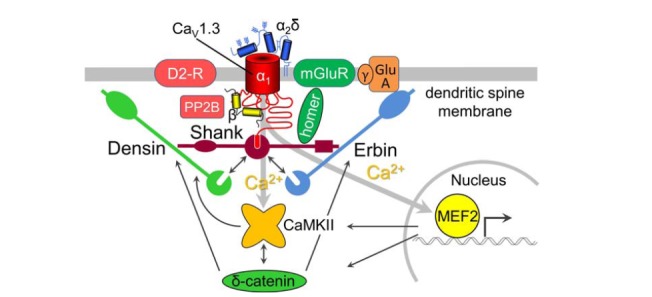
Alterations in dendritic spine morphology and postsynaptic structure are a hallmark of neurological disorders. Particularly spine pruning of striatal medium spiny neurons and aberrant rewiring of corticostriatal synapses have been associated with the pathology of Parkinson's disease and LDOPA induced dyskinesia, respectively. Owing to its low activation threshold the neuronal L-type calcium channel CaV1.3 is particularly critical in the control of neuronal excitability and thus in the calcium-dependent regulation of neuronal functions. CaV1.3 channels are located in dendritic spines and contain a C-terminal class 1 PDZ domain-binding sequence. Until today the postsynaptic PDZ domain proteins shank, densin-180, and erbin have been shown to interact with CaV1.3 channels and to modulate their current properties. Interestingly experimental evidence suggests an involvement of all three PDZ proteins as well as CaV1.3 itself in regulating dendritic and postsynaptic morphology. Here we briefly review the importance of CaV1.3 and its proposed interactions with PDZ proteins for the stability of dendritic spines. With a special focus on the pathology associated with Parkinson's disease, we discuss the hypothesis that CaV1.3 L-type calcium channels may be critical modulators of dendritic spine stability.
Figures
References
-
- Obermair G., Flucher B. In: Neuronal Functions of Auxiliary Calcium Channel Subunits, Modulation of Presynaptic Calcium Channels; Stephens, G.; Mochida, S. Netherlands S., editor. 2013. pp. 29–59.
-
- Moosmang S., Haider N., Klugbauer N., Adelsberger H., Langwieser N., Muller J., Stiess M., Marais E., Schulla V., Lacinova L., Goebbels S., Nave K.A., Storm D.R., Hofmann F., Kleppisch T. Role of hippocampal Cav1.2 Ca2+ channels in NMDA receptor-independent synaptic plasticity and spatial memory. J. Neurosci. 2005;25(43):9883–9892. - PMC - PubMed
-
- Ibata K., Sun Q., Turrigiano G.G. Rapid synaptic scaling induced by changes in postsynaptic firing. Neuron. 2008;57(6):819–826. - PubMed
Publication types
MeSH terms
Substances
Grants and funding
LinkOut - more resources
Full Text Sources
Other Literature Sources