


Risk factors for pelvic organ prolapse and its recurrence: a systematic review
- PMID: 25966804
- PMCID: PMC4611001
- DOI: 10.1007/s00192-015-2695-8
Risk factors for pelvic organ prolapse and its recurrence: a systematic review
Abstract
Introduction and hypothesis: Pelvic organ prolapse (POP) is a common condition with multifactorial etiology. The purpose of this systematic review was to provide an overview of literature on risk factors for POP and POP recurrence.
Methods: PubMed and Embase were searched with "pelvic organ prolapse" combined with "recurrence" and combined with "risk factors," with Medical Subject Headings and Thesaurus terms and text words variations until 4 August 2014, without language or publication date restrictions. Only cohort or cross-sectional studies carried out in western developed countries containing multivariate analyses and with a definition of POP based on anatomical references were included. POP recurrence had to be defined as anatomical recurrence after native tissue repair without mesh. Follow-up after surgery should have been at least 1 year. Articles were excluded if POP was not a separate entity or if it was unclear whether the outcome was primary POP or recurrence.
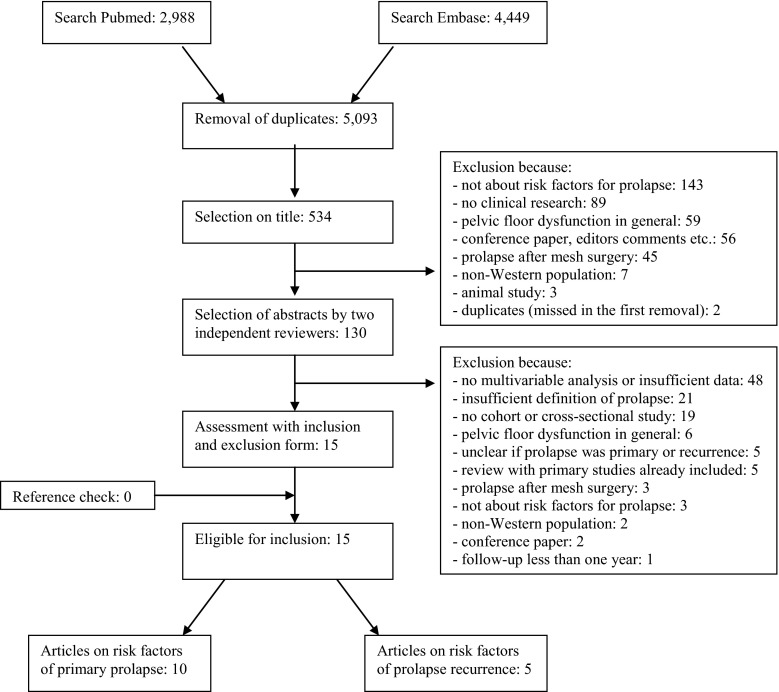
Results: PubMed and Embase revealed 2,988 and 4,449 articles respectively. After preselection, 534 articles were independently evaluated by two researchers, of which 15 met the selection criteria. In 10 articles on primary POP, 30 risk factors were investigated. Parity, vaginal delivery, age, and body mass index (BMI) were significantly associated in at least two articles. In 5 articles on POP recurrence, 29 risk factors were investigated. Only preoperative stage was significantly associated in at least two articles.
Conclusion: Parity, vaginal delivery, age, and BMI are risk factors for POP and preoperative stage is a risk factor for POP recurrence.
Keywords: Pelvic organ prolapse; Recurrence; Risk factors.
Figures
Comment in
-
Comment on Vergeldt et al.: Risk factors for pelvic organ prolapse and its recurrence: a systematic review.Int Urogynecol J. 2016 Apr;27(4):651-2. doi: 10.1007/s00192-016-2953-4. Epub 2016 Feb 6. Int Urogynecol J. 2016. PMID: 26852028 No abstract available.
-
Response to the letter to the editor by Shek et al. on Vergeldt et al: Risk factors for pelvic organ prolapse and its recurrence: a systematic review.Int Urogynecol J. 2016 Apr;27(4):653. doi: 10.1007/s00192-016-2955-2. Epub 2016 Feb 6. Int Urogynecol J. 2016. PMID: 26852029 No abstract available.
References
Publication types
MeSH terms
LinkOut - more resources
Full Text Sources
Other Literature Sources
Medical
Miscellaneous
