Rationale and Approaches to Phosphate and Fibroblast Growth Factor 23 Reduction in CKD
- PMID: 25967123
- PMCID: PMC4587706
- DOI: 10.1681/ASN.2015020117
Rationale and Approaches to Phosphate and Fibroblast Growth Factor 23 Reduction in CKD
Abstract
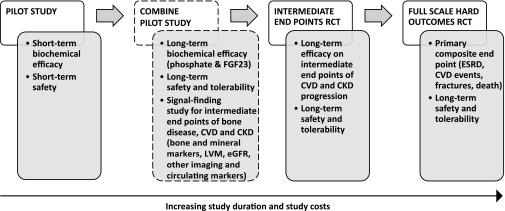
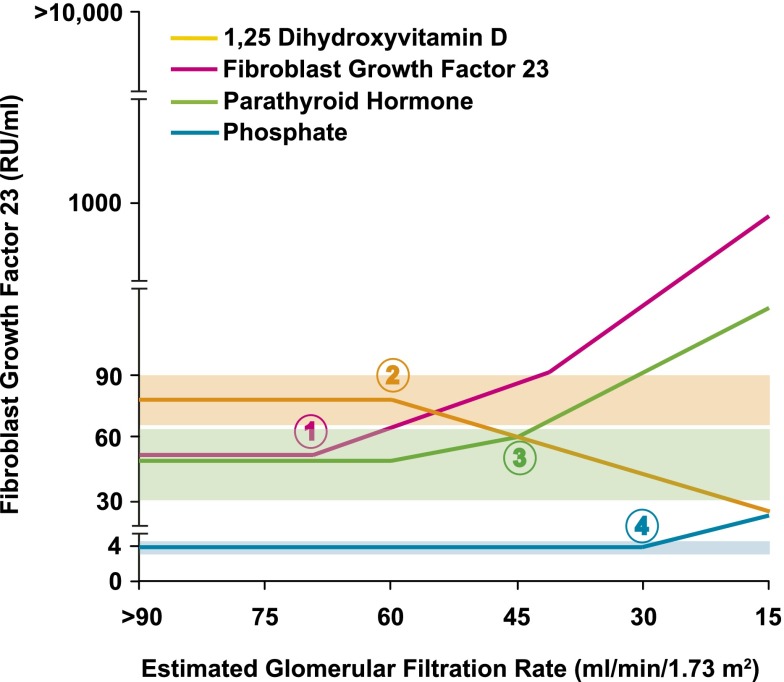
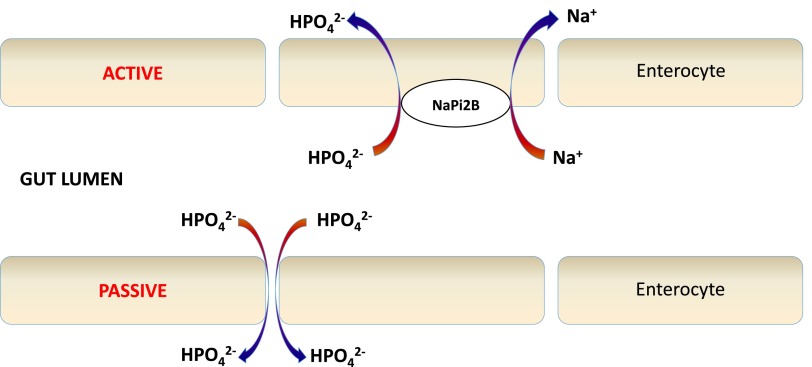
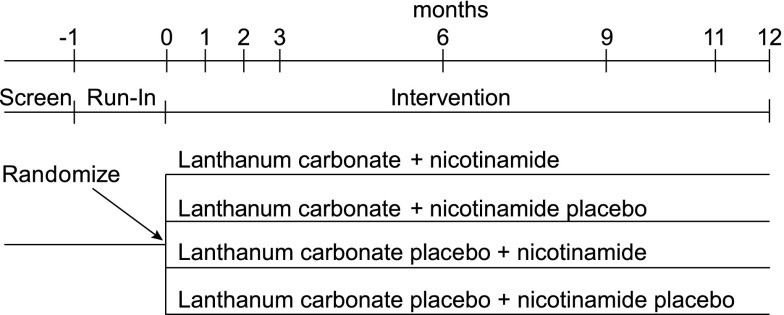
Patients with CKD often progress to ESRD and develop cardiovascular disease (CVD), yet available therapies only modestly improve clinical outcomes. Observational studies report independent associations between elevated serum phosphate and fibroblast growth factor 23 (FGF23) levels and risks of ESRD, CVD, and death. Phosphate excess induces arterial calcification, and although elevated FGF23 helps maintain serum phosphate levels in the normal range in CKD, it may contribute mechanistically to left ventricular hypertrophy (LVH). Consistent epidemiologic and experimental findings suggest the need to test therapeutic approaches that lower phosphate and FGF23 in CKD. Dietary phosphate absorption is one modifiable determinant of serum phosphate and FGF23 levels. Limited data from pilot studies in patients with CKD stages 3-4 suggest that phosphate binders, low phosphate diets, or vitamin B3 derivatives, such as niacin or nicotinamide, may reduce dietary phosphate absorption and serum phosphate and FGF23 levels. This review summarizes current knowledge regarding the deleterious systemic effects of phosphate and FGF23 excess, identifies questions that must be addressed before advancing to a full-scale clinical outcomes trial, and presents a novel therapeutic approach to lower serum phosphate and FGF23 levels that will be tested in the COMBINE Study: The CKD Optimal Management With BInders and NicotinamidE study.
Keywords: chronic kidney disease; phosphate binders; phosphate uptake.
Copyright © 2015 by the American Society of Nephrology.
Figures
References
-
- Go AS, Chertow GM, Fan D, McCulloch CE, Hsu CY: Chronic kidney disease and the risks of death, cardiovascular events, and hospitalization. N Engl J Med 351: 1296–1305, 2004 - PubMed
-
- Lewis EJ, Hunsicker LG, Bain RP, Rohde RD, The Collaborative Study Group : The effect of angiotensin-converting-enzyme inhibition on diabetic nephropathy. N Engl J Med 329: 1456–1462, 1993 - PubMed
-
- Baigent C, Landray MJ, Reith C, Emberson J, Wheeler DC, Tomson C, Wanner C, Krane V, Cass A, Craig J, Neal B, Jiang L, Hooi LS, Levin A, Agodoa L, Gaziano M, Kasiske B, Walker R, Massy ZA, Feldt-Rasmussen B, Krairittichai U, Ophascharoensuk V, Fellström B, Holdaas H, Tesar V, Wiecek A, Grobbee D, de Zeeuw D, Grönhagen-Riska C, Dasgupta T, Lewis D, Herrington W, Mafham M, Majoni W, Wallendszus K, Grimm R, Pedersen T, Tobert J, Armitage J, Baxter A, Bray C, Chen Y, Chen Z, Hill M, Knott C, Parish S, Simpson D, Sleight P, Young A, Collins R, SHARP Investigators : The effects of lowering LDL cholesterol with simvastatin plus ezetimibe in patients with chronic kidney disease (Study of Heart and Renal Protection): a randomised placebo-controlled trial. Lancet 377: 2181–2192, 2011 - PMC - PubMed
Publication types
MeSH terms
Substances
Grants and funding
- U01 DK099933/DK/NIDDK NIH HHS/United States
- U01-DK099924/DK/NIDDK NIH HHS/United States
- U01-DK099933/DK/NIDDK NIH HHS/United States
- U01 DK099930/DK/NIDDK NIH HHS/United States
- R01 DK076116/DK/NIDDK NIH HHS/United States
- R01 DK102438/DK/NIDDK NIH HHS/United States
- U01 DK099924/DK/NIDDK NIH HHS/United States
- U01-DK099877/DK/NIDDK NIH HHS/United States
- U01-DK097093/DK/NIDDK NIH HHS/United States
- K23 DK081673/DK/NIDDK NIH HHS/United States
- U01 DK099877/DK/NIDDK NIH HHS/United States
- K23-DK081673/DK/NIDDK NIH HHS/United States
- R01 DK081374/DK/NIDDK NIH HHS/United States
- K24 DK093723/DK/NIDDK NIH HHS/United States
- IK2 CX000537/CX/CSRD VA/United States
- U01-DK099930/DK/NIDDK NIH HHS/United States
- U01 DK097093/DK/NIDDK NIH HHS/United States
- K23 DK087858/DK/NIDDK NIH HHS/United States
- R01-DK102438/DK/NIDDK NIH HHS/United States
LinkOut - more resources
Full Text Sources
Other Literature Sources
Medical