


The Effect of Lesion Size on the Organization of the Ipsilesional and Contralesional Motor Cortex
- PMID: 25967757
- PMCID: PMC4766967
- DOI: 10.1177/1545968315585356
The Effect of Lesion Size on the Organization of the Ipsilesional and Contralesional Motor Cortex
Abstract
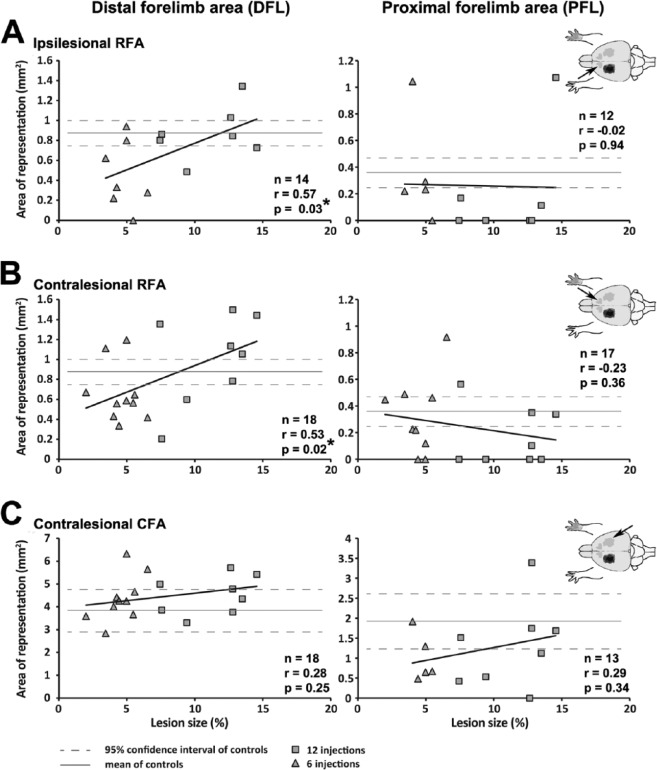
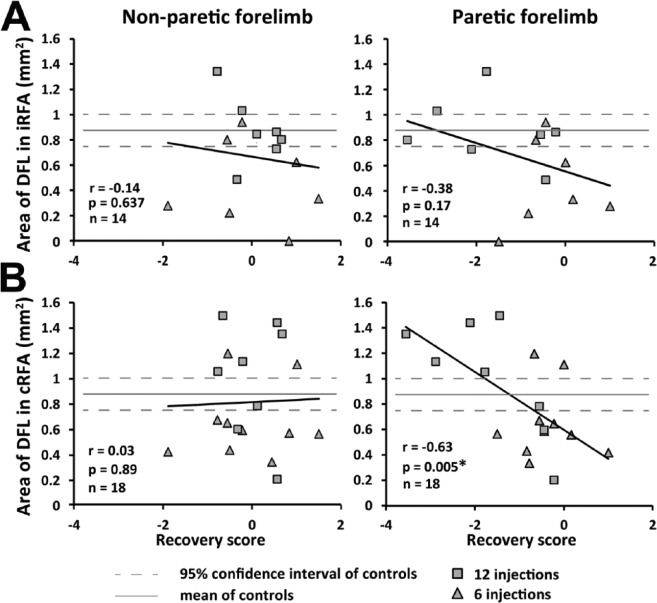
Recovery of hand function following lesions in the primary motor cortex (M1) is associated with a reorganization of premotor areas in the ipsilesional hemisphere, and this reorganization depends on the size of the lesion. It is not clear how lesion size affects motor representations in the contralesional hemisphere and how the effects in the 2 hemispheres compare. Our goal was to study how lesion size affects motor representations in the ipsilesional and contralesional hemispheres. In rats, we induced lesions of different sizes in the caudal forelimb area (CFA), the equivalent of M1. The effective lesion volume in each animal was quantified histologically. Behavioral recovery was evaluated with the Montoya Staircase task for 28 days after the lesion. Then, the organization of the CFA and the rostral forelimb area (RFA)--the putative premotor area in rats--in the 2 cerebral hemispheres was studied with intracortical microstimulation mapping techniques. The distal forelimb representation in the RFA of both the ipsilesional and contralesional hemispheres was positively correlated with the size of the lesion. In contrast, lesion size had no effect on the contralesional CFA, and there was no relationship between movement representations in the 2 hemispheres. Finally, only the contralesional RFA was negatively correlated with chronic motor deficits of the paretic forelimb. Our data show that lesion size has comparable effects on motor representations in premotor areas of both hemispheres and suggest that the contralesional premotor cortex may play a greater role in the recovery of the paretic forelimb following large lesions.
Keywords: contralesional; cortex; hand; intact hemisphere; ipsilesional; lesion size; motor representations; plasticity; recovery; stroke.
© The Author(s) 2015.
Conflict of interest statement
Figures
References
-
- Dancause N. Vicarious function of remote cortex following stroke: recent evidence from human and animal studies. Neuroscientist. 2006;12:489-499. - PubMed
-
- Nudo RJ. Mechanisms for recovery of motor function following cortical damage. Curr Opin Neurobiol. 2006;16:638-644. - PubMed
-
- Dancause N, Barbay S, Frost SB, et al. Effects of small ischemic lesions in the primary motor cortex on neurophysiological organization in ventral premotor cortex. J Neurophysiol. 2006;96:3506-3511. - PubMed
-
- Frost SB, Barbay S, Friel KM, Plautz EJ, Nudo RJ. Reorganization of remote cortical regions after ischemic brain injury: a potential substrate for stroke recovery. J Neurophysiol. 2003;89:3205-3214. - PubMed
Publication types
MeSH terms
Substances
Grants and funding
LinkOut - more resources
Full Text Sources
Other Literature Sources
